CLM vs Wet Signature: Why Contract Lifecycle Management Is Going Digital
Contract lifecycle management (CLM), e-signatures, and wet signatures all represent ways to formalize agreement—but they operate on entirely different levels of speed, control, and business impact. What used to be a simple legal formality has evolved into a critical competitive advantage, where how you sign can directly influence how fast you grow.
In today’s digital economy, relying on wet signatures doesn’t just slow processes down—it creates hidden risks and missed opportunities. Businesses that fail to modernize their contract workflows are not only delaying deals, but also sacrificing visibility, compliance, and revenue potential.
Key Takeaways
- CLM (Contract Lifecycle Management) transforms contracts from static documents into dynamic, trackable business assets.
- Wet signatures slow down deal cycles, increase operational risk, and create compliance gaps in modern enterprises.
- E-signatures integrated into CLM platforms accelerate execution by up to 80% while maintaining legal enforceability.
- Audit trails, automation, and AI-driven insights make CLM systems far superior to manual signature processes.
- Global regulations (ESIGN, eIDAS, UETA) now support digital signatures, making wet signatures increasingly obsolete.
- Companies adopting CLM report faster revenue realization and reduced contract leakage.
- Fortva positions itself as a next-generation CLM platform, combining document management, automation, and secure e-signature workflows in one ecosystem.
Picture this: It’s the last day of the quarter. Your sales team has worked relentlessly to close a high-value deal. Legal has reviewed the contract, procurement has approved the terms, and all that’s left is a signature.
But the client insists on a wet signature.
The document is printed, scanned, emailed, misplaced, corrected, re-signed, and delayed again. Hours turn into days. Meanwhile, the deal stalls, stakeholders grow impatient, and your revenue pipeline starts slipping.
Now imagine the alternative: a CLM system sends the contract instantly, tracks engagement in real time, captures a legally binding e-signature within minutes, and logs every action automatically. This is no longer a futuristic scenario, it’s the new standard.
Benefits of E-Signatures (Quick Overview)
| Benefit | What It Means for Your Business |
| Faster Execution | Contracts get signed in minutes instead of days, accelerating deal cycles and revenue recognition. |
| Legal Validity | Fully enforceable under global laws (ESIGN, UETA, eIDAS), with stronger proof than wet signatures. |
| Enhanced Security | Encrypted, tamper-proof, and protected with authentication—far safer than paper-based signatures. |
| Audit Trails | Every action is tracked (who, when, where), providing full transparency and compliance readiness. |
| Cost Savings | Eliminates printing, courier, and storage costs while reducing manual administrative work. |
| Remote Accessibility | Sign from anywhere, on any device—ideal for global teams and distributed workforces. |
| Seamless Integrations | Connects with CRM, document tools, and automation platforms for end-to-end workflow efficiency. |
| Better User Experience | Simple, intuitive signing process increases completion rates and improves client satisfaction. |
| Sustainability | Reduces paper usage, supporting environmentally friendly and digital-first operations. |
| Scalability | Easily handle hundreds or thousands of contracts without increasing operational complexity. |
CLM Vs Wet Signatures
To fully grasp why contract lifecycle management (CLM) is replacing wet signatures, it’s important to understand the fundamental difference between the two. A wet signature represents a single moment—the act of signing a document—while CLM represents the entire lifecycle of a contract, from creation and negotiation to execution, storage, and renewal. This shift reflects a move from isolated actions to integrated business processes.
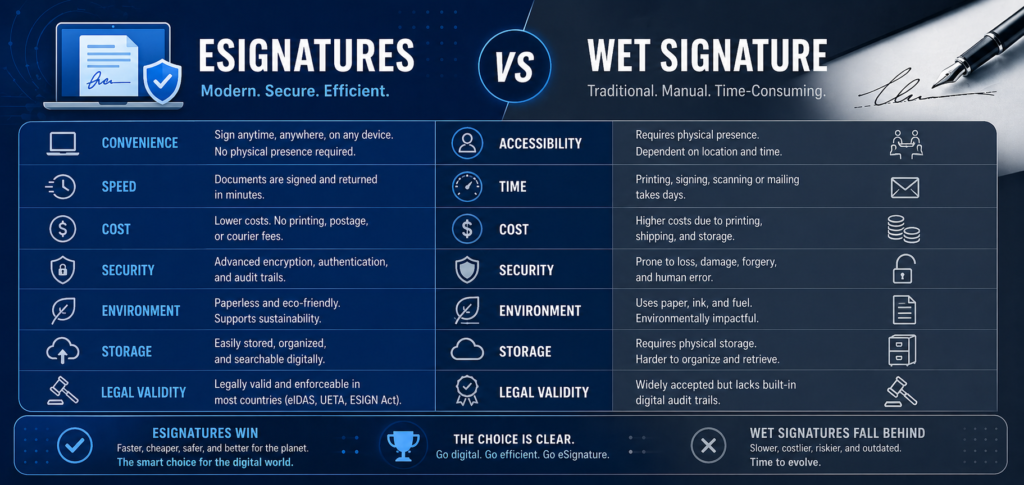
From an operational standpoint, wet signatures introduce friction. They rely on manual handling, physical documents, and disconnected workflows, which slow down execution and increase the risk of errors or lost information. In contrast, CLM systems streamline operations by automating approvals, centralizing documents, and enabling real-time collaboration across teams, making contract management faster and more efficient.
Strategically, the difference is even more significant. Wet signatures offer no visibility beyond the signed document, while CLM transforms contracts into valuable data assets. With features like audit trails, analytics, and AI-driven insights, businesses can track performance, manage risk, and make informed decisions—turning contracts from static records into drivers of growth and competitive advantage.
What is a Wet Signature?
A wet signature refers to the traditional method of signing documents using pen and ink. While historically considered the gold standard for authenticity, it comes with inherent limitations in today’s digital-first business environment.
Wet signatures require physical presence or document exchange, manual verification, and physical storage. They introduce friction into workflows that modern businesses cannot afford.
How to Create a Wet Signature
Creating a wet signature is straightforward, but to ensure legal validity and avoid disputes, it should follow a structured process. Even though it’s a traditional method, attention to detail is critical—especially for formal agreements, compliance documents, and regulated transactions.
- Print the document — Always sign the final, approved version of the document, not a draft. Signing the wrong version can create legal confusion or invalidate the agreement.
- Sign in ink — Use a blue or black pen and sign exactly as your legal name appears in the contract. Consistency helps with identity verification and enforceability.
- Add the date — Include the signing date next to your signature if required. This establishes when the agreement became effective and is important for timelines and obligations.
- Initial pages (if needed) — Some contracts require you to initial each page to confirm that all sections have been reviewed and accepted.
- Witness or notarize if required — Certain documents, such as real estate agreements, affidavits, or government forms, may require a witness or notary to validate the signature.
- Store securely — Keep the original signed document in a safe place and create a scanned copy for digital storage and easy access.
Today, many organizations still follow this process but immediately scan and upload the signed document into a digital system. This hybrid approach helps maintain compliance while improving accessibility, auditability, and record management within modern contract workflows.
What is an E-Signature?
An e-signature (electronic signature) is a digital method of indicating agreement or approval on a document without the need for pen and paper. It can take many forms—such as typing your name, drawing a signature, or clicking “I agree”—and is legally recognized in most countries under regulations like the ESIGN Act and eIDAS.
Unlike a simple image of a signature, modern e-signatures are backed by secure technology that captures key data such as timestamps, IP addresses, and authentication details. When integrated into a contract lifecycle management system, e-signatures provide not just convenience, but also enhanced security, traceability, and compliance.
How to Create E-Signatures with Fortva
Creating e-signatures in Fortva is designed to be fast, secure, and fully integrated into your contract lifecycle workflow. Instead of juggling multiple tools, Fortva centralizes everything—from drafting to signing—so you can execute agreements without friction or delays.
- Upload or Create Your Document — Start by either uploading an existing contract or using Fortva’s built-in templates to draft one from scratch. This ensures your document is standardized, compliant, and ready for execution without back-and-forth edits.
- Prepare the Document for Signing — Add signature fields, date fields, and any required inputs directly within the platform. You can assign these fields to specific recipients, ensuring each party knows exactly where and how to sign.
- Add Recipients and Define Roles — Enter the email addresses of all signers and assign their roles (e.g., signer, approver, viewer). Fortva allows you to control the signing order, so contracts follow the correct approval workflow before execution.
- Send for E-Signature — Once everything is set, send the document instantly. Recipients receive a secure link where they can review and sign the document from any device—no downloads or printing required.
- Track in Real Time — Monitor the status of your document as it moves through the signing process. Fortva provides real-time notifications, so you know when a document is opened, reviewed, or signed.
- Securely Sign and Authenticate — Signers can complete their e-signature using Fortva’s secure integration with DocuSign, ensuring compliance with global legal standards and adding an extra layer of authentication and trust.
- Automatic Storage and Audit Trail — Once signed, the document is automatically stored in Fortva’s centralized system with a complete audit trail. Every action—timestamps, user activity, and version history—is recorded for compliance and future reference.
- Leverage AI and Workflow Automation — After execution, Fortva uses AI and intelligent OCR to extract key data from the contract, trigger workflows, and provide actionable insights—turning your signed document into a living business asset.
Why It Matters
With Fortva, creating an e-signature isn’t just about signing a document—it’s about automating the entire contract lifecycle. From creation to execution and beyond, every step is optimized for speed, security, and scalability, giving your business a clear advantage over outdated, manual processes.
What is CLM (Contract Lifecycle Management)?
CLM is a comprehensive system that manages the entire contract lifecycle—from drafting and negotiation to execution, storage, compliance tracking, and renewal.
Unlike wet signatures, CLM doesn’t just focus on signing. It transforms contracts into living systems of record, integrating workflows, approvals, automation, analytics, and compliance monitoring. Platforms like Fortva elevate this even further by combining:
- Intelligent OCR for data extraction
- Workflow automation
- Version control and redlining
- Secure e-signature integrations
- Centralized document ecosystems
CLM vs Wet Signature: A Strategic Comparison
| Feature | Wet Signature | CLM (Contract Lifecycle Management) |
| Execution Speed | Slow (days to weeks) | Fast (minutes to hours) |
| Accessibility | Physical presence required | Remote, global access |
| Audit Trail | Manual, incomplete | Automated, real-time tracking |
| Compliance | Risk-prone | Built-in compliance frameworks |
| Security | Risk of loss/damage | Encrypted, controlled access |
| Scalability | Limited | Enterprise-ready |
| Workflow Integration | None | Fully automated workflows |
| Data Insights | None | AI-driven analytics |
Why Businesses Are Moving Away from Wet Signatures
The shift from wet signatures to CLM is not just about convenience—it is driven by measurable business outcomes. A study by Deloitte found that organizations with digital contract processes reduce contract cycle times by up to 83%. Meanwhile, McKinsey reports that automation in contract workflows can improve productivity by 20–30%. These are not marginal gains. They represent a structural transformation in how businesses operate.
1. Speed and Revenue Acceleration
Every delay in contract execution directly impacts revenue. Wet signatures introduce unnecessary lag, while CLM systems streamline approvals, automate workflows, and enable instant execution. Sales teams no longer wait for signatures—they close deals in real time.
2. Operational Efficiency
Manual processes create bottlenecks. Printing, scanning, emailing, and tracking documents consume valuable time and resources. CLM eliminates these inefficiencies by centralizing all contract activities in one platform.
3. Compliance and Risk Management
According to World Commerce & Contracting, poor contract management can cost businesses up to 9% of their annual revenue due to inefficiencies and compliance failures. Wet signatures offer little visibility or control, while CLM systems provide:
- Automated compliance checks
- Real-time audit trails
- Regulatory alignment
The Rise of E-Signatures Within CLM
E-signatures are often misunderstood as a simple digital replacement for wet signatures. In reality, they are just one component of a broader CLM ecosystem.
When integrated into a CLM platform like Fortva, e-signatures become part of a seamless workflow that includes drafting, negotiation, approval, execution, and storage.
Research by Forrester indicates that businesses using e-signatures can reduce document turnaround time by up to 80%, significantly accelerating deal cycles.
10 Benefits of E-Signatures
- Faster Contract Execution and Deal Velocity
E-signatures dramatically reduce the time it takes to finalize agreements. Instead of printing, scanning, emailing, and waiting days—or even weeks—contracts can be signed within minutes from anywhere in the world. This acceleration has a direct impact on revenue, especially for sales and procurement teams where timing is critical. In a CLM environment, this speed compounds further because contracts are automatically routed for approval and execution without manual intervention, eliminating bottlenecks entirely. - Enhanced Legal Enforceability and Compliance
Modern e-signature solutions are built to comply with global legal frameworks such as the ESIGN Act (U.S.), UETA, and eIDAS (EU). This means electronically signed documents carry the same legal weight as wet signatures in most business scenarios. More importantly, e-signatures often provide stronger evidence in disputes because they include metadata like timestamps, IP addresses, and authentication logs. When integrated into a CLM system, compliance is further strengthened through automated audit trails and version control. - Improved Security and Reduced Risk
Contrary to outdated assumptions, e-signatures are often more secure than traditional signatures. Physical documents can be lost, forged, or accessed without authorization, while digital signatures are protected through encryption, identity verification, and secure storage. Platforms like Fortva go even further with zero-knowledge encryption and controlled access permissions, ensuring that only authorized users can view or sign documents. This significantly reduces the risk of fraud and data breaches. - Comprehensive Audit Trails and Transparency
One of the most powerful advantages of e-signatures is the ability to track every action taken on a document. From the moment a contract is sent to the moment it is signed, every interaction is recorded. This includes who opened the document, when it was reviewed, and when it was signed. These audit trails are invaluable for compliance, dispute resolution, and internal accountability. In a CLM system, this visibility extends across the entire contract lifecycle. - Cost Savings and Operational Efficiency
E-signatures eliminate the need for paper, printing, courier services, and physical storage. While these costs may seem small individually, they add up significantly at scale. More importantly, they reduce the hidden costs of inefficiency—such as employee time spent managing manual processes. By automating contract execution, businesses can reallocate resources to higher-value activities like negotiation and strategy. - Remote Accessibility and Global Reach
In today’s distributed work environment, the ability to sign contracts from anywhere is essential. E-signatures enable stakeholders across different locations, time zones, and countries to execute agreements without delay. This is particularly important for global enterprises managing cross-border transactions. CLM platforms enhance this capability by centralizing contracts and ensuring consistent workflows regardless of geography. - Seamless Integration with Business Systems
E-signatures do not operate in isolation—they integrate with broader business ecosystems. When connected to CRM platforms like Salesforce or HubSpot, document tools like MS Word, and automation tools like Zapier, e-signatures become part of a seamless workflow. For example, a sales contract can be generated, sent for signature, and automatically recorded in the CRM without manual input. This level of integration improves accuracy and reduces administrative burden. - Better Customer and User Experience
User experience is often overlooked in contract execution, but it plays a critical role in conversion rates. E-signatures simplify the process for clients and partners, allowing them to review and sign documents quickly on any device. This convenience reduces friction, shortens decision cycles, and improves overall satisfaction. In competitive markets, a smoother signing experience can be the difference between closing a deal and losing one. - Environmental Sustainability
By eliminating paper usage, e-signatures contribute to more sustainable business practices. Organizations can significantly reduce their environmental footprint by going fully digital. This not only aligns with corporate social responsibility goals but also resonates with clients and partners who prioritize sustainability. - Scalability for High-Volume Transactions
As businesses grow, the volume of contracts increases. E-signatures allow organizations to scale without increasing administrative complexity. Whether handling dozens or thousands of agreements, the process remains consistent and efficient. When combined with CLM platforms like Fortva, this scalability is amplified through automation, templates, and centralized management.
Contract Workflow Automation
Contract workflow automation is where CLM truly outperforms wet signatures.
Manual Workflow (Wet Signature)
- Draft contract
- Print document
- Send via email
- Wait for response
- Track manually
- Store physically
Automated Workflow (CLM)
- Draft using templates
- Route for approval automatically
- Track engagement in real time
- Capture e-signature instantly
- Store securely with audit trail
This transformation eliminates human error and ensures consistency across all contracts.
Audit Trail and Transparency
One of the biggest limitations of wet signatures is the lack of transparency. With CLM, every action is recorded:
- Who viewed the document
- When changes were made
- Who approved each stage
- When the contract was signed
This level of visibility is critical for compliance, especially in regulated industries like finance, healthcare, and energy.
Security and Data Protection
Security is often cited as a reason to stick with wet signatures, but this is a misconception. Physical documents can be lost, damaged, or accessed without authorization. In contrast, CLM platforms like Fortva use:
- Military-grade encryption
- Zero-knowledge security architecture
- Role-based access controls
According to IBM’s Cost of a Data Breach Report, the average cost of a data breach reached $4.45 million in 2023. Secure digital systems are no longer optional—they are essential.
Contract Data and AI Insights
Wet signatures capture a moment in time. CLM captures data. With AI and OCR capabilities, platforms like Fortva extract critical contract data, enabling:
- Performance tracking
- Risk identification
- Renewal alerts
- Strategic insights
This turns contracts into actionable intelligence rather than static records.
Wet Signature Requirements by Region
Despite the global shift toward digital contracts, certain jurisdictions still recognize or require wet signatures in specific scenarios.
| Region | Legal Framework | Wet Signature Requirement | Digital Acceptance |
| United States | ESIGN Act, UETA | Rare (specific legal docs) | Widely accepted |
| European Union | eIDAS Regulation | Limited cases | Strong acceptance |
| United Kingdom | Electronic Communications Act | Case-dependent | Accepted |
| Asia-Pacific | Varies by country | Moderate | Increasing adoption |
| Middle East | Emerging frameworks | Higher reliance | Growing acceptance |
The trend is clear: digital signatures are becoming the global standard, with wet signatures reserved for niche use cases.
Contract Templates and Standardization
One of the hidden inefficiencies of wet signatures is the lack of standardization. CLM platforms provide built-in templates that:
- Reduce drafting time
- Ensure legal consistency
- Minimize risk
Fortva enhances this with customizable templates that businesses can use or upload, significantly accelerating contract creation.
Integration with Business Systems
Contracts do not exist in isolation. They are part of a broader business ecosystem. CLM platforms integrate with:
- CRM systems (Salesforce, HubSpot)
- Document tools (MS Word)
- Automation platforms (Zapier)
- E-signature providers (DocuSign)
This integration ensures that contracts flow seamlessly across the entire customer lifecycle.
Why Fortva Stands Out in CLM vs Wet Signature Debate
While many platforms offer digital signatures, few provide a complete ecosystem. Fortva differentiates itself by combining:
- Document management
- Contract lifecycle management
- Workflow automation
- AI-driven insights
- Secure collaboration
This all-in-one approach eliminates the need for multiple tools and creates a unified contract management experience.
Fortva vs Traditional CLM Platforms
| Feature | Traditional CLM | Fortva |
| Ease of Use | Complex | Very intuitive |
| Workflow Automation | Limited | Advanced |
| AI & OCR | Basic | Intelligent extraction |
| Security | Standard | Zero-knowledge encryption |
| Integration | Partial | Extensive |
| Templates | Limited | Built-in + customizable |
The Legal Perspective: Are Wet Signatures Still Necessary?
From an attorney’s standpoint, the enforceability of a contract depends on intent, consent, and authenticity—not the medium of signature. Laws such as:
- ESIGN Act (US)
- UETA (US)
- eIDAS (EU)
have established that electronic signatures are legally binding in most cases. Wet signatures are now primarily required for:
- Certain real estate transactions
- Notarized documents
- Specific jurisdictional requirements
For the vast majority of business contracts, digital execution is fully compliant.
Clickwrap Agreements
Clickwrap agreements have quietly become one of the most powerful—and underestimated—tools in modern contract lifecycle management. While they may look deceptively simple, their legal enforceability and operational efficiency make them a cornerstone of high-volume digital contracting.
At their core, clickwrap agreements replace the traditional act of signing with a simple action: clicking “I agree.” Yet behind that click lies a legally binding acknowledgment of terms, backed by audit trails, timestamps, and user authentication.
What Is Clickwrap?
A clickwrap agreement is a type of digital contract where a user explicitly agrees to terms by taking a clear affirmative action—typically clicking a checkbox or button labeled “I agree,” “Accept,” or “Continue.”
Unlike wet signatures, which require physical interaction, or even standard e-signatures that replicate handwritten intent, clickwrap is designed for speed, scale, and clarity. Clickwraps are typically embedded directly into:
- Website sign-up flows
- Checkout pages
- Software onboarding processes
- Digital contract interfaces
Why Clickwrap Is Not “Just a Button”
It’s easy to dismiss clickwrap as a simple UX element, but legally and operationally, it carries significant weight. Courts across jurisdictions—including under frameworks like the ESIGN Act and eIDAS—have consistently upheld clickwrap agreements as enforceable, provided that:
- The terms are clearly presented
- The user has an opportunity to review them
- There is an unambiguous affirmative action
In fact, clickwrap often holds stronger enforceability than passive agreement methods (like browsewrap), because it requires deliberate user consent.
How Clickwrap Fits Into CLM vs Wet Signature
Clickwrap represents a critical evolution in the broader CLM vs wet signature conversation. While wet signatures are slow and e-signatures digitize the signing process, clickwrap goes one step further—it eliminates the need for traditional signing altogether in many scenarios. Within a CLM system like Fortva, clickwrap can be:
- Embedded into workflows
- Linked to specific clauses or policies
- Tracked with full audit trails
- Stored alongside other contract data
Clickwrap vs Other Agreement Types
| Agreement Type | User Action | Speed | Legal Strength | Best Use Case |
| Wet Signature | Handwritten signature | Slow | High | Formal/legal documents |
| E-Signature | Digital signature | Medium | High | Business contracts |
| Clickwrap | Click “I agree” | Very fast | High (if structured properly) | High-volume agreements |
| Browsewrap | Passive use | Fast | Weak | Low-risk terms |
Best Uses of Clickwrap in Modern Business
Clickwrap is not limited to one industry or function. Its flexibility makes it applicable across a wide range of use cases, especially where speed and volume are critical.
1. SaaS and Software Agreements
Software companies rely heavily on clickwrap for:
- Terms of service agreements
- Privacy policies
- End-user license agreements (EULAs)
When users sign up or log in, clickwrap ensures immediate acceptance without disrupting the onboarding experience.
This is particularly powerful when integrated into CLM systems like Fortva, where agreements can be tracked, updated, and enforced centrally.
2. E-Commerce and Online Transactions
Clickwrap is the backbone of digital commerce.
At checkout, customers agree to:
- Purchase terms
- Refund policies
- Shipping conditions
Without clickwrap, every online purchase would require manual contract execution—a logistical nightmare. Its efficiency is what enables businesses to scale globally without operational bottlenecks.
3. High-Volume Vendor and Supplier Agreements
Procurement teams often deal with hundreds—or thousands—of vendors. Clickwrap allows organizations to:
- Standardize agreements
- Accelerate onboarding
- Reduce legal review cycles
Instead of negotiating every contract manually, businesses can deploy standardized terms with clickwrap acceptance, tracked within a CLM system.
4. Employee Onboarding and HR Policies
HR departments use clickwrap for:
- Employee handbooks
- Code of conduct agreements
- Confidentiality policies
This ensures that every employee has acknowledged key policies, with a verifiable record stored in the system.
5. Financial Services and Compliance Acknowledgments
In regulated industries, documentation is everything. Clickwrap is used to capture:
- Risk disclosures
- Investment agreements
- Compliance acknowledgments
When combined with audit trails and encryption (as seen in Fortva), it provides a secure and compliant way to manage sensitive agreements.
6. Contract Clause Acknowledgment
One of the more advanced uses of clickwrap is within contracts themselves. Businesses can use clickwrap to:
- Highlight critical clauses
- Require explicit acknowledgment of terms
- Ensure visibility of financial provisions
This reduces disputes by ensuring that all parties have actively acknowledged key elements of the agreement.
Why Legal Teams Prefer Clickwrap
Clickwrap has become a favorite among legal departments—not because it replaces legal rigor, but because it enhances it. It provides:
- Clear evidence of consent
- Time-stamped records
- User identification data
- Version control of terms
In contrast to wet signatures, which can be ambiguous or difficult to track, clickwrap offers precision and accountability.
Clickwrap + CLM: A Powerful Combination
On its own, clickwrap is efficient. But when integrated into a CLM platform like Fortva, it becomes transformative. Here’s what that looks like in practice:
- A contract is generated using a template
- Specific clauses require clickwrap acknowledgment
- The system routes the contract for approval
- The recipient clicks “I agree”
- The action is logged with a full audit trail
- The contract is stored securely and indexed
This seamless flow eliminates friction while maintaining legal integrity.
Common Misconceptions About Clickwrap
Despite its widespread use, clickwrap is often misunderstood. One common misconception is that it is less legally binding than traditional signatures. In reality, courts have repeatedly upheld clickwrap agreements when properly implemented.
Another misconception is that it lacks security. However, when paired with encryption, authentication, and audit trails—as in Fortva—it can be more secure than physical signatures.
Finally, some believe clickwrap is only for simple agreements. In truth, it is increasingly used in complex contractual environments, particularly when combined with CLM systems.
The Strategic Advantage of Clickwrap
Clickwrap is not just a convenience—it is a strategic advantage. It enables businesses to:
- Scale operations without increasing legal overhead
- Accelerate customer onboarding
- Reduce contract cycle times
- Improve compliance and audit readiness
In a world where speed and efficiency define success, clickwrap provides a competitive edge.
Final Thought
For decades, the signature marked the end of a contract. In today’s world, it is just the beginning. CLM transforms contracts into ongoing, data-driven assets that power business decisions, improve efficiency, and reduce risk.
Wet signatures, once a symbol of trust, are now a bottleneck. The future belongs to organizations that embrace contract lifecycle management—not just as a tool, but as a strategic advantage.
Start managing your contracts, and approve offers anytime and anywhere. Start a free trial or book a demo.
Frequently Asked Questions
In what use cases is Wet Ink Signature required?
Wet ink signatures are still required in certain regulated or high-risk transactions where physical verification is mandated by law. Common examples include real estate closings, notarized documents, wills, affidavits, and some court filings. Certain jurisdictions may also require wet signatures for government forms or highly sensitive financial agreements. However, these cases are increasingly limited as digital signature laws expand globally.
How to do a wet signature on Word?
To add a wet signature in Microsoft Word, you typically print the document, sign it manually using ink, and then scan it back into digital format. Alternatively, you can insert a scanned image of your handwritten signature into the Word document. However, this does not replace a true wet signature unless the original signed document exists.
Can a wet signature be scanned?
Yes, a wet signature can be scanned and stored digitally. This scanned version is commonly used for record-keeping, email sharing, and internal documentation. However, the legally binding version is still the original physically signed document, not the scanned copy.
Original signature vs wet signature — what is the difference?
An original signature refers to the actual handwritten signature placed directly on a physical document. A wet signature is the act of signing with ink, which creates the original signature. In most contexts, both terms are used interchangeably, but “wet signature” emphasizes the physical ink-based signing process.
Can I convert a wet ink signature into a digital format?
Yes, you can digitize a wet ink signature by scanning it or capturing it as an image file. This digital version can be used for reference or placed into documents. However, it does not carry the same legal authentication as an e-signature unless properly validated within a secure system.
Are wet ink signatures legally stronger than digital ones?
Not necessarily. Under laws such as the ESIGN Act (US) and eIDAS (EU), e-signatures are legally equivalent to wet ink signatures in most business contexts. In fact, digital signatures often provide stronger proof due to built-in audit trails, timestamps, and identity verification.
Do all countries treat wet ink signatures the same way legally?
No. Legal recognition of wet ink and electronic signatures varies by jurisdiction. While most countries accept both, the conditions differ. The EU (via eIDAS), the US (via ESIGN and UETA), and many APAC countries recognize digital signatures widely, but some specific document types may still require wet signatures.
How do I prove a wet signature is authentic if challenged?
Authenticity of a wet signature is usually proven through witness testimony, notarization, handwriting analysis, or supporting documentation. However, this process can be time-consuming and subjective compared to digital signatures, which include built-in verification logs.
What are best practices when collecting wet signatures?
Best practices include ensuring the correct version of the document is signed, using consistent ink color, adding dates, obtaining initials on each page if required, and storing the original securely. Many organizations also scan signed documents immediately for backup and accessibility.
Are there accessibility concerns with wet ink signatures?
Yes. Wet signatures can be challenging for individuals with disabilities, remote teams, or those in different geographic locations. They require physical presence and manual handling, which can create delays and accessibility barriers compared to digital alternatives.
Can a faxed or photocopied wet signature be considered valid?
In many cases, faxed or photocopied signatures are accepted for informal agreements or internal processes. However, they may not hold the same legal weight as original wet signatures in disputes, especially for high-value or regulated contracts.
What happens if I lose the original document with the wet signature?
If the original signed document is lost, proving its contents and validity becomes more difficult. You may need copies, witness statements, or supporting records. In legal disputes, lack of the original can weaken enforceability.
Is a wet signature necessary for remote international contracts?
Generally, no. Most international contracts now rely on e-signatures due to cross-border inefficiencies with wet ink signing. Digital signatures are widely accepted under global frameworks, making them the preferred method for remote agreements.
How can businesses transition away from wet signatures?
Businesses can transition by adopting a CLM platform that supports e-signatures, automating contract workflows, digitizing templates, and integrating approval systems. Platforms like Fortva help organizations move from manual signing to fully automated, secure digital contract lifecycle management.
Disclaimer
Fortva is not a law firm, and nothing on this page constitutes or should be interpreted as legal advice. The information provided is for general informational and educational purposes only. To determine the accuracy, completeness, or applicability of any content to your specific business needs, you should consult with a qualified and licensed attorney.
Use of Fortva’s platform, resources, or website does not create an attorney-client relationship between you and Fortva. While Fortva provides tools to support contract lifecycle management and document workflows, it does not provide legal representation or legal advisory services.