
The Impact of Implementing Document Management System (DMS) at workplace
The impact of implementing DMS in the workplace is enormous. We are living in a data-driven economy, and documents are no longer static files stored in cabinets or scattered across folders—they are the lifeblood of business operations, compliance, and decision-making. A modern Document Management System (DMS) has evolved into a strategic infrastructure layer that governs how organizations create, store, secure, automate, and extract value from their information.
Key Takeaways
- A document management system (DMS) centralizes how businesses capture, store, manage, and secure documents across their lifecycle.
- The DMS market is growing rapidly, projected to exceed $20 billion by 2030, driven by digital transformation and compliance needs.
- Cloud-based DMS platforms are leading in adoption due to scalability, remote access, and lower costs.
- DMS software transforms documents from static files into active, workflow-driven business assets.
- Workflow automation reduces manual tasks, speeds up approvals, and boosts team productivity significantly.
- Built-in audit trails, version control, and permissions help organizations stay compliant and reduce risk.
- AI and intelligent OCR enable businesses to extract data, gain insights, and automate decisions from documents.
- Machine learning improves over time, making document classification, search, and analysis more accurate and efficient.
- Integration with tools like CRM, e-signatures, and automation platforms ensures documents flow seamlessly across business systems.
- Industries like financial services, legal, healthcare, and procurement gain the most from secure, compliant document workflows.
- The convergence of DMS and CLM is creating all-in-one platforms that manage both documents and contracts efficiently.
- Modern DMS solutions are shifting from storage tools to strategic platforms for growth, compliance, and decision-making.
- Businesses that adopt intelligent document management gain a competitive advantage in speed, accuracy, and scalability.
- Platforms like Fortva represent the next generation of DMS by combining automation, AI, security, and contract lifecycle management in one system.
This in-depth, research-backed report explores not only what a document management system is, but how it works, why it has become mission-critical across industries, and how emerging technologies like artificial intelligence and machine learning are redefining the future of document and contract management.
What Is a Document Management System (DMS)?
A Document Management System (DMS) is a centralized software platform that enables organizations to capture, store, organize, manage, track, and secure documents throughout their lifecycle—from creation to archival or deletion.
Unlike basic file storage tools, a modern DMS integrates advanced capabilities such as workflow automation, version control, audit trails, permissions management, and intelligent data extraction. These features transform documents from passive records into active drivers of business processes.
At its core, a DMS solves three fundamental business challenges: information chaos, operational inefficiency, and compliance risk. Organizations across sectors—from financial services and legal firms to healthcare, procurement, and logistics—rely on DMS platforms to maintain control over growing volumes of structured and unstructured data.
Market Intelligence: The Growing Importance of Document Management Systems
The global demand for document management systems has accelerated significantly over the past decade, driven by digital transformation, regulatory pressures, and the exponential growth of enterprise data.
According to Grand View Research, the global document management system market was valued at over USD 6.2 billion in 2022 and is projected to expand at a compound annual growth rate (CAGR) exceeding 15% through 2030. This growth reflects a fundamental shift in how organizations perceive documents—not as static assets, but as dynamic, data-rich resources.
Several macroeconomic and technological factors are fueling this expansion. First, regulatory compliance requirements continue to intensify across industries such as finance, healthcare, and insurance, requiring organizations to maintain auditable and secure document trails. Second, the rise of remote and hybrid work environments has increased the need for cloud-based, accessible, and collaborative document platforms. Third, advancements in artificial intelligence and intelligent OCR have enabled organizations to extract actionable insights from previously unstructured data.
Regional trends further reinforce this growth trajectory. North America currently leads the market due to early adoption of enterprise technologies, while Asia-Pacific is experiencing rapid growth driven by digital transformation initiatives and expanding SME adoption.

Market Estimates and Forecasts (2018–2030)
Between 2018 and 2023, the DMS market experienced steady adoption as organizations transitioned from paper-based systems to digital repositories. However, the period from 2024 to 2030 marks a new phase characterized by intelligent automation and AI-driven document processing.
Forecast data suggests that by 2030, the market could surpass USD 20 billion, driven by increasing integration of DMS platforms with enterprise ecosystems such as CRM, ERP, and contract lifecycle management systems.
Cloud-based deployment models are expected to dominate, accounting for the majority of new implementations due to their scalability, cost efficiency, and accessibility. Meanwhile, industries such as financial services, healthcare, and legal services are projected to generate the highest revenue shares due to their document-intensive operations and strict compliance requirements.
This shift signals a broader transformation: document management is no longer a back-office function but a strategic enabler of enterprise agility and growth.

Growth Opportunities and Emerging Trends
The evolution of document management systems is closely tied to broader technological trends shaping the digital economy. One of the most significant opportunities lies in intelligent automation. Organizations are increasingly seeking solutions that not only store documents but also automate workflows such as approvals, contract reviews, and compliance checks. This demand is driving innovation in workflow engines that can adapt to complex business processes.
Another major trend is the integration of AI-powered data extraction. Intelligent OCR technology now enables systems to read, interpret, and categorize documents with high accuracy, transforming unstructured data into structured insights that can inform decision-making.
The rise of zero-trust security architectures is also influencing DMS design. Businesses are prioritizing platforms that offer granular access controls, encryption, and auditability to protect sensitive information.
How Document Management Systems Work: A Beginner-to-Expert Guide
To understand the true value of a DMS, it is essential to examine how it operates across the document lifecycle. The process begins with document capture, where files are imported into the system through scanning, uploads, email ingestion, or integrations with external applications. Advanced systems leverage OCR to convert scanned documents into searchable and editable formats.
Once captured, documents are indexed and organized using metadata, tags, and classification rules. This enables users to retrieve information quickly through search functions rather than navigating complex folder structures.
The next stage involves storage and security. Documents are stored in a centralized repository with access controls that ensure only authorized users can view or modify them. Encryption and secure cloud infrastructure protect data from breaches and unauthorized access.
As documents move through their lifecycle, workflow automation comes into play. Approval processes, contract negotiations, and compliance checks are automated, reducing manual intervention and accelerating operations.
How DMS Software Improves Workflow Automation and Team Productivity
One of the most transformative benefits of a document management system is its ability to streamline workflows and enhance productivity across teams.
In traditional environments, document-related processes are often fragmented, relying on emails, manual approvals, and disconnected systems. This leads to delays, errors, and inefficiencies that can significantly impact business performance.
A DMS addresses these challenges by automating routine tasks and standardizing workflows. For example, contract approvals can be routed automatically to relevant stakeholders based on predefined rules, eliminating bottlenecks and ensuring consistency.
Collaboration is also significantly improved. Teams can work on documents simultaneously, track changes in real time, and maintain a single source of truth. Version control ensures that users always access the most up-to-date information, reducing the risk of errors.
Empirical evidence supports these benefits. A study examining document management system usage in an academic environment found that respondents were highly satisfied with the system’s ability to organize, store, track, and manage documents efficiently, highlighting its impact on operational effectiveness.
For industries such as financial services, legal, and procurement, where document accuracy and timeliness are critical, these improvements translate into tangible business outcomes, including faster deal cycles, reduced administrative overhead, and enhanced client satisfaction.
How Document Management Systems Ensure Compliance and Reduce Risk
Compliance and risk management are among the most compelling drivers of DMS adoption.
Organizations today operate in increasingly complex regulatory environments, where failure to comply with data protection and record-keeping requirements can result in significant financial and reputational damage. A document management system mitigates these risks through several key mechanisms.
- First, it provides audit trails that record every action taken on a document, creating a transparent and verifiable history. This is essential for regulatory audits and internal governance.
- Second, access controls and permissions ensure that sensitive information is only accessible to authorized individuals. This reduces the risk of data breaches and unauthorized disclosures.
- Third, document retention policies automate the lifecycle management of records, ensuring that documents are retained or deleted in accordance with regulatory requirements.
- Finally, version control prevents errors by maintaining a clear record of document revisions, allowing organizations to track changes and revert to previous versions if necessary.
These capabilities are particularly critical in industries such as healthcare, insurance, and financial services, where compliance requirements are stringent and constantly evolving.
Competition Strategy and Market Landscape
The document management space is highly competitive, with established players such as DocuWare, Laserfiche, and Contractbook offering robust solutions.
These platforms have historically focused on enterprise content management and contract workflows. However, the market is shifting toward more integrated and user-friendly solutions that combine DMS, CLM, and automation capabilities in a single platform.
Modern solutions like Fortva differentiate themselves through ease of use, AI-driven insights, and seamless integrations with business tools such as CRM systems and e-signature platforms. The ability to unify document and contract management while delivering actionable insights is becoming a key competitive advantage.
Fortva vs Competitors (Quick Comparison)
| Feature | Fortva | DocuWare | Laserfiche | Contractbook |
|---|---|---|---|---|
| Core Focus | DMS + CLM + Automation (All-in-one) | Document management | ECM + workflows | Contract lifecycle only |
| Ease of Use | ⭐⭐⭐⭐⭐ Simple & modern | ⭐⭐⭐⭐ Moderate | ⭐⭐⭐ Complex | ⭐⭐⭐⭐⭐ Easy |
| AI & Automation | Built-in AI + smart workflows | Limited AI | Workflow-heavy, less AI | Basic automation |
| Contract Management | ✅ Native CLM included | ❌ Not core | ❌ Limited | ✅ Core strength |
| Audit Trail & Compliance | ✅ Advanced, real-time tracking | ✅ Standard | ✅ Strong | ⚠️ Basic |
| Integrations | Seamless (CRM, e-sign, APIs) | Good | Strong enterprise | Limited |
| Best For | Growing + compliance-driven businesses | Mid-size companies | Large enterprises | Legal/contract teams |
| Value for Money | 💡 High (multiple tools in one) | 💰 Can get expensive | 💰 Enterprise pricing | 💰 Narrow use case |
Product Innovation: Staying Ahead of the Curve
Innovation in document management is no longer incremental—it is transformational. Leading platforms are incorporating advanced features such as intelligent OCR, AI-driven data extraction, and predictive analytics. These capabilities enable organizations to move beyond document storage and into data-driven decision-making.
Another area of innovation is integration ecosystems. Modern DMS platforms are designed to connect seamlessly with tools such as Microsoft Word, CRM systems like Salesforce and HubSpot, and automation platforms like Zapier. This connectivity ensures that documents are embedded within broader business workflows rather than existing in isolation.
Security innovations, including zero-knowledge encryption and advanced authentication mechanisms, are also becoming standard as organizations prioritize data protection.
How Intelligent Automation Is Transforming Workflows
Intelligent automation represents the next frontier in document management. By combining workflow automation with artificial intelligence, organizations can automate complex processes that previously required human intervention. This includes tasks such as document classification, data extraction, and compliance verification.
For example, contracts can be automatically analyzed to identify key clauses, risks, and obligations, enabling faster and more informed decision-making. Similarly, invoices and financial documents can be processed automatically, reducing errors and accelerating processing times.
This transformation is particularly impactful for industries with high document volumes, such as accounting, procurement, and logistics, where efficiency gains can translate into significant cost savings and competitive advantages.
The Role of Machine Learning in Document and Contract Management Systems
Machine learning is playing an increasingly important role in the evolution of document management systems. Unlike traditional rule-based systems, machine learning algorithms can learn from data and improve over time. This enables more accurate document classification, better data extraction, and more sophisticated analytics.
In contract management, machine learning can identify patterns and anomalies, helping organizations detect risks and optimize contract performance. It can also provide insights into contract trends, enabling better negotiation strategies and improved outcomes.
As these technologies continue to mature, they will further enhance the capabilities of document management systems, making them indispensable tools for modern businesses.
Market Insights, Industry Applications for Document Management Systems
Building on the foundational understanding of Document Management Systems (DMS), this section explores deeper market segmentation, regional dynamics, advanced use cases, and forward-looking strategies that define how organizations gain a competitive advantage through intelligent document and contract management.
Segment and Regional Revenue Forecasts for Market Assessment
The global DMS market is not only expanding in size but also diversifying across deployment models, enterprise sizes, and industry verticals. According to Grand View Research, cloud-based solutions are expected to dominate future revenue streams, driven by their scalability, lower upfront costs, and ability to support distributed workforces.
From a segmentation perspective, large enterprises initially led adoption due to their complex compliance and document needs. However, small and medium-sized businesses are rapidly closing the gap as cloud-native platforms reduce barriers to entry. This democratization of document management technology is a key factor behind the projected double-digit growth rate through 2030.
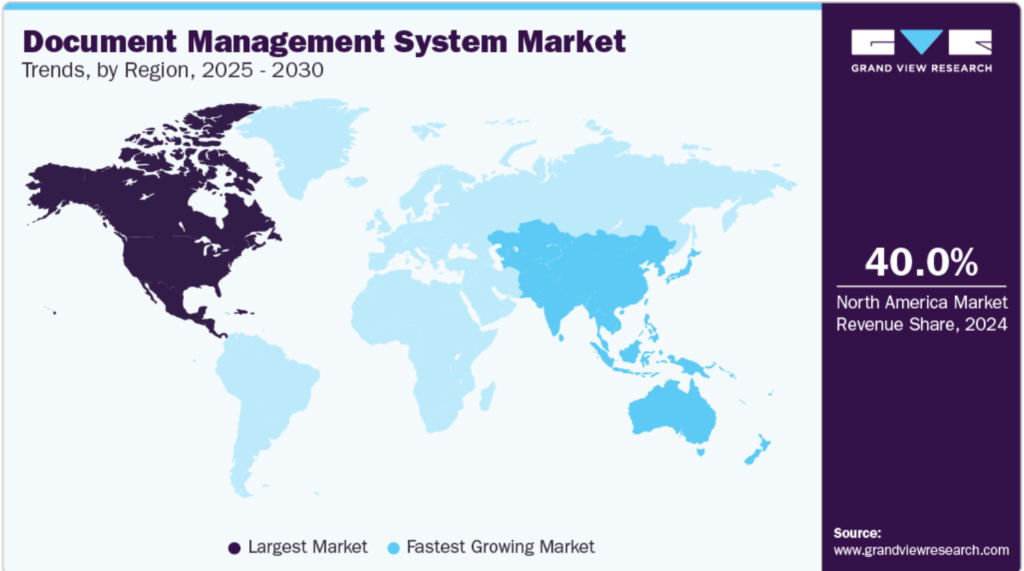
Regionally, North America continues to account for the largest share of revenue due to early technology adoption and stringent regulatory requirements. Europe follows closely, with strong demand driven by data protection regulations such as GDPR. Meanwhile, the Asia-Pacific region is emerging as the fastest-growing region, fueled by digital transformation initiatives, government-led digitization programs, and increasing awareness among SMEs.
These regional patterns reveal an important strategic insight: organizations are no longer adopting DMS purely for operational efficiency but as a foundational component of digital infrastructure that supports compliance, scalability, and cross-border collaboration.
Industry-Specific Applications: Where DMS Delivers the Most Value
While document management systems are broadly applicable, their impact is most pronounced in document-intensive industries where accuracy, compliance, and speed are critical.
In financial services, institutions manage vast volumes of sensitive client data, regulatory filings, and transactional records. A DMS enables secure document handling, automated compliance workflows, and real-time audit readiness. Wealth managers and family offices, in particular, benefit from centralized client document repositories that enhance transparency and client trust.
Legal and consulting firms rely heavily on document accuracy and version control. Contracts, case files, and advisory reports must be meticulously managed to avoid errors and maintain compliance. A DMS ensures that professionals always work with the latest versions while maintaining a complete history of changes.
Healthcare organizations face unique challenges related to patient records, privacy regulations, and operational efficiency. A robust DMS supports secure storage, controlled access, and streamlined workflows, enabling healthcare providers to focus on patient care rather than administrative burdens.
In procurement and supply chain management, document workflows such as vendor contracts, purchase orders, and compliance certifications are critical to operational continuity. Automating these processes reduces delays, minimizes errors, and improves supplier relationships.
Industries such as construction, real estate, and manufacturing also benefit significantly from DMS platforms, where managing blueprints, contracts, and compliance documentation is essential to project success. Similarly, HR departments across all sectors use DMS solutions to securely manage employee records, onboarding documents, and policy documentation.
These use cases highlight a common theme: regardless of industry, organizations that effectively manage their documents gain a measurable advantage in efficiency, compliance, and decision-making.
Advanced Use Cases: Moving Beyond Storage to Strategic Enablement
Modern document management systems are no longer limited to storage and retrieval; they are increasingly being used as strategic tools that enable business transformation.
One advanced use case is end-to-end contract lifecycle management, where documents are not only stored but actively managed throughout their lifecycle. From creation and negotiation to approval, execution, and renewal, a unified platform ensures visibility and control at every stage. This is particularly valuable for sales teams, procurement departments, and legal professionals who depend on timely contract execution.
Another critical use case is client-advisor collaboration. In sectors such as financial services and consulting, seamless and secure document exchange is essential. A DMS enables organizations to share documents securely, track interactions, and maintain a centralized record of all communications, improving both efficiency and client experience.
Data-driven decision-making is also becoming a key application. By leveraging AI and analytics, organizations can extract insights from documents, identify trends, and make informed strategic decisions. For example, analyzing contract data can reveal patterns in pricing, risk exposure, and vendor performance.
Additionally, remote and hybrid work environments have amplified the importance of cloud-based document management. Employees can access, edit, and collaborate on documents from anywhere, ensuring business continuity and productivity regardless of location.
Strategic Decision Framework: Choosing the Right DMS
Selecting the right document management system is a critical decision that can significantly impact an organization’s operational efficiency and long-term success.
A key consideration is scalability. As organizations grow, their document volumes and complexity increase. A DMS must be able to scale seamlessly without compromising performance or security.
Integration capabilities are equally important. Modern businesses rely on interconnected systems, and a DMS should integrate with existing tools such as CRM platforms, ERP systems, and e-signature solutions. This ensures that documents are embedded within broader business workflows.
Security and compliance features are non-negotiable, particularly for industries dealing with sensitive data. Organizations should prioritize platforms that offer robust encryption, access controls, and audit capabilities.
User experience is another critical factor. Even the most advanced system will fail to deliver value if it is difficult to use. Intuitive interfaces and streamlined workflows are essential for user adoption and productivity.
Finally, organizations should consider the platform’s ability to support automation and AI-driven capabilities, as these features are increasingly becoming essential for maintaining a competitive edge.
The Convergence of DMS and CLM: A New Standard
One of the most significant developments in the document management space is the convergence of DMS and contract lifecycle management into unified platforms.
Traditionally, organizations used separate systems for document storage and contract management, leading to inefficiencies and data silos. Today, integrated solutions enable organizations to manage all documents and contracts within a single ecosystem.
This convergence offers several advantages. It improves visibility by providing a single source of truth for all documents and contracts. It enhances efficiency by automating workflows across both domains. It also reduces risk by ensuring consistent compliance and auditability.
Platforms like Contractbook have contributed to advancing CLM capabilities, while broader enterprise solutions such as DocuWare and Laserfiche have expanded their offerings to include workflow automation and integrations. The market is now moving toward more unified, intelligent platforms that combine the strengths of both, and that is Fortva.
What Will Define the Next Decade of Document Management?
Looking ahead, several trends are poised to shape the future of document management systems. Artificial intelligence will continue to play a central role, enabling more advanced data extraction, predictive analytics, and automation. As machine learning models become more sophisticated, they will unlock new possibilities for analyzing and leveraging document data.
Automation will become more intelligent and context-aware, allowing systems to adapt to complex workflows and make decisions based on real-time data. This will further reduce manual intervention and improve operational efficiency.
Security will remain a top priority, with increasing adoption of zero-trust architectures and advanced encryption technologies to protect sensitive information.
Another key trend is the growing emphasis on user-centric design. As organizations prioritize employee experience, DMS platforms will need to offer intuitive interfaces and seamless integrations that enhance productivity rather than hinder it.
Finally, the role of document management systems will expand beyond operational efficiency to become a strategic enabler of innovation and growth. Organizations that leverage these systems effectively will be better positioned to navigate complexity, adapt to change, and achieve long-term success.
A Subtle Shift Toward Unified Platforms
While traditional systems focused solely on document storage and retrieval, the modern DMS is evolving into a unified platform that integrates document management, contract lifecycle management, workflow automation, and AI-driven insights.
This shift reflects a broader trend toward digital ecosystems where information flows seamlessly across systems and processes. Organizations that adopt such platforms are better positioned to scale operations, improve efficiency, and maintain compliance in an increasingly complex business environment.
Solutions like Fortva exemplify this evolution by combining document management, contract lifecycle management, workflow automation, and AI-powered insights into a single, user-friendly platform designed for modern enterprises.
Start a free trial or
Book a demo.
Frequently Asked Questions
What is a document management system?
A document management system (DMS) is software that helps businesses store, organize, and track documents digitally. It improves efficiency, security, and compliance by centralizing document workflows.
How does a document management system work?
A DMS captures documents, stores them securely, and organizes them using metadata. It also automates workflows, controls access, and tracks document activity through audit trails.
What are the key features of a document management system?
Core features include document storage, search functionality, version control, access permissions, workflow automation, and audit trails. Advanced systems also include AI-powered data extraction and integrations.
How does a DMS improve productivity?
A document management system reduces time spent searching for files, automates approvals, and enables real-time collaboration. This allows teams to focus on high-value tasks instead of manual processes.
Is Google Drive a document management system?
Google Drive is primarily a cloud storage tool, not a full document management system. It lacks advanced features like workflow automation, audit trails, and compliance controls found in DMS platforms.
What are the disadvantages of a document management system?
Some challenges include initial setup time, user adoption, and integration complexity. However, modern cloud-based DMS platforms significantly reduce these barriers.
Who needs a document management system?
Any organization that handles large volumes of documents—such as legal firms, financial services, healthcare, HR, and procurement—can benefit from a DMS.
How secure is a document management system?
Modern DMS platforms use encryption, access controls, and audit logs to protect data. Advanced systems also offer zero-knowledge encryption and compliance-ready security frameworks.
What is the best document management software?
The best document management system depends on your needs, but key factors include security, automation, ease of use, and integration capabilities.
