What Is an Invoice? Invoicing Features for Small Businesses and Accounting
An invoice is more than a bill—it’s a legally significant document that drives cash flow, enforces payment terms, and connects contracts to revenue.
Key Takeaways
- An invoice is a formal request for payment that documents a transaction between a buyer and seller, essential for accounting and cash flow management.
- While invoices and contracts are related, they serve different purposes—contracts define terms, invoices trigger payment.
- Invoices can be legally binding when tied to an agreement, accepted by the buyer, and supported by clear terms.
- Modern businesses rely on automated invoice management systems to reduce errors, accelerate payments, and improve financial visibility.
- Contract and invoice management together create a seamless workflow from agreement to payment collection.
- Platforms like Fortva streamline document workflows, automate invoicing processes, and ensure compliance with financial controls.
What Is an Invoice in Business and Accounting?
An invoice is a commercial document issued by a seller to a buyer that itemizes goods or services provided and requests payment within a specified timeframe. In accounting, invoices play a critical role in revenue recognition, accounts receivable tracking, and financial reporting.
A typical invoice includes essential details such as the seller’s and buyer’s information, invoice number, issue date, payment terms, line items, taxes, and total amount due. These components ensure transparency and provide a clear audit trail for both parties.
From a legal and operational standpoint, invoices are not just administrative paperwork. They are financial instruments that connect sales activity to cash inflow. Without proper invoicing, even profitable businesses can struggle with liquidity due to delayed or missed payments.
According to a report by Atradius, nearly 60% of B2B invoices are paid late globally, highlighting the importance of structured invoicing processes and automation.
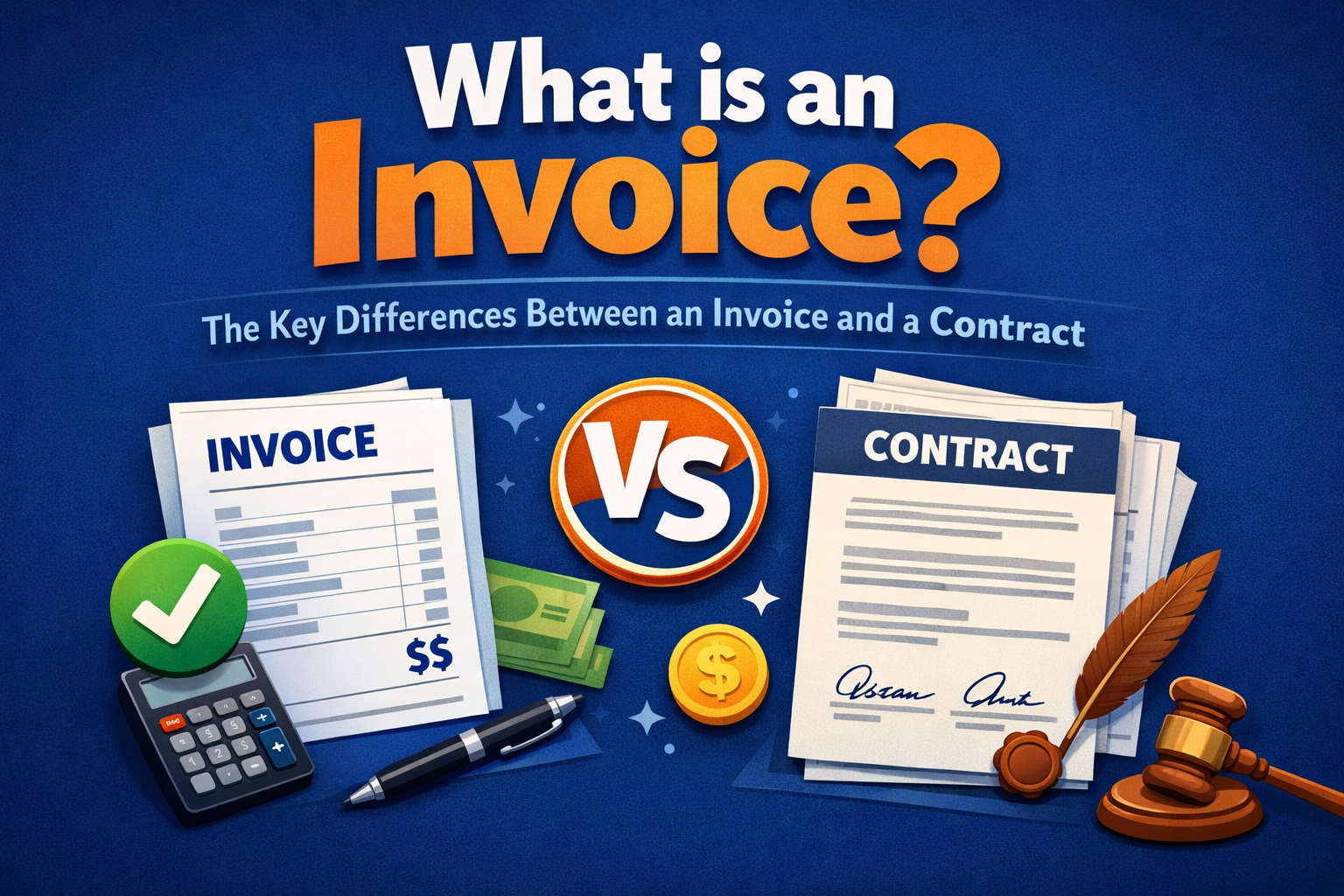
Contract vs. Invoice: Key Differences
| Aspect | Invoice | Contract |
| Purpose | Requests payment for goods or services delivered | Defines the terms and conditions of a business agreement |
| Timing | Issued after work is completed or goods are delivered | Created before any transaction begins |
| Legal Role | Supports a payment claim; can be enforceable in some cases | Legally binding agreement that governs the entire relationship |
| Content | Includes amounts due, payment terms, due date, and itemized charges | Includes obligations, rights, pricing terms, timelines, and legal clauses |
| Function | Triggers the payment process | Establishes expectations and protects both parties |
| Level of Detail | Focused on financial details only | Covers legal, operational, and financial details |
| Dependency | Often based on an existing contract or agreement | Exists independently and forms the foundation for invoices |
| Risk Coverage | Limited protection in disputes | Strong legal protection with defined dispute resolution |
| Lifecycle Stage | Part of the billing and accounts receivable process | Part of the negotiation and agreement phase |
In simple terms: A contract sets the rules, while an invoice enforces payment based on those rules.
What Is Invoice Management?
Invoice management refers to the process of creating, sending, tracking, and storing invoices throughout their lifecycle. It ensures that invoices are accurate, approved, delivered on time, and paid efficiently.
In traditional systems, invoice management is often manual—handled through spreadsheets, emails, and paper documents. This approach increases the risk of errors, lost invoices, duplicate payments, and delayed collections.
Modern invoice management systems automate these workflows by integrating invoicing with accounting software, document management systems, and contract lifecycle management tools. This allows businesses to maintain control, reduce operational costs, and gain real-time visibility into cash flow.
A study by Ardent Partners found that companies using automated invoice processing reduce invoice processing costs by up to 80% and significantly shorten payment cycles.
What Is a Contract?
A contract is a legally binding agreement between two or more parties that outlines rights, obligations, terms, and conditions of a business relationship. Contracts establish the foundation of a transaction, defining what is being exchanged, how it will be delivered, and under what conditions payment will occur.

Unlike invoices, which request payment, contracts define the rules that govern that payment. They include clauses related to pricing, delivery timelines, dispute resolution, termination, and liability.
Contracts are critical for risk management and compliance. They protect businesses from misunderstandings, enforce accountability, and provide legal recourse in case of disputes.
Is an Invoice a Contract?
An invoice is not typically a contract, but it can become legally enforceable under certain conditions.
If an invoice references an agreed-upon contract, includes clear payment terms, and is accepted by the buyer (either explicitly or through payment or continued business), it may serve as evidence of a binding agreement.
However, relying solely on invoices without a formal contract increases legal risk. Invoices do not usually cover critical elements such as liability limitations, intellectual property rights, or dispute resolution mechanisms. For this reason, businesses should treat invoices as complementary to contracts—not replacements.
Contract vs. Invoice: What’s the Difference?
Understanding the difference between a contract and an invoice is essential for effective financial and legal management.
A contract is created before a transaction begins and outlines the terms of the agreement. It defines expectations, responsibilities, and protections for both parties.
An invoice, on the other hand, is issued after goods or services are delivered. Its purpose is to request payment based on the terms defined in the contract.
The contract governs the relationship, while the invoice executes the financial transaction. In practical terms, a contract answers “what was agreed,” while an invoice answers “what is owed.”
Are Invoices Legally Binding?
Invoices can be legally binding if they meet certain criteria. These include clear identification of the parties involved, a detailed description of goods or services, agreed pricing, and defined payment terms. If a client accepts an invoice—either by signing, acknowledging, or making partial or full payment—it can strengthen its enforceability.
However, the legal strength of an invoice is significantly enhanced when it is backed by a formal contract. Courts generally rely on contracts as the primary source of truth in disputes, with invoices serving as supporting evidence. Businesses that rely solely on invoices without contractual backing may face challenges in enforcing payment or resolving disputes.
How to Handle Contracts and Invoices Efficiently
Managing contracts and invoices separately creates silos that lead to inefficiencies, errors, and revenue leakage. The most effective approach is to integrate both processes into a unified workflow.
This begins with creating standardized contracts that clearly define billing terms, payment schedules, and penalties for late payments. Once a contract is executed, invoicing should be triggered automatically based on milestones or delivery events.
Centralized document management ensures that contracts and invoices are stored securely, easily accessible, and linked for audit purposes. Automated reminders and tracking systems help ensure timely payments and reduce administrative burden. Small businesses that adopt integrated contract and invoice workflows report faster payment cycles, improved compliance, and better financial forecasting.
Contract and Invoice Management
Contract and invoice management is the coordinated process of handling agreements and payment requests within a single system. It ensures that financial transactions align with contractual obligations and that all documentation is accurate, compliant, and traceable.
This approach eliminates duplication, reduces manual errors, and improves collaboration across legal, finance, and operations teams. In a modern business environment, contract and invoice management is not just about efficiency—it is a strategic function that impacts revenue, risk, and customer relationships.
Key Features of Contract and Invoice Management
- Centralized Document Storage
Stores all contracts and invoices in one secure location, creating a single source of truth. This ensures easy access, better organization, and complete version control across teams. - Workflow Automation
Automates approvals, reminders, and task assignments to eliminate manual processes. This reduces delays, improves efficiency, and ensures nothing falls through the cracks. - Accounting and CRM Integration
Connects seamlessly with accounting tools and CRM platforms to sync financial and customer data. This improves accuracy, reduces duplication, and enhances visibility across departments. - E-Signature Capabilities
Enables fast, secure digital signing of contracts without paperwork or delays. This accelerates deal closure and ensures legally compliant execution. - Audit Trails and Compliance Tracking
Maintains a detailed history of document changes, approvals, and actions. This ensures transparency, supports compliance, and simplifies audits. - AI-Powered Data Extraction (OCR)
Uses AI and OCR to automatically extract key data from invoices and contracts. This speeds up processing, reduces manual entry, and delivers actionable financial insights.
Benefits of Using Contract and Invoice Management
- Improved Cash Flow
Ensures invoices are sent on time and payments are collected faster through automation. This reduces late payments and keeps your revenue cycle predictable. - Enhanced Accuracy and Fewer Errors
Eliminates manual data entry and duplicate records across systems. This leads to cleaner financial data and more reliable reporting. - Stronger Compliance and Risk Management
Maintains consistent records, audit trails, and standardized workflows. This helps businesses stay compliant and reduces legal and financial risks. - Increased Operational Efficiency
Automates repetitive tasks, freeing up finance and legal teams for higher-value work. This improves productivity and reduces administrative overhead. - Better Financial Visibility
Provides real-time insights into invoices, payments, and outstanding balances. This helps leaders make faster, data-driven decisions. - Faster Dispute Resolution
Keeps all documents and transaction history organized and accessible. This makes it easier to resolve billing issues quickly and maintain client trust.
Invoice Management in the Digital Era
In today’s digital landscape, invoice management has evolved from a back-office function to a strategic driver of business performance. Companies are increasingly adopting cloud-based solutions to automate invoicing, improve visibility, and enhance customer experience.
Digital invoicing enables real-time tracking, faster approvals, and seamless integration with other business systems. It also supports remote work and global operations, allowing businesses to manage invoices from anywhere.
According to a report by Billentis, e-invoicing adoption continues to grow globally, with billions of invoices processed electronically each year. This trend reflects the increasing demand for efficiency, transparency, and compliance in financial operations.
Need Help Getting Started? Use Ready-to-Go Contract Templates
Creating contracts from scratch can be time-consuming and risky, especially without legal expertise. That’s why many businesses rely on pre-built templates to ensure consistency and compliance.
Fortva offers a library of professionally designed contract templates that can be customized to suit your business needs. These templates help you standardize agreements, reduce legal risks, and accelerate deal execution.
Whether you’re drafting service agreements, vendor contracts, or client engagements, having the right templates in place ensures that your invoicing process is built on a solid foundation. Explore ready-to-use free contract templates here:
Control Your Contracts and Invoices with Confidence and Ease
Managing contracts and invoices doesn’t have to be complex or time-consuming. With the right tools, businesses can automate workflows, reduce risks, and gain full visibility into their financial operations.
Fortva is a cloud-based document management and contract lifecycle management platform designed to simplify how businesses handle contracts and invoices. It goes beyond basic storage by offering workflow automation, version control, redlining, and secure document sharing.
With features like e-signatures, AI-powered data extraction, and integrations with tools like Salesforce and HubSpot, Fortva connects your contracts directly to your revenue lifecycle. This ensures that every agreement translates into timely and accurate invoicing.
For industries like manufacturing, where documentation and compliance are critical, Fortva provides a centralized system to manage complex workflows efficiently.
Streamline Your Invoices and Contracts with Fortva
Disconnected systems slow down payments, increase risk, and create unnecessary complexity. Fortva brings your contracts and invoices together into a single, intelligent platform—helping you automate workflows, reduce errors, and get paid faster. Start managing your documents, contracts, and invoices with confidence.
Frequently Asked Questions
What is an invoice in simple terms?
An invoice is a document a business sends to a customer requesting payment for goods or services provided. It includes details like the amount due, payment terms, and due date.
What is an invoice used for in accounting?
In accounting, invoices are used to record revenue, track accounts receivable, and maintain accurate financial records. They serve as proof of a transaction for audits and reporting.
Is an invoice the same as a contract?
No, an invoice is not the same as a contract. A contract defines the agreement and terms, while an invoice requests payment based on those agreed terms.
Are invoices legally binding?
Invoices can be legally binding if they include clear terms and are accepted by the client. However, they are strongest when supported by a formal contract.
What should be included in an invoice?
An invoice should include the business name, client details, invoice number, date, description of goods or services, total amount, taxes, and payment terms.
What is the difference between an invoice and a receipt?
An invoice is sent before payment to request money, while a receipt is issued after payment as proof that the transaction has been completed.
How do businesses manage invoices efficiently?
Businesses use invoice management systems to automate creation, approvals, tracking, and payments. This reduces errors and improves cash flow visibility.
How do contracts and invoices work together?
Contracts define the terms of a deal, including pricing and payment schedules. Invoices are then issued based on those terms to collect payment, ensuring consistency and compliance.
What is invoice management?
Invoice management is the process of creating, sending, tracking, and storing invoices. It ensures timely payments and accurate financial records.
Can small businesses benefit from invoice automation?
Yes, small businesses benefit significantly from automation by saving time, reducing manual errors, and getting paid faster through streamlined workflows.