
What Is a Unilateral Contract in Insurance Contracts?
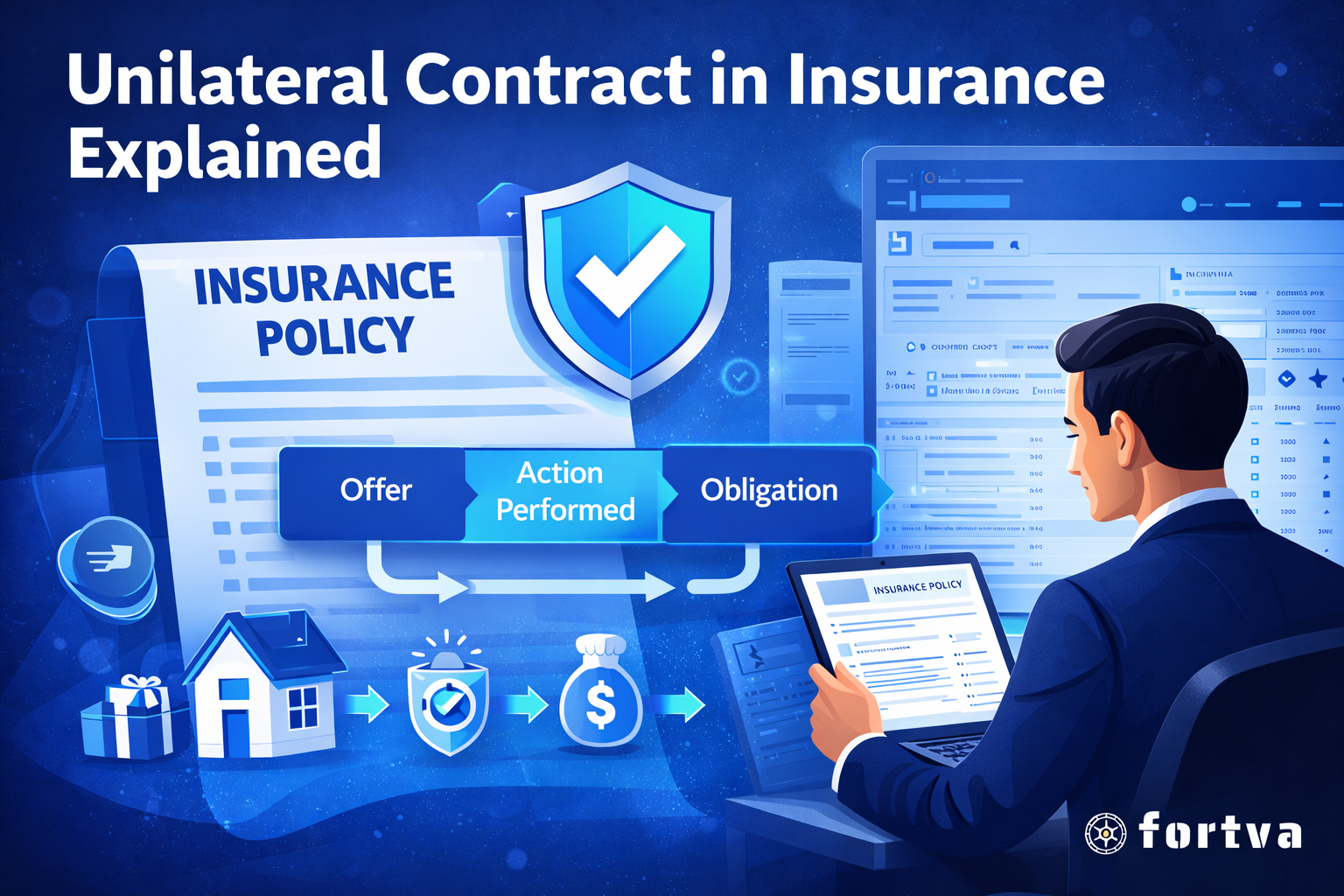
A unilateral contract is a legally binding agreement where only one party makes a promise, and the other party accepts that promise by performing a specific action.
Imagine you’re a contract manager responsible for overseeing dozens of agreements—from supplier contracts to employee agreements and insurance policies. Some contracts require both parties to promise something in return, while others place the obligation on only one side. For example, an insurance company promises to pay compensation if a policyholder files a valid claim after an accident or loss. The policyholder does not promise anything in return beyond fulfilling the policy conditions.
Now imagine managing hundreds of such agreements across departments. Do you know how to identify a unilateral contract, track its obligations, and ensure compliance throughout the contract lifecycle?
Key Takeaways
- A unilateral contract is a contract where only one party makes a legally enforceable promise that becomes binding when the other party performs a specific action.
- Insurance policies are classic unilateral contract examples because the insurer promises to compensate the insured when certain conditions are met.
- Understanding the meaning of unilateral contract is essential for contract managers, legal teams, and procurement professionals responsible for contract compliance.
- Unlike a bilateral contract, which involves mutual promises from both parties, unilateral agreements are accepted through performance rather than a counter-promise.
- Businesses increasingly use contract management software and electronic signature software to track unilateral agreements, automate obligations, and manage contract documents securely.
- Effective contract lifecycle management (CLM) helps organizations monitor unilateral contract obligations, policy conditions, and claim triggers across departments.
Understanding the Meaning of a Unilateral Contract
Before exploring insurance policies and business use cases, it helps to start with the contract definition itself.
In legal terms, a contract is an agreement between two or more parties that creates enforceable obligations recognized by law. When lawyers or contract managers define a contract, they typically refer to four essential elements: offer, acceptance, consideration, and mutual intent.
A unilateral contract differs from other types of agreements because only one party makes a promise at the beginning of the agreement. The contract becomes enforceable once the other party completes the required action.
For example, a company may offer a reward for returning lost property. The company promises to pay the reward, but no one is obligated to search for the item. Once someone finds and returns the item, the contract becomes binding and the reward must be paid. This structure is what distinguishes unilateral agreements from most traditional contracts used in business and procurement.
Why Insurance Policies Are Unilateral Contracts
Insurance contracts provide one of the most well-known examples of unilateral agreements in modern commerce. When an insurance company issues a policy, it promises to compensate the policyholder if a specified event occurs. The policyholder is not required to promise anything beyond meeting the policy conditions, such as paying premiums and reporting claims honestly.
For instance, consider a homeowner’s insurance policy. The insurer promises to cover damages if the insured property is affected by fire, theft, or natural disasters covered under the policy. The homeowner does not promise to experience a fire or theft; instead, the insurer’s obligation only arises if the insured event actually occurs.
Because only the insurer’s promise becomes enforceable once the policyholder performs the required conditions, the arrangement is considered a unilateral contract in insurance.
Insurance companies manage thousands or even millions of these agreements simultaneously. According to industry research from the Insurance Information Institute, the global insurance market processes trillions of dollars in premiums annually, highlighting the enormous scale at which unilateral contracts operate in the financial ecosystem.
Read also: What Is a Force Majeure Clause? Meaning, Examples, and How It Works in Contracts
Unilateral Contract Example in Everyday Business
While insurance policies are the most recognized unilateral contracts, they are not the only example used in business.
Organizations frequently create unilateral agreements when offering incentives, rewards, or conditional promises. For example, a company might announce a public reward for identifying a software bug in its platform. The company promises a payment if someone successfully discovers and reports the vulnerability.
In this case, the company is the only party making a binding promise. Developers or security researchers are not required to search for the bug, but if they successfully identify it and submit proof, the company must fulfill the promised reward.
This type of arrangement is common in industries such as cybersecurity, marketing promotions, and recruitment incentives. Businesses often manage these agreements through contract management systems to ensure every promise is properly documented and fulfilled.
Unilateral Contract in Real Estate Transactions
Real estate professionals also encounter unilateral agreements in several scenarios.
One example involves option contracts used during property negotiations. A property owner may offer a buyer the exclusive right to purchase a property within a specified time frame. The buyer pays an option fee, but the seller alone promises to keep the offer open during the option period.
If the buyer chooses to exercise the option and purchase the property, the seller must honor the agreement. Until the buyer acts, however, the seller is the only party obligated under the contract.
This structure illustrates how unilateral agreements appear in property transactions, particularly when buyers want time to conduct inspections, secure financing, or evaluate investment opportunities.
For real estate organizations managing large portfolios of agreements, document management systems help centralize contracts, option agreements, and related documentation.
Rea also:What Is a Performance Contract? | CLM and Contract Templates
Unilateral Contract Consideration Explained
Another essential concept in contract law is consideration, which refers to the value exchanged between parties.
In unilateral agreements, consideration takes the form of a promise exchanged for performance rather than a promise exchanged for another promise.
For example, when an insurance company promises to pay compensation after an accident, the policyholder’s act of submitting a valid claim and complying with policy conditions serves as the consideration that activates the insurer’s obligation.
Legal scholars often emphasize that unilateral contracts must still satisfy the same legal principles that govern all contracts, including:
- A clear and definite offer
- The ability to perform the requested action
- Legal intent to create an enforceable agreement
Without these elements, even a unilateral promise may not be legally enforceable.
Unilateral Contract vs Bilateral Contract
Understanding the difference between unilateral and bilateral contracts is crucial for contract managers responsible for reviewing agreements.
A bilateral contract involves mutual promises between two parties. Both parties commit to performing specific obligations. For example, an employment agreement requires an employer to pay wages while the employee promises to perform services.
By contrast, unilateral agreements depend on performance rather than reciprocal promises.
Consider a bilateral contract example in procurement. A supplier agrees to deliver goods, and the buyer agrees to pay for them. Both sides make commitments from the beginning of the agreement.
In unilateral agreements, however, the promise only becomes enforceable once the requested action occurs.
Because organizations manage both types of contracts simultaneously, modern contract lifecycle management platforms help track obligations, deadlines, and compliance requirements across all contract types.
Unilateral Contract vs Bilateral Contract vs Option Contract
| Feature | Unilateral Contract | Bilateral Contract | Option Contract |
| Definition | A contract where one party makes a promise that becomes enforceable once the other party performs a specific action. | A contract where both parties exchange promises and commit to performing obligations. | A contract that gives one party the right, but not the obligation, to enter into another agreement within a specified time. |
| Acceptance Method | Acceptance occurs through performance rather than a promise. | Acceptance occurs when both parties exchange mutual promises. | Acceptance occurs when the option holder chooses to exercise the option. |
| Obligation Structure | Only one party is obligated once performance occurs. | Both parties are obligated from the beginning of the agreement. | The option giver is obligated to keep the offer open during the option period. |
| Common Industry Use | Insurance policies, reward offers, promotional incentives. | Employment contracts, supplier agreements, service contracts. | Real estate transactions, investment agreements, licensing deals. |
| Risk Exposure | Lower initial obligation for the second party because they are not required to act. | Higher obligation for both parties since each promise is legally binding. | The option holder has flexibility, while the option grantor carries the primary obligation. |
Why These Differences Matter in Contract Management
In real-world business environments, organizations rarely deal with only one type of agreement. A single company may simultaneously manage insurance policies, vendor contracts, employment agreements, and property deals, each governed by different contractual structures.
For example, a procurement department might rely heavily on bilateral contracts when negotiating supply agreements. In these arrangements, the supplier promises to deliver goods while the buyer promises to pay a specified amount. Both parties are immediately bound by the agreement once the contract is executed.
By contrast, an insurance department dealing with risk management primarily handles unilateral contracts. The insurance provider promises compensation if a covered event occurs, but the insured party does not promise that the event will happen. The insurer’s obligation is triggered only when the insured fulfills the policy conditions.
Option contracts, often used in real estate and investment transactions, introduce yet another dynamic. These agreements grant one party the exclusive right to execute a future transaction while requiring the other party to keep the offer open for a specified period.
Understanding these structural differences is not merely an academic exercise. It directly impacts how organizations manage contract obligations, risk exposure, and compliance responsibilities.

How Contract Lifecycle Management Supports All Three
As companies scale, managing multiple types of agreements manually becomes increasingly difficult. Legal teams often face challenges tracking obligations, monitoring deadlines, and ensuring that contracts are executed according to their terms.
This is where contract lifecycle management (CLM) technology becomes essential. Modern CLM platforms allow organizations to organize contracts based on their type, automate approval workflows, and monitor key milestones throughout the contract lifecycle.
For example, a contract management system can automatically flag deadlines in option contracts, ensuring that organizations do not miss the window to exercise or terminate an option. It can also monitor conditions within unilateral agreements, such as policy triggers in insurance contracts or reward fulfillment requirements.
Meanwhile, bilateral agreements such as vendor contracts can be tracked through automated workflows that monitor deliverables, payment schedules, and compliance requirements.
When combined with document management systems and electronic signature software, these tools provide a centralized platform for managing every stage of the contract lifecycle—from drafting and negotiation to execution and renewal.
For organizations dealing with hundreds or thousands of agreements, this level of automation and visibility is critical for maintaining operational efficiency and minimizing legal risk.
Advantages & Disadvantages of Unilateral Contracts
Unilateral contracts are widely used in insurance, promotions, rewards programs, and certain real estate arrangements because they are straightforward and performance-driven. However, like any legal structure, they come with both strengths and limitations. Understanding these factors helps contract managers, legal teams, and business leaders decide when a unilateral agreement is the right approach.
The table below highlights the key advantages and disadvantages of unilateral contracts in practical business terms.
| Aspect | Advantages | Disadvantages |
| Simplicity | Unilateral contracts are relatively simple to structure because only one party makes the primary promise. This reduces negotiation time and makes them easier to implement in situations like insurance policies or reward programs. | If the contract terms are not clearly written, disputes can arise over what constitutes valid performance or whether the promised reward must be paid. |
| Performance-Driven Structure | These contracts motivate action because the reward or benefit is tied directly to completing a specific task or achieving a defined outcome. This makes them effective for incentives and promotional offers. | There is no guarantee that anyone will perform the required action, meaning the offer may never be accepted or executed. |
| Usefulness in Open Offers | Unilateral contracts are ideal for public offers, such as reward announcements, insurance coverage promises, or bug bounty programs in technology companies. | Because the offer is open, the offeror may have limited control over who performs the action or claims the reward. |
| Certainty of Obligation | The offeror’s legal obligation only arises once the required performance has been completed. This protects the party making the offer from premature liability. | The offeree has limited legal protection until the performance is completed, which can discourage participation in certain situations. |
| Flexibility | Businesses can design unilateral agreements around specific results, allowing them to structure incentives, compensation, or rewards according to desired outcomes. | If performance expectations are not precisely defined, disagreements may arise about whether the task was completed correctly. |
| Risk Management | Since payment or reward occurs only after successful performance, unilateral contracts can reduce upfront financial risk for the offeror. | If multiple individuals complete the requested task simultaneously, the offeror may face unexpected financial obligations depending on how the offer was structured. |
| Administrative Efficiency | These agreements typically require less negotiation and documentation compared to complex bilateral contracts, making them faster to implement. | Limited documentation can sometimes weaken legal clarity if the agreement is not properly recorded or stored. |
| Enforceability | Once the specified conditions are fulfilled, unilateral contracts become legally enforceable under contract law, providing a clear trigger for obligation. | Legal enforcement can become complicated if there is partial performance or disagreement over whether the conditions were fully satisfied. |
The Role of Contract Management in Unilateral Agreements
Managing unilateral contracts can become complicated as organizations grow and accumulate hundreds or thousands of agreements. Without a centralized system, companies often struggle with:
- Tracking open offers and obligations
- Monitoring deadlines or performance triggers
- Ensuring legal compliance across departments
- Maintaining secure records of signed agreements
Research from World Commerce & Contracting suggests that poor contract management practices can cost organizations up to 9% of annual revenue due to missed obligations, compliance failures, and inefficiencies. This is why many organizations implement contract management software to streamline the contract lifecycle.
A contract lifecycle management system helps businesses organize contract documents, automate approvals, and track obligations throughout the entire lifecycle—from drafting and negotiation to execution and renewal.
Digital Contracts and Electronic Signatures
The shift toward digital operations has also transformed how contracts are created and executed. Many organizations now use electronic signature software to sign agreements online rather than relying on physical paperwork. Digital signatures enable faster contract approvals while maintaining legal validity in many jurisdictions.
In the context of unilateral agreements, electronic signatures are particularly useful for documenting insurance policies, reward offers, or promotional agreements where one party promises a future benefit.
Studies from industry analysts show that digital contract workflows can reduce contract turnaround time by more than 80%, allowing organizations to finalize agreements faster and maintain accurate records.
When combined with document management systems, electronic signatures create a secure environment where contracts can be stored, searched, and analyzed efficiently.
How Contract Templates Improve Consistency
Another challenge organizations face is maintaining consistent contract language across departments.
Standardized contract templates help businesses create legally consistent agreements while reducing drafting time. Templates ensure that essential legal clauses, definitions, and conditions appear in every contract.
Many companies maintain a centralized library of templates so legal teams and contract managers can quickly generate new agreements when needed.
Organizations that adopt template-driven contract workflows often experience faster contract creation and fewer legal risks because standardized language reduces ambiguity.
The Importance of Document Management for Contracts
Contracts generate large volumes of documentation throughout their lifecycle.
Policy agreements, amendments, claims documentation, and compliance records must all be stored securely and easily accessible. Without a centralized document management strategy, organizations risk losing critical information or missing important deadlines.
Cloud-based document management systems provide a structured repository for storing and managing contracts. These platforms enable organizations to categorize documents, automate approval workflows, and retrieve information quickly.
As businesses increasingly rely on digital documentation, modern platforms also incorporate artificial intelligence and optical character recognition (OCR) technology to extract key contract data automatically.
This capability allows contract managers to analyze agreements, monitor obligations, and generate insights that improve decision-making.
How Can You Manage Unilateral Contracts Effectively?
Forva offers tools to streamline unilateral agreement management:
- Centralized repository for open offers and requests.
• Automated alerts for performance deadlines.
• Workflow automation for tracking tasks and obligations.
• Budget and payment tracking for promised rewards.
Final Thoughts
Unilateral contracts are common in both personal and business contexts. Understanding their structure and enforceability is key to avoiding legal pitfalls. For organizations managing multiple unilateral agreements, contract management software like Fortva can simplify oversight and ensure compliance.
Start a 7-day free trial or book a demo today to see how Fortva can transform your contract management and document management chaos into productivity.
Frequently Asked Questions About Unilateral Contracts
What is a unilateral contract?
A unilateral contract is a legally binding agreement where one party makes a promise that becomes enforceable when the other party performs a specific action. Unlike many traditional contracts, only one side is obligated at the start of the agreement.
For example, if a company offers a reward for returning a lost item, the company promises to pay the reward. Anyone who successfully returns the item accepts the offer through performance. Once the action is completed, the company must fulfill its promise.
In contract law, unilateral contracts are commonly used in reward offers, insurance policies, and promotional incentives where the acceptance of the contract occurs through action rather than a counter-promise.
What is a good example of a unilateral contract?
One of the most common unilateral contract examples is an insurance policy. When someone purchases an insurance policy, the insurer promises to compensate the policyholder if a specific event occurs, such as an accident, theft, or property damage.
The policyholder does not promise that the event will occur. Instead, the insurance company’s obligation becomes enforceable only when the insured person files a valid claim under the policy conditions.
Another simple example is a reward announcement. If a business offers $500 to anyone who finds and returns a lost company laptop, the contract becomes binding once someone successfully performs the requested action.
What are the different types of management contracts?
Management contracts generally refer to agreements where one party is hired to manage operations, services, or assets on behalf of another organization. These agreements are commonly used in industries such as hospitality, real estate, and healthcare.
Some common types of management contracts include operational management agreements, project management contracts, facility management agreements, and asset management contracts. In these arrangements, one party agrees to oversee day-to-day operations while the other party provides compensation for those services.
Although management contracts are typically bilateral agreements involving mutual promises, organizations often manage them alongside unilateral agreements using the same contract management systems and document management tools.
Who is responsible in a unilateral contract?
In a unilateral contract, the primary responsibility rests with the offeror, which is the party making the promise. The offeror is legally obligated to fulfill the promise once the other party completes the required action.
The offeree, or the person performing the action, is not obligated to perform the task at all. However, if they successfully complete the required performance according to the contract terms, they gain the legal right to receive the promised benefit.
For example, in an insurance contract, the insurer is responsible for paying compensation once the policyholder satisfies the claim conditions outlined in the policy.
What is a unilateral contract in contract law?
In contract law, a unilateral contract is defined as an agreement in which one party promises to perform a certain obligation if another party completes a specific act. The contract becomes legally enforceable once that act is performed.
This differs from bilateral contracts where both parties exchange promises from the beginning of the agreement. Courts generally enforce unilateral contracts once the offeree completes the required performance, provided that the offer was clear and lawful.
What is a unilateral contract in real estate?
In real estate, unilateral contracts often appear in option agreements. An option contract gives a potential buyer the exclusive right to purchase a property within a specified time frame.
The property owner promises to keep the offer open during the option period, while the buyer is not obligated to purchase the property unless they choose to exercise the option. If the buyer decides to proceed, the seller must honor the agreement according to the contract terms.
These arrangements allow buyers time to secure financing, conduct inspections, or evaluate investment opportunities before committing to the full purchase agreement.
What is a unilateral contract in insurance?
Insurance policies are among the most widely recognized unilateral contracts in business and finance. When an insurer issues a policy, it promises to compensate the insured if certain conditions occur, such as a covered accident, illness, or property loss.
The insured person is not required to trigger the event. Instead, the insurer’s obligation arises only when the insured fulfills the policy requirements and submits a valid claim.
Because the insurer alone makes the binding promise at the beginning of the agreement, insurance contracts are considered unilateral by nature.
What is a unilateral contract modification?
A unilateral contract modification occurs when one party attempts to change the terms of an existing agreement without the consent of the other party.
In most legal systems, unilateral modifications are not enforceable unless the contract itself allows one party to make certain changes under specified conditions. For example, some insurance policies may allow insurers to adjust policy terms at renewal periods, but not during the active coverage period.
Proper contract management and documentation are important to ensure that modifications comply with legal requirements and contractual obligations.
What is the difference between a unilateral contract and a bilateral contract?
The key difference between a unilateral contract and a bilateral contract lies in how obligations are created.
In a unilateral contract, only one party makes a promise that becomes binding once the other party performs a specific action. The offeree is not required to perform the action but gains the benefit if they do.
In a bilateral contract, both parties exchange promises from the beginning. Each party commits to performing certain obligations, making the agreement mutually binding once it is executed.
For example, an employment contract is a bilateral agreement because the employer promises wages while the employee promises to perform services.
What is a unilateral contract in life insurance?
A life insurance policy is another classic example of a unilateral contract. The insurer promises to pay a death benefit to the designated beneficiaries if the insured person passes away while the policy is active.
The policyholder pays premiums and must comply with policy conditions, but they are not promising that the insured event will occur. The insurer’s obligation arises only when the claim conditions are satisfied.
Because only the insurer makes the enforceable promise, life insurance agreements are categorized as unilateral contracts in insurance law.
What is a unilateral contract in simple terms?
In simple terms, a unilateral contract is a promise made by one party that becomes binding when someone performs a specific action.
A good everyday example is a reward offer. If someone promises to pay a reward for finding a lost pet, the contract becomes valid once someone returns the pet according to the terms of the offer.
This structure makes unilateral contracts straightforward and commonly used for incentives, promotions, and insurance agreements.
What is a unilateral contract in business law?
In business law, unilateral contracts are used in situations where one party wants to encourage a specific action without requiring anyone to commit in advance.
Businesses often use these agreements for promotional campaigns, reward programs, referral bonuses, and performance-based incentives. The contract becomes enforceable once the required action has been successfully completed.
For organizations managing large volumes of agreements, modern contract lifecycle management platforms and document management systems help track unilateral promises, store documentation, and ensure compliance throughout the contract lifecycle.


