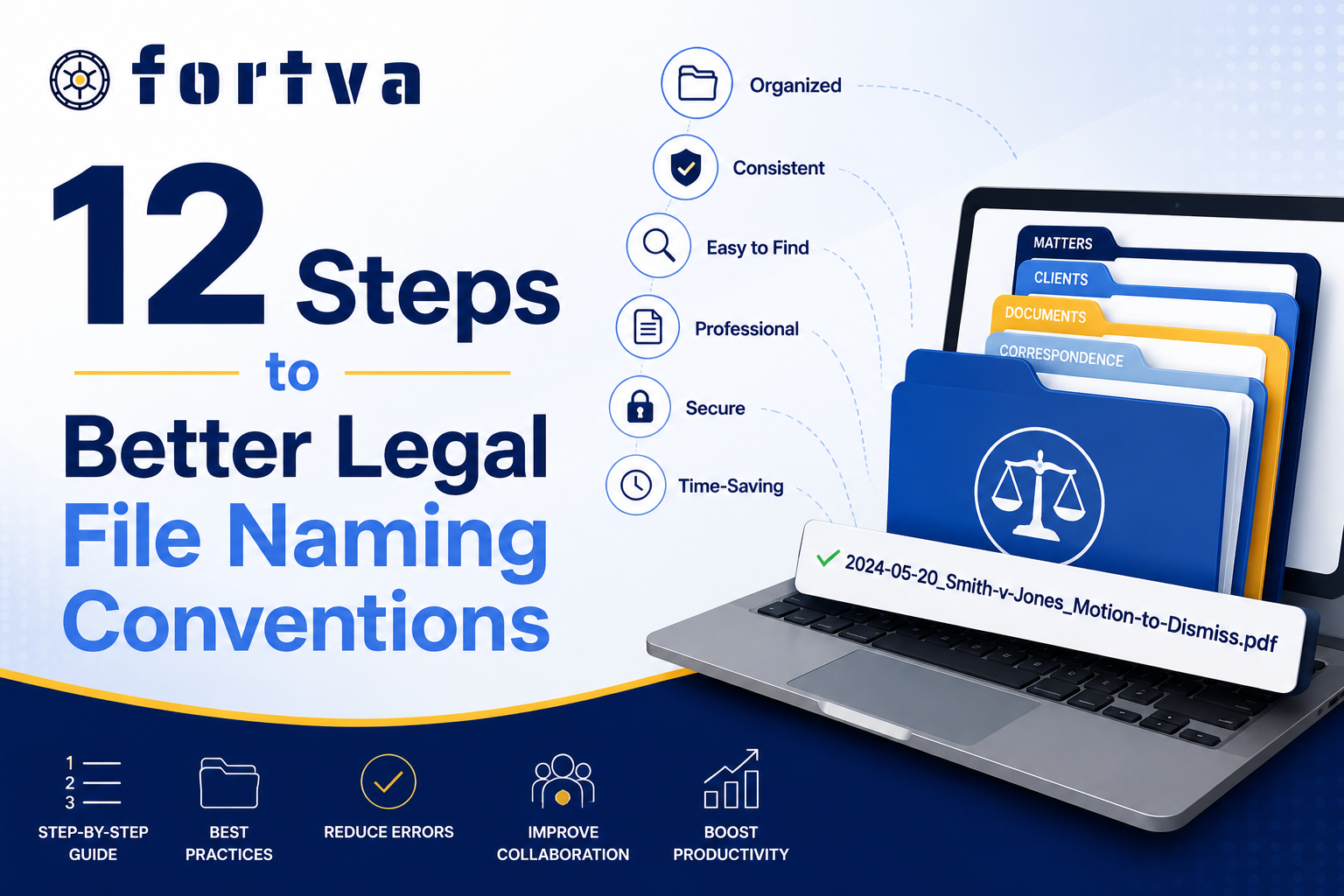
12 Steps to Better Legal File Naming Conventions For Legal Teams
Looking for a better legal file naming system that prevents document chaos at scale? Fortva replaces manual naming conventions with automated, structured workflows so legal teams never lose track of contracts, versions, or approvals again.
If your organization is still relying on humans to “name files correctly,” you are already one step away from version confusion, compliance risk, and contract delays.
Key Takeaways
- Legal file naming is a hidden driver of compliance risk and operational inefficiency
- Most document chaos comes from inconsistent naming, not lack of storage
- Version confusion (“final_final_v3”) is still one of the most common legal errors in enterprises
- Manual naming conventions break down as teams scale across departments and geographies
- Audit failures often stem from poor document traceability, not missing documents
- Standardization alone is not enough—automation is required at enterprise scale
- Fortva eliminates naming dependency by embedding structure directly into workflows
Just imagine this: A general counsel is preparing for an urgent regulatory audit. Contracts are spread across shared drives, email threads, and case management tools. A vendor agreement exists in three versions with no clear “final” copy. Finance is working off an outdated file, procurement has a different version entirely, and legal is manually trying to reconstruct the document history. Now multiply this across hundreds or thousands of contracts.
Sound familiar?
According to McKinsey, employees spend nearly 20% of their time searching for internal information instead of doing productive work. Another report by Gartner highlights that poor information governance significantly increases compliance risk and slows down legal operations in enterprise environments.
Research from World Commerce & Contracting shows that inefficient contract management contributes to up to 9% annual revenue leakage due to missed obligations and errors. Meanwhile, IDC estimates that enterprise data volume is growing by over 55% annually, making manual document organization increasingly unsustainable.
And Deloitte’s legal operations studies consistently show that fragmented document systems are one of the top drivers of legal inefficiency and audit delays. This is not a file naming problem. This is a system design problem disguised as a naming problem.
12 Steps to Better Legal File Naming Conventions
Strong legal file naming conventions are still important—but they must work as part of a larger governed system, not as a manual discipline. Below are 12 practical standards used in high-performing legal and compliance environments.
1. Define a Legal File Naming Framework
Every organization must start by defining a structured framework that all departments follow. Without this, naming becomes subjective and inconsistent across legal, finance, HR, and procurement teams. A framework ensures that every file follows a predictable structure rather than individual interpretation.
2. Standardize Document Type Prefixes
Every file should begin with a consistent document identifier.
Examples:
- NDA_ for confidentiality agreements
- AGR_ for general agreements
- EMP_ for employment contracts
- SUP_ for supplier agreements
3. Always Include Counterparty Identification
Legal teams often waste time searching for “that vendor contract” instead of identifying it clearly. A standardized naming rule must include:
- Legal entity name or standardized vendor ID
4. Use Machine-Readable Date Formatting (YYYY-MM-DD)
Dates should always be structured for sorting and automation.
Example:
- 2026-05-10 instead of 10/05/26 or May 10th
5. Embed Version Control Into Every File Name
Version confusion is one of the most common legal operational risks.
Use structured versioning:
- v1.0, v1.1, v2.0 (preferred)
Avoid informal labels like:
- final, final_final, revised_final
6. Clearly Define Document Status
File names should reflect lifecycle stage when necessary:
- DRAFT
- REVIEW
- APPROVED
- EXECUTED
7. Avoid Personal Naming Conventions Completely
Legal documents must never depend on individuals.
Avoid:
- John_signed_contract
- Maria_updated_version
Contracts are organizational assets, not personal files.
8. Separate Internal and External Documents
Use clear indicators:
- INT_ for internal use
- EXT_ for external sharing
9. Maintain Consistency Across Departments
One of the biggest failures in legal operations is departmental fragmentation. Legal may follow strict rules, while HR, finance, and procurement use different naming logic. This creates system-wide inconsistency that breaks searchability and audit readiness.
10. Align Naming With Metadata Structure
File names alone are not enough. They must align with:
- contract type
- department ownership
- jurisdiction
- renewal dates
- risk classification
Without metadata alignment, scalability breaks.
11. Enforce Naming Standards Through Governance
Most organizations fail not because rules don’t exist—but because they are not enforced. Without enforcement:
- teams create their own naming styles
- version duplication increases
- audit readiness decreases
- searchability collapses
12. Remove Manual Dependency With Workflow Automation
This is where traditional systems break and modern platforms win. Even perfect naming conventions fail when:
- employees forget rules under pressure
- multiple teams interpret standards differently
- contracts move through email instead of structured systems
- versions multiply across storage locations
This is exactly the problem Fortva eliminates. With Fortva:
- file naming is automated through structured templates
- metadata replaces manual naming decisions
- version control is system-enforced
- contracts are created inside governed workflows
- documents are never lost in folders or email threads
- every contract is traceable from draft to execution
Instead of asking employees to follow rules, Fortva builds the rules into the system itself.
Why This Matters for Modern Enterprises
The problem is not naming—it is fragmentation. As Gartner notes, poor information governance significantly increases operational and compliance risk across enterprises.
McKinsey research shows employees lose up to a fifth of their productive time searching for information. And World Commerce & Contracting reports that inefficient contract processes are a direct contributor to revenue leakage across organizations globally. At scale, manual naming conventions collapse under complexity.
Naming Rules Don’t Scale—Systems Do
Legal file naming conventions are useful, but they are only a temporary control mechanism inside broken systems. The real solution is not better naming discipline. It is eliminating the need for naming dependency entirely.
That is where Fortva changes the model—from manual document control to automated contract intelligence. Because in modern legal operations, the question is no longer:
“Did someone name this file correctly?”
It becomes:
“Why are we still naming files manually at all?”
7 Benefits of Better Legal File Naming Conventions
Legal file naming conventions may sound like a small operational detail, but in reality, they are one of the foundations of efficient legal operations and contract governance. Poorly named files create confusion, increase compliance risk, slow down collaboration, and make audits painful. Strong naming conventions help legal teams organize contracts, maintain version control, improve searchability, and reduce costly mistakes. But when paired with intelligent platforms like Fortva, file naming becomes more than organization—it becomes part of a structured, automated contract lifecycle system where files no longer fall through the cracks.
1. Faster Document Retrieval
One of the biggest advantages of standardized legal file naming is speed.
When contracts follow a consistent structure, teams can instantly locate:
- vendor agreements
- NDAs
- employment contracts
- compliance records
- executed agreements
Without opening multiple folders or relying on memory. Instead of wasting time searching for “the latest version,” teams can identify documents immediately through structured names and metadata.
2. Better Version Control
Version confusion is one of the most common legal operational problems. Poor naming practices often lead to:
- duplicate contracts
- outdated agreements being used
- conflicting edits
- approval delays
Structured naming conventions make it easier to identify:
- drafts
- reviewed versions
- approved copies
- executed agreements
When combined with Fortva’s automated version control and redlining workflows, organizations eliminate the “final_final_v3” chaos entirely.
3. Improved Compliance and Audit Readiness
Legal and compliance teams must be able to trace document history quickly during audits or disputes.
Better naming conventions create:
- clear document timelines
- identifiable revisions
- structured contract histories
- easier audit preparation
This becomes even more powerful inside Fortva, where workflows automatically track edits, approvals, signatures, and document activity in a complete audit trail.
4. Stronger Team Collaboration
Legal documents often move across:
- legal departments
- finance teams
- HR
- procurement
- external stakeholders
Without consistent naming, collaboration breaks down because teams cannot identify the correct document version.
Standardized naming creates clarity across the organization and reduces communication errors caused by document confusion.
5. Reduced Risk of Lost or Misplaced Contracts
Many businesses do not actually “lose” contracts—they lose visibility. Files stored with inconsistent names across shared drives, emails, and folders become difficult to locate when needed most. Better naming conventions improve:
- contract traceability
- storage consistency
- document visibility
- operational control
Fortva goes further by centralizing every contract in one governed repository so documents never disappear into disconnected systems.
6. Increased Productivity Across Legal Operations
Legal professionals should spend time managing risk and strategy—not hunting for files. Clear naming conventions reduce administrative friction by making documents easier to:
- search
- categorize
- retrieve
- review
- update
This allows teams to move faster while reducing manual effort and duplicated work.
7. Scalability for Growing Organizations
What works for a small legal team often collapses at enterprise scale. As organizations grow:
- document volume increases
- departments multiply
- workflows become more complex
- compliance demands rise
Without standardized naming systems, document chaos becomes unavoidable. This is why modern organizations combine naming standards with workflow automation platforms like Fortva. Instead of relying entirely on humans to organize files correctly, Fortva embeds naming structure, metadata, approvals, and version governance directly into the contract lifecycle itself.
Final Insight
Better legal file naming conventions do more than organize folders—they create operational clarity, compliance confidence, and stronger contract governance.But the real evolution happens when businesses stop depending on manual naming habits altogether. With Fortva, you are covered.
Start a free trial or book a demo today to see how Fortva can transform your contract naming.
FAQ
Why are legal file naming conventions important?
Legal file naming conventions ensure that contracts and documents are easy to locate, track, and audit. Without a structured system, organizations face version confusion, compliance risks, and wasted time searching for critical documents.
What is the biggest problem with manual file naming in legal teams?
The biggest issue is inconsistency. Even with rules in place, different teams interpret naming formats differently. This leads to duplicate files, outdated versions being used, and poor visibility across legal, finance, HR, and procurement departments.
What is the correct structure for legal file names?
A strong legal file naming structure typically includes:
- Document type (e.g., NDA, AGR, EMP)
- Counterparty name
- Date (YYYY-MM-DD format)
- Version number (v1.0, v2.0, etc.)
- Status (DRAFT, APPROVED, EXECUTED if needed)
This structure improves clarity and traceability across systems.
What is the most common mistake in legal file naming?
The most common mistake is using informal labels like:
- “final”
- “final_final”
- “updated_version”
- “revised2”
These create version confusion and make it impossible to determine the correct document during audits or contract reviews.
How do poor file naming conventions affect compliance?
Poor naming practices make it difficult to:
- prove document version history
- track approvals and changes
- locate the correct contract during audits
- ensure regulatory compliance
According to Gartner, poor information governance significantly increases compliance and operational risk in enterprise environments.
Can file naming conventions scale in large organizations?
Not effectively on their own. As organizations grow, manual naming rules break down due to human error, departmental inconsistency, and volume of documents. This is why enterprises shift toward automated document governance systems.
How does Fortva improve legal file organization?
Fortva removes the dependency on manual naming by embedding structure directly into workflows. Instead of relying on users to name files correctly, Fortva:
- automatically applies standardized naming rules
- uses metadata to organize contracts
- enforces version control within the system
- centralizes all documents in one secure repository
- ensures every contract is traceable from draft to execution
Does Fortva eliminate the need for file naming conventions?
Yes, in practice. Fortva replaces manual naming with automated structure and metadata-driven organization. This means users no longer need to worry about naming rules—everything is governed by the system itself.
Why do companies switch from traditional document systems to Fortva?
Companies switch because manual systems create:
- lost or duplicated contracts
- inconsistent version control
- slow audit preparation
- fragmented document storage
- heavy reliance on email and spreadsheets
Fortva solves these by centralizing and automating the entire contract lifecycle.
Is Fortva suitable for legal, finance, and procurement teams?
Yes. Fortva is designed for cross-functional use across:
- legal teams managing contracts and compliance
- finance teams tracking obligations and renewals
- procurement teams managing vendors
- HR teams handling employment agreements
It ensures all departments operate from a single source of truth.
What is the main advantage of Fortva over manual file systems?
The main advantage is elimination of human error in document management. Instead of relying on people to follow naming rules, Fortva enforces structure automatically through workflows, metadata, and AI-driven organization.