Onehub.com Alternative vs Egnyte.com Alternative Best Alternative | Switch To Fortva
Looking for a better alternative to Onehub or Egnyte that actually goes beyond file sharing? Fortva combines document management and contract lifecycle management into one intelligent system—so your team stops chasing files and starts closing work faster.
Key Takeaways
- Onehub is a secure file sharing platform, not a full document management or contract lifecycle system
- Businesses outgrow Onehub when they need workflow automation, approvals, and contract tracking
- Lack of deep collaboration, version intelligence, and CLM features slows down scaling teams
- Fortva fills these gaps with automation, AI extraction, approvals, and contract lifecycle visibility
- If your team handles contracts, compliance, or multi-department workflows, Onehub becomes limiting
Just imagine this: your legal team is chasing the latest contract version across shared folders, your sales team is sending outdated agreements to clients, and finance is waiting on approvals buried in email threads. Everyone assumes the file in Onehub is “the latest”—until it’s not.
Sound familiar? According to IDC, employees spend nearly 30% of their time searching for information, while McKinsey reports that improved collaboration technologies can raise productivity by 20–25%. Yet most companies still rely on tools that were built for storage—not for decision-making.
The global enterprise content management market is projected to exceed $67 billion by 2030, according to Fortune Business Insights, driven by demand for automation, compliance, and lifecycle visibility—not just file sharing. That’s where many Onehub and Egnyte users begin to feel the gap.
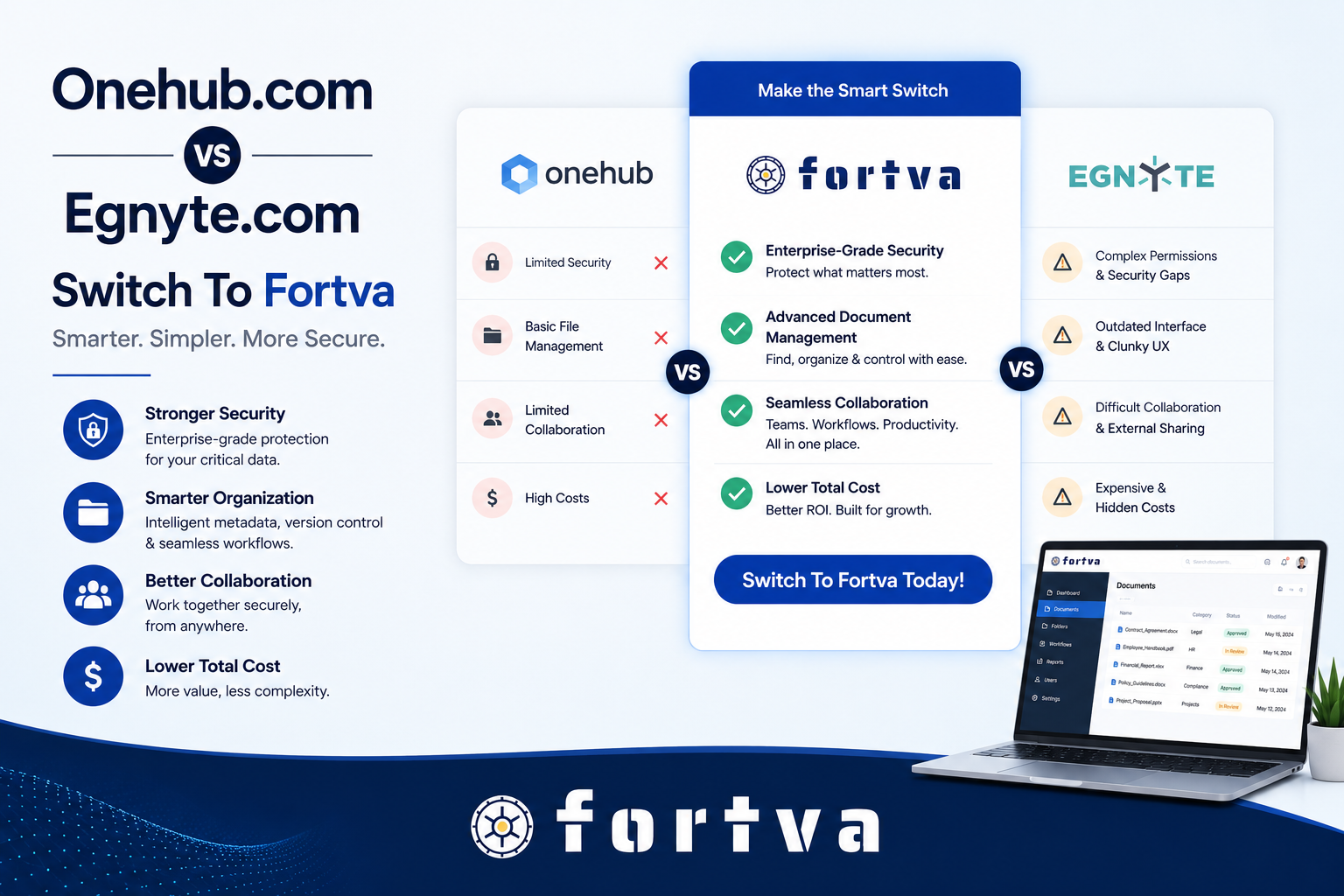
Onehub vs Egnyte vs Fortva Comparison Table
| Feature / Capability | Onehub (File Sharing) | Egnyte (DMS & Governance) | Fortva (DMS + CLM ) |
| Core Focus | Secure file sharing | Document storage & governance | End-to-end document + contract lifecycle |
| Document Management (DMS) | Basic | Advanced | Advanced + intelligent automation |
| Contract Lifecycle Management (CLM) | Not available | Not native | Fully built-in (draft → sign → renew) |
| Workflow Automation | Very limited | Limited / requires setup | Fully automated workflows & approvals |
| E-Signatures (DocuSign Integration) | No native | Integration required | Built-in seamless DocuSign integration |
| AI Data Extraction & OCR | None | Limited (governance-focused) | AI-powered insights & data extraction |
| Version Control & Redlining | Basic | Available | Advanced collaboration + redlining |
| Collaboration Across Teams | Basic | Good | Built for cross-functional teams |
| Client Portals | Yes | Yes | Yes (more integrated with workflows) |
| Approval Workflows | Manual | Limited | Automated, trackable approvals |
| Compliance & Audit Trails | Basic tracking | Strong | Strong + workflow visibility |
| Ease of Use | Very simple | Complex | Simple + powerful |
| Scalability for Growing Teams | Limited | Enterprise-heavy | Built for scaling businesses |
| Integrations (CRM, Automation Tools) | Limited | Good | Deep integrations (Salesforce, HubSpot, Zapier) |
| All-in-One Platform | No | No | Yes (No tool switching needed) |
| Best For | File sharing | Enterprise storage & compliance | Running business workflows & contracts |
Onehub: (Secure File Sharing & Virtual Data Room Software)
What is Onehub?
Onehub is a cloud-based secure file sharing and virtual data room platform designed to help businesses store, share, and control access to files. It is widely used for client portals, deal rooms, and document distribution, particularly in industries like finance, legal, and real estate.
While Onehub positions itself as a secure collaboration tool, its core strength remains controlled file sharing, not full-scale document lifecycle management or workflow automation.
Best Onehub Use Cases (Who Onehub Works Best For)
Onehub works best for organizations that primarily need secure file distribution with permission controls rather than full document or contract lifecycle oversight. It is commonly used by:
- Businesses sharing sensitive documents with external stakeholders
- M&A teams creating virtual data rooms for transactions
- Real estate firms managing client-facing document portals
- Small teams needing simple file access control
However, once workflows become more complex—especially involving approvals, contract tracking, or compliance audits—teams often need more than Onehub can offer.
Key Features of Onehub (Secure File Sharing Platform)
- Secure File Sharing and Storage
Onehub allows users to upload, organize, and securely share files with internal and external users, using permission-based access controls. - Client Portals and Virtual Data Rooms
Businesses can create branded portals where clients or partners access documents in a controlled environment. - Granular Permissions and Role-Based Access
Administrators can define who can view, download, print, or edit files, ensuring data security. - Document Activity Tracking
Basic tracking features show who accessed files and when, which is useful for deal rooms and audits. - Branding and Customization
Companies can customize portals with logos and branding to maintain a professional client experience. - Basic Collaboration Tools
Users can leave comments and interact around documents, though collaboration remains limited compared to modern platforms.
Benefits of Using Onehub for File Sharing
- Strong security for external file sharing
Onehub is designed with encryption and permission controls, making it suitable for sensitive document exchange. - Simple interface for non-technical users
Teams can quickly upload and share files without needing extensive training. - Useful for short-term projects and deal rooms
Virtual data room functionality supports transactions and client interactions. - Controlled document distribution
Businesses maintain visibility over who accesses documents.
Onehub Storage Limits and Scalability
Onehub offers cloud storage depending on the pricing plan, typically ranging from limited storage tiers to higher enterprise allocations.
However, storage alone is not the issue—scalability becomes a challenge when managing document workflows, approvals, and contract lifecycles, which Onehub does not fully support.
Pros of Onehub
- Easy to use for basic file sharing
- Strong permission and security controls
- Reliable for client portals and external sharing
- Clean interface with minimal setup required
Cons of Onehub
- Limited workflow automation for document approvals and processes
- No built-in contract lifecycle management (CLM) capabilities
- Weak version control for complex document collaboration
- Minimal AI or intelligent document processing features
- Lacks deep integrations for end-to-end business workflows
- Not designed for cross-department collaboration at scale
This is where many growing businesses start looking for a Onehub alternative—especially when documents are no longer static files but part of a larger operational workflow.
Platforms like Fortva address this by combining document management with contract lifecycle automation, ensuring documents are not just stored—but actively managed, tracked, and executed.
Onehub Pricing (2026)
| Plan | Features Overview | Pricing (Approx.) |
| Team | Basic sharing, permissions, storage | $15/user/month |
| Business | Advanced permissions, branding, tracking | $30/user/month |
| Enterprise | Custom features, higher storage, support | Custom pricing |
Note: Pricing may vary depending on storage, users, and enterprise requirements.
Onehub Use Cases in Real Businesses
- Securely sharing financial documents with clients
- Managing M&A deal rooms and investor communications
- Providing client portals for document access
- Distributing sensitive files across teams
While effective for these scenarios, businesses managing contracts, approvals, compliance, and multi-step workflowsoften require a more advanced system that integrates document handling with operational processes.
What Users Are Saying About Onehub (G2, Capterra Insights)
Users consistently highlight Onehub’s ease of use and security features as major strengths. Many appreciate how quickly they can set up client portals and share documents securely.
However, recurring feedback points to limitations around collaboration, workflow automation, and document organization at scale. Some users mention that as their business grows, they need additional tools to handle approvals, version control, and contract tracking—leading to tool fragmentation.
This fragmentation is exactly what modern platforms like Fortva aim to eliminate by offering a unified system for document and contract lifecycle management, rather than just file sharing.
Egnyte: (Enterprise Content Collaboration & Document Management Platform)
What is Egnyte?
Egnyte is a cloud-based enterprise content collaboration and document management platform designed to help organizations manage, secure, and govern their files across cloud and hybrid environments. It is widely recognized for its strong security, compliance controls, and hybrid storage capabilities, making it popular among regulated industries such as healthcare, financial services, and construction.
Unlike Onehub, Egnyte goes beyond file sharing into document management and governance. However, while it adds more structure and control, it still stops short of delivering a fully integrated document + contract lifecycle management system. That distinction becomes critical as businesses scale.
Best Egnyte Use Cases
Egnyte is best suited for organizations that require strict compliance, data governance, and secure collaboration across distributed teams. It is commonly used by:
- Enterprises managing sensitive or regulated data
- Construction and engineering firms handling large project files
- Healthcare organizations needing HIPAA-compliant storage
- Financial services firms requiring audit trails and governance
However, companies that need end-to-end workflow automation, contract lifecycle tracking, and cross-functional collaboration often find Egnyte only solves part of the problem.
Key Features of Egnyte (Enterprise Document Management System)
- Cloud and Hybrid File Storage
Egnyte allows businesses to store files in the cloud, on-premise, or in a hybrid environment, giving flexibility for data control and compliance. - Advanced Security and Compliance Controls
The platform includes data governance, access control policies, and compliance support for regulations like GDPR and HIPAA. - Content Collaboration and File Sharing
Teams can collaborate on files, share documents securely, and manage permissions across departments and external users. - AI-Powered Content Intelligence (Limited Scope)
Egnyte offers some AI capabilities for content classification and risk detection, but these are largely focused on governance—not workflow execution. - Audit Trails and Reporting
Detailed logs track document access and activity, helping organizations meet compliance requirements. - Third-Party Integrations
Egnyte integrates with tools like Microsoft 365, Google Workspace, and some business applications.
Benefits of Using Egnyte for Enterprise Document Management
- Strong compliance and governance capabilities
Egnyte excels in industries where data security and regulatory compliance are critical. - Flexible deployment options (cloud + hybrid)
Organizations can maintain control over where their data is stored. - Scalable for large enterprises
The platform is built to handle large volumes of data and users. - Reliable file synchronization and access
Teams can access documents across devices and locations.
Where Egnyte Falls Short for Modern Workflows
Despite its strengths, Egnyte reflects a traditional approach to document management—focused on storage, governance, and access, rather than execution and lifecycle automation. This becomes a bottleneck as businesses evolve.
According to Gartner, organizations that adopt integrated workflow automation platforms can reduce operational inefficiencies by up to 30%, yet many legacy-style systems still rely heavily on manual processes layered on top of document storage.
Additionally, a Forrester report highlights that over 60% of enterprises struggle with disconnected systems, where documents live in one platform while approvals, contracts, and workflows happen elsewhere. Egnyte often contributes to this fragmentation.
Pros of Egnyte
- Enterprise-grade security and compliance controls
- Flexible storage architecture (cloud, on-premise, hybrid)
- Strong audit trails and governance features
- Scalable for large organizations and regulated industries
Cons of Egnyte
- No native contract lifecycle management (CLM) system
- Workflow automation is limited and often requires integrations
- Complex setup and administrative overhead
- User experience can feel heavy and less intuitive
- AI capabilities focus on governance, not execution or insights
- Requires multiple tools to manage full document-to-contract lifecycle
For businesses that want to draft, review, approve, sign, and track contracts in one place, Egnyte often becomes just one piece of a much larger—and more complicated—tech stack.
This is where platforms like Fortva step in, unifying document management, workflow automation, and contract lifecycle management into a single, streamlined system.
Egnyte Pricing (2026)
| Plan | Features Overview | Pricing (Approx.) |
| Business | File sharing, collaboration, basic governance | $20/user/month |
| Enterprise | Advanced security, compliance, integrations | Custom pricing |
| Enterprise Lite | Limited enterprise features for smaller teams | ~$38/user/month |
Note: Pricing varies based on storage, number of users, and deployment type.
Egnyte Use Cases in Real Businesses
- Managing regulated documents in healthcare and finance
- Handling large-scale construction project files
- Enabling secure enterprise-wide document collaboration
- Supporting compliance audits and governance reporting
While Egnyte performs well in these areas, organizations that need faster deal cycles, automated approvals, and contract intelligence often require a platform that goes beyond document storage and governance.
What Users Are Saying About Egnyte (G2, Capterra Insights)
Egnyte is frequently praised for its security, reliability, and compliance capabilities, especially among enterprise users.
However, common concerns include complex implementation, pricing at scale, and limited workflow flexibility. Many users note that while Egnyte is strong for storing and securing documents, it does not fully support end-to-end business processes like contract lifecycle management or automated approvals. This leads teams to adopt additional tools—creating silos, increasing costs, and slowing down operations.
Modern platforms like Fortva address this gap by combining secure document management with intelligent workflows and contract lifecycle automation, eliminating the need for multiple disconnected systems.
What is Fortva? (Document Management + Contract Lifecycle Management in One Platform)
Fortva is a modern cloud-based Document Management System (DMS) and Contract Lifecycle Management (CLM) platform built for businesses that don’t just store documents—but actually work through them.
Where Onehub focuses on file sharing and Egnyte focuses on storage and governance, Fortva bridges the gap by delivering a complete document-to-contract lifecycle system—from creation and collaboration to approval, signing, tracking, and renewal.
This means your documents are no longer static files sitting in folders. They become active assets driving decisions, workflows, and revenue.
Best Fortva Use Cases
Fortva is designed for organizations that rely on documents to operate—especially where contracts, approvals, compliance, and collaboration intersect. It is ideal for:
- Legal teams managing contracts, reviews, and compliance workflows
- Sales teams handling proposals, agreements, and deal cycles
- Finance teams tracking approvals, vendor contracts, and obligations
- Procurement teams managing supplier agreements and renewals
- HR departments handling employee contracts and documentation
- Professional services firms managing client documents and approvals
If your business depends on documents moving through processes, not just being stored, Fortva is built for you.
Key Features of Fortva
- Centralized Document Management System (DMS)
Store, organize, and access all business documents in one secure platform with structured control and visibility across teams. - End-to-End Contract Lifecycle Management (CLM)
Draft, review, approve, sign, track, and renew contracts—all within a single system without switching tools. - Built-in Contract Templates (Ready to Use)
Access pre-built templates or upload your own to standardize contract creation and reduce legal bottlenecks. - E-Signature Integration with DocuSign
Send and sign contracts seamlessly without leaving the platform, accelerating deal cycles and approvals. - Workflow Automation and Approvals
Automate document routing, approvals, and notifications so nothing gets stuck in inboxes or forgotten. - AI-Powered Data Extraction and OCR
Automatically extract key data from documents and contracts, enabling smarter decisions and faster processing. - Version Control and Redlining
Track changes, compare versions, and collaborate on documents with full transparency and auditability. - Granular Permissions and Secure Access
Control who can view, edit, approve, or sign documents with enterprise-grade security and zero-knowledge encryption. - Team Collaboration and Client Portals
Work seamlessly across departments and securely share documents with clients, advisors, and external stakeholders. - Integrations with Business Tools
Connect with Microsoft Word, Salesforce, HubSpot, Zapier, and more to align documents with your business workflows.
Benefits of Using Fortva
- Eliminate Tool Fragmentation
Instead of using separate tools for storage, approvals, e-signatures, and contract tracking, Fortva brings everything into one system. - Accelerate Contract and Approval Cycles
Automated workflows ensure documents move instantly between stakeholders, reducing delays and missed opportunities. - Improve Visibility and Control
Know exactly where every document or contract stands—who reviewed it, who approved it, and what comes next. - Reduce Risk and Strengthen Compliance
Built-in audit trails, version control, and structured workflows ensure consistency and regulatory readiness. - Increase Team Productivity
According to PwC, organizations that digitize and automate document workflows can improve operational efficiency by up to 40%—a gap Fortva directly addresses. - Turn Documents into Business Intelligence
With AI-powered insights and data extraction, documents become a source of actionable information—not just storage.
Fortva vs Onehub and Egnyte: The Real Difference
The difference is not just features—it’s philosophy.
- Onehub helps you share files.
- Egnyte helps you store and govern files.
- Fortva helps you run your business through documents and contracts.
According to Deloitte, organizations with integrated digital workflows are 2.5x more likely to achieve faster time-to-market, yet most companies still rely on disconnected systems. Fortva eliminates that disconnect.
Fortva Pricing (Flexible for Growing Businesses)
| Plan | Features Overview | Pricing |
| Starter | Core DMS, document storage, basic collaboration | Self customization |
| Professional | Workflow automation, approvals, integrations | Self customization |
| Enterprise | Full CLM, AI extraction, advanced security, API access | Self customization |
Fortva pricing is tailored based on your business needs, users, and workflow complexity—ensuring you only pay for what you actually use.
Fortva Use Cases in Real Businesses
- Managing the full contract lifecycle from drafting to renewal
- Automating internal approvals across departments
- Centralizing legal, financial, and operational documents
- Accelerating sales agreements and closing deals faster
- Ensuring compliance with structured audit trails
- Managing client and advisor document collaboration securely
What Users Experience with Fortva
Businesses adopting modern DMS + CLM platforms report measurable impact. A Forrester Total Economic Impact study found that organizations using integrated document and contract management systems achieved:
- Faster contract turnaround times
- Reduced administrative workload
- Improved compliance and audit readiness
Why Companies Are Switching from Onehub and Egnyte to Fortva
Companies don’t switch because Onehub or Egnyte are “bad.” They switch because those tools were built for a different era—when storing and sharing files was enough. Today, businesses need systems that:
- Automate workflows instead of relying on manual follow-ups
- Manage contracts from creation to renewal—not just store them
- Connect teams instead of creating silos
- Turn documents into actionable insights
Break Free from onehub.com and egnyte.com and Manage Your Contracts with Fortva
Now is the time for you to do the same and invest in a smart DMS and CLM. Stop digging through folders or chasing updates. Fortva keeps every contract, term, and change in one place—so legal, finance, sales, procurement, accountants, and HR always work from a single source of truth.
See how Fortva supports your full document and contract lifecycle. Take a closer look at how your team can collaborate, automate workflows, and save time chasing documents that should never be chased in the first place.
Start your free trial or book a demo today.
Frequently Asked Questions
Is Onehub or Egnyte better for document management?
It depends on what you mean by “document management.”
Onehub is primarily a secure file sharing platform, so its document management capabilities are basic. Egnyte offers a more advanced document management system with governance and compliance features, making it the stronger choice between the two for structured storage.
However, both platforms fall short when it comes to managing documents as part of business workflows—such as approvals, contract tracking, and lifecycle visibility. This is where modern platforms like Fortva provide a more complete solution by combining document management with workflow automation and contract lifecycle management in one system.
What are the best Onehub alternatives in 2026?
The best Onehub alternatives depend on your needs, but most businesses searching for alternatives are looking for more than just file sharing. Common reasons users switch include:
- Lack of workflow automation
- No contract lifecycle management
- Limited collaboration and version control
Modern alternatives like Fortva go beyond file storage by offering end-to-end document workflows, approvals, e-signatures, and contract tracking, eliminating the need for multiple tools.
Is Egnyte worth it for small or growing businesses?
Egnyte is a powerful platform, especially for enterprises that require strict compliance and data governance. However, for small to mid-sized or fast-growing businesses, it can feel complex, expensive, and heavier than necessary.
Many teams find that while Egnyte handles storage well, they still need additional tools for:
- Contract creation and management
- Workflow automation
- Approvals and e-signatures
This often leads to higher costs and fragmented systems. Platforms like Fortva simplify this by offering a single solution designed to scale with your business, without the overhead of multiple tools.
Does Onehub or Egnyte support contract lifecycle management (CLM)?
No—neither Onehub nor Egnyte offers a fully built-in contract lifecycle management system.
While Egnyte provides document governance and Onehub supports file sharing, both require additional software to manage contracts from drafting to signing and renewal.
If your business handles contracts regularly, this gap becomes significant. Fortva addresses this by integrating contract creation, approvals, e-signatures, tracking, and renewals directly into the document management system.
Why do companies switch from Egnyte or Onehub to alternatives?
Most companies don’t switch because these platforms are плох—they switch because their needs evolve. Common reasons include:
- Too many manual processes around documents
- Lack of visibility into approvals and contract status
- Using multiple disconnected tools for workflows
- Difficulty scaling collaboration across teams
As businesses grow, they need systems that connect documents to real operations, not just store them. This is why many organizations move toward platforms like Fortva, which unify document management, workflows, and contract lifecycle management in one place.
Which platform is better for contract-heavy teams (legal, sales, procurement)?
For teams that handle contracts daily, neither Onehub nor Egnyte is fully optimized. They can store contracts—but they don’t manage the full lifecycle, including:
- Drafting and templates
- Internal approvals
- Redlining and negotiation
- E-signatures
- Renewal tracking
This often forces teams to rely on multiple tools, increasing complexity and risk. Fortva is designed specifically for these use cases, allowing teams to manage contracts from start to finish without leaving the platform.
Can Onehub or Egnyte automate document workflows?
Automation is limited in both platforms. Onehub offers minimal workflow capabilities, mostly around file sharing. Egnyte provides some workflow functionality, but it often requires additional setup or integrations and is not deeply embedded into business processes.
Modern platforms like Fortva are built with automation at their core—ensuring documents move automatically through review, approval, signing, and storage stages without manual follow-ups.
Is there an all-in-one alternative to Onehub and Egnyte?
Yes—and this is exactly what many businesses are searching for. Instead of combining:
- A file storage tool
- A workflow tool
- An e-signature tool
- A contract management system
All-in-one platforms like Fortva bring everything together into a single system. This reduces complexity, lowers costs, and improves visibility across teams.
What should I look for in a Onehub or Egnyte alternative?
When evaluating alternatives, focus on what actually impacts your operations:
- Can it manage the full document lifecycle, not just storage?
- Does it include workflow automation and approvals?
- Can it handle contracts from drafting to renewal?
- Does it integrate with your existing tools (CRM, e-signature, etc.)?
- Will it reduce the number of tools your team uses daily?
If the answer is yes across all these areas, you’re no longer just choosing a document system—you’re choosing a platform that runs your business more efficiently.
What Most Buyers Realize Too Late
Most teams start with tools like Onehub or Egnyte because they solve an immediate problem—file storage or sharing. But as operations grow, the real challenge isn’t where documents are stored. It’s:
- How they move
- Who approves them
- How contracts are tracked
- And how decisions are made around them
That’s the gap modern platforms like Fortva are built to solve—quietly replacing multiple tools with one system that actually works the way businesses operate today.