
How to Audit Procurement: A Step-by-Step Guide to Improving Procurement Controls
Procurement controls the flow of company spending, supplier relationships, contracts, approvals, and payments, yet many organizations struggle to identify hidden risks across their purchasing processes. Without proper oversight, procurement weaknesses can lead to unnecessary costs, supplier fraud, compliance failures, and poor business decisions.
A procurement audit helps businesses uncover inefficiencies, strengthen internal controls, and create a more transparent purchasing process. With an AI-powered document management and contract lifecycle management platform like Fortva, organizations can centralize procurement records, automate workflows, secure supplier documents, and gain better visibility into every stage of the procurement lifecycle.
Key Takeaways
- A procurement audit is a structured review of purchasing processes, supplier management, contracts, approvals, and payment controls to identify risks and improve operational efficiency.
- Regular procurement audits help organizations reduce unnecessary spending, prevent fraud, improve supplier accountability, and ensure procurement decisions align with business objectives.
- Procurement risks often occur because businesses lack visibility into supplier documentation, approval workflows, contracts, purchase orders, and payment records.
- A successful procurement audit examines the entire procurement lifecycle, including purchasing policies, supplier selection, contract management, receiving processes, and financial controls.
- Modern procurement teams are using AI-powered document management and automation tools to replace manual tracking, improve audit readiness, and create stronger procurement governance.
- Fortva helps businesses organize procurement documents, manage supplier contracts, automate approval workflows, maintain audit trails, and securely collaborate with internal teams and external partners.
What Is a Procurement Audit?
A procurement audit is a systematic examination of an organization’s procurement activities to determine whether purchasing processes are efficient, compliant, cost-effective, and properly controlled.
Unlike a traditional financial audit that focuses primarily on financial records and reporting accuracy, a procurement audit evaluates the complete purchasing process. It examines how businesses identify purchasing needs, select suppliers, approve purchases, manage contracts, receive goods or services, process invoices, and make payments. Procurement audits help organizations answer important questions:
- Are purchases being made according to approved policies?
- Are employees following proper approval procedures?
- Are suppliers selected fairly and transparently?
- Are contracts and supplier agreements properly managed?
- Are businesses receiving the expected value from their purchases?
- Are procurement documents secure, accessible, and easy to track?
Procurement is one of the most important business functions because it directly affects company spending and supplier relationships. A weak procurement process can result in financial losses, operational delays, compliance issues, and reputational damage.
According to research from the Chartered Institute of Procurement & Supply (CIPS), procurement functions are increasingly expected to move beyond cost reduction and play a strategic role in improving resilience, supplier performance, and business value.
Modern procurement audits also evaluate whether organizations have the right technology systems in place. Many businesses still manage procurement documents through spreadsheets, email conversations, shared folders, and disconnected platforms. This creates challenges when teams need to locate supplier contracts, verify approvals, or prepare for compliance reviews.
AI-powered procurement document management platforms like Fortva help solve these challenges by creating a centralized environment where procurement teams can securely manage contracts, supplier documents, approvals, and purchasing records.
What ROI Can Procurement Teams Get From Fortva?
For procurement teams, the ROI from Fortva comes from two primary areas: reducing the cost of manual contract work and recovering value lost through weak contract controls.
Fortva’s ROI Calculator estimates a 30% efficiency gain from automation and a 25% recovery of contract-related value leakage. For example, using the calculator’s illustrative figures:
| Procurement ROI | Annual Value |
|---|---|
| Time & labor reclaimed | $58,500 |
| Value leakage recovered | $562,500 |
| Combined annual opportunity | $621,000 |
| Hours returned to the team | 900 hours |
The calculator estimates this against a $3,588 annual Fortva plan, producing a 17,208% ROI and a 2-day payback period in that example. These are directional estimates and will vary based on your contract volume, labor costs, revenue, and existing procurement processes.

Why Every Business Needs a Procurement Audit
Procurement decisions influence almost every area of an organization. From office supplies and technology purchases to supplier agreements, manufacturing materials, professional services, and operational expenses, procurement affects both daily operations and long-term profitability.
However, many organizations only review procurement processes after problems occur. A supplier dispute, unexpected cost increase, compliance issue, or payment error often reveals weaknesses that should have been identified earlier.
A proactive procurement audit allows businesses to identify problems before they become expensive.
Improve Financial Control and Reduce Unnecessary Spending
Procurement represents a significant portion of organizational spending, making effective controls essential. Without proper oversight, businesses may experience unnecessary purchases, inconsistent pricing, poor supplier negotiations, or payments for goods and services that do not deliver expected value.
A procurement audit helps organizations understand where money is being spent and whether purchasing decisions support business goals.
By reviewing supplier agreements, purchase records, contracts, and payment processes, businesses can identify opportunities to reduce waste and improve purchasing efficiency.
Strengthen Supplier Management
Suppliers play a critical role in business success, but poor supplier management can create operational and financial risks.
A procurement audit helps organizations evaluate whether suppliers are properly selected, documented, monitored, and managed throughout the relationship. Businesses can review:
- Supplier onboarding procedures.
- Vendor qualification requirements.
- Contract terms and obligations.
- Supplier performance records.
- Compliance documentation.
A centralized procurement management system helps teams maintain complete supplier records instead of searching across multiple disconnected systems.
Fortva enables organizations to securely manage supplier contracts, compliance documents, and procurement records while maintaining clear ownership and access controls.
Reduce Procurement Fraud and Internal Risks
Procurement processes are vulnerable to fraud because they involve financial decisions, supplier relationships, approvals, and payments. Common procurement fraud risks include:
- Fake suppliers being added to vendor lists.
- Employees creating unauthorized purchases.
- Suppliers inflating prices.
- Duplicate invoices being processed.
- Conflicts of interest between employees and vendors.
A procurement audit helps organizations identify control weaknesses and strengthen prevention measures.
Research from the Association of Certified Fraud Examiners (ACFE) highlights that occupational fraud frequently involves asset misuse, corruption, and fraudulent financial activities, making strong internal controls essential for organizations.
Technology also plays an important role in reducing procurement risks. Automated approval workflows, audit trails, permission controls, and centralized document storage make it easier to monitor procurement activity.
Improve Compliance and Audit Readiness
Businesses must comply with internal procurement policies, industry regulations, contractual requirements, and financial controls. Without regular procurement audits, organizations may discover too late that:
- Required approvals were missing.
- Supplier documents were outdated.
- Contracts were not properly maintained.
- Procurement policies were not followed.
A procurement audit creates better visibility into compliance gaps and helps organizations establish stronger governance.
Fortva supports procurement compliance by providing secure document storage, version control, access permissions, and complete activity histories so businesses can easily track document changes and approvals.
Increase Procurement Efficiency
Many procurement teams spend unnecessary time searching for documents, following up on approvals, comparing contract versions, and manually tracking supplier information.
These administrative challenges slow down purchasing decisions and prevent procurement professionals from focusing on strategic activities such as supplier negotiations and cost optimization. A procurement audit helps identify processes that can be improved through automation.
With Fortva, organizations can automate document workflows, manage approvals, organize procurement records, and connect procurement documents with broader business processes.
7 Key Benefits of Conducting a Procurement Audit
1. Identify Hidden Procurement Risks Before They Become Problems
One of the biggest benefits of a procurement audit is the ability to uncover weaknesses before they create financial or operational damage.
Businesses often have hidden risks within supplier relationships, approval processes, contracts, and payment workflows. Without regular reviews, these problems may continue unnoticed.
A procurement audit provides a structured approach to identifying gaps and creating stronger controls.
2. Improve Spending Visibility and Cost Management
Organizations cannot optimize procurement spending without understanding where money is going.
A procurement audit helps businesses analyze purchasing patterns, supplier costs, contract terms, and spending behaviors.
This visibility allows procurement teams to identify opportunities for better negotiations, supplier consolidation, and cost reduction.
3. Strengthen Supplier Accountability
A procurement audit evaluates whether suppliers are meeting contractual obligations and delivering expected value.
Businesses can review supplier performance, delivery timelines, pricing accuracy, and compliance requirements.
Better supplier visibility leads to stronger partnerships and improved procurement outcomes.
4. Standardize Procurement Processes Across Teams
Different departments often develop their own purchasing habits, creating inconsistent processes and unnecessary risk. A procurement audit helps organizations establish standardized procedures for:
- Purchase requests.
- Approvals.
- Supplier selection.
- Contract management.
- Document storage.
5. Improve Contract and Document Management
Procurement involves large volumes of documents, including supplier contracts, agreements, invoices, compliance certificates, purchase orders, and delivery records.
A procurement audit reveals whether these documents are properly organized, protected, and accessible.
Fortva helps organizations create a centralized procurement document environment where teams can securely store, search, collaborate, and manage critical procurement information.
6. Increase Transparency and Accountability
Strong procurement processes require clear records showing who requested, approved, reviewed, and completed each transaction.
A procurement audit improves transparency by ensuring important activities are documented and traceable.
Automated workflows and audit trails make it easier to understand procurement decisions and maintain accountability.
7. Prepare the Organization for Automation and Digital Transformation
Many businesses want to introduce procurement automation but lack visibility into their current processes.
A procurement audit creates the foundation for successful digital transformation by identifying inefficient workflows, document gaps, and automation opportunities.
With Fortva, organizations can move beyond manual procurement management and create a smarter environment powered by AI document extraction, workflow automation, secure collaboration, and intelligent contract management.
7 Risks of Not Auditing Your Procurement Process
Failing to audit procurement processes can expose businesses to financial losses, supplier risks, compliance issues, and operational inefficiencies. Without regular reviews, organizations may not realize that their purchasing processes are creating unnecessary costs or exposing them to avoidable risks.
1. Increased Risk of Procurement Fraud
Without proper auditing, fraudulent activities can go unnoticed for long periods.
Weak supplier controls, limited approval visibility, and poor documentation management create opportunities for unauthorized purchases, fake vendors, inflated invoices, and conflicts of interest.
A procurement audit helps businesses identify control weaknesses and establish stronger safeguards.
2. Unnecessary Spending and Cost Leakage
Without visibility into procurement activities, businesses may continue paying higher prices, renewing unfavorable supplier agreements, or purchasing unnecessary products and services.
Regular audits help organizations identify spending inefficiencies and improve purchasing decisions.
3. Poor Supplier Performance Management
Organizations that do not review supplier relationships may continue working with vendors that consistently deliver poor quality, miss deadlines, or fail to meet contractual requirements.
Procurement audits help businesses evaluate supplier performance and ensure vendors deliver expected value.
4. Compliance Failures
Missing documentation, incomplete approvals, and outdated contracts can create compliance risks.
Without regular audits, organizations may struggle during regulatory reviews or internal investigations because they cannot demonstrate proper procurement controls.
5. Lost Contract Visibility
Procurement teams often manage numerous supplier agreements, but without proper systems, important details can be overlooked.
Missed renewal dates, unclear contract ownership, and outdated supplier agreements can create unnecessary risks.
6. Inefficient Manual Processes
Manual procurement processes require employees to spend significant time searching for documents, requesting approvals, and tracking purchasing activities.
These inefficiencies slow operations and increase the chance of errors.
7. Difficulty Implementing Procurement Automation
Organizations cannot successfully automate procurement processes without understanding their current challenges.
Without an audit, businesses may implement technology without addressing workflow problems, document gaps, or process inconsistencies.
A procurement audit creates the foundation for building a modern procurement environment where technology can improve efficiency, visibility, and control.
How Fortva Helps Organizations Build a More Transparent Procurement Environment
Modern procurement requires more than storing documents. Businesses need a secure, intelligent system that connects procurement records, supplier contracts, approvals, and workflows. Fortva helps organizations transform procurement management by providing:
- AI-powered document extraction that identifies important information from contracts and procurement documents.
- Secure cloud-based document management for supplier agreements, purchase records, and business documents.
- Workflow automation for approvals, reviews, and collaboration.
- Version control and audit trails to maintain document history.
- Permission management to protect sensitive procurement information.
- Contract lifecycle management capabilities for managing supplier agreements from creation to renewal.
- Integration with tools such as DocuSign, Salesforce, HubSpot, Slack, and Zapier to connect procurement workflows with business operations.
The Procurement Audit Process: 10 Steps to Audit Your Procurement Cycle
A procurement audit is most effective when it follows a structured process that examines every stage of the procurement lifecycle, from identifying a business need to completing supplier payments. A detailed audit does not only look for mistakes; it evaluates whether procurement activities are delivering value, following company policies, reducing risk, and supporting business objectives.
The procurement cycle involves multiple teams, documents, approvals, suppliers, contracts, and financial transactions. Because of this complexity, organizations need a systematic approach to review procurement activities and identify areas for improvement.
Here are the10 steps businesses can evaluate their procurement controls, detect risks, improve supplier management, and create a more transparent purchasing process.
1. Understand the Complete Procurement Lifecycle
Before beginning a procurement audit, auditors must first understand how procurement operates within the organization. Every company has a unique procurement process, but most follow a similar lifecycle:
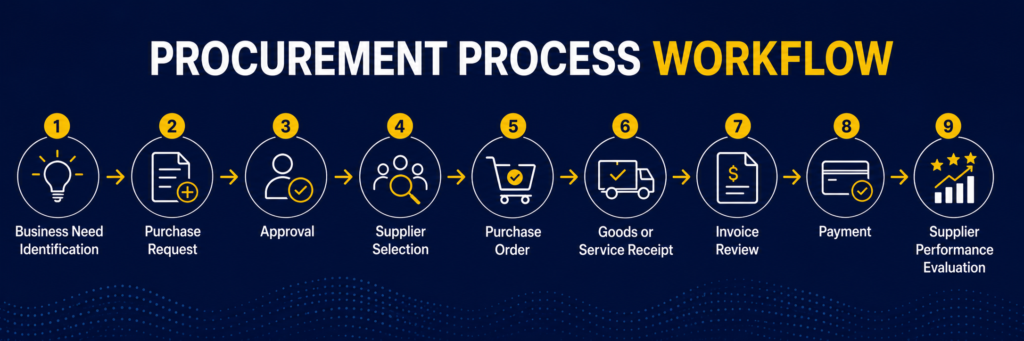
Business Need Identification → Purchase Request → Approval → Supplier Selection → Purchase Order → Goods or Service Receipt → Invoice Review → Payment → Supplier Performance Evaluation
Understanding this flow helps auditors identify where controls exist and where weaknesses may occur. For example, an auditor cannot properly evaluate supplier selection without understanding who requests purchases, who approves them, what criteria are used to select vendors, and how the final decision is documented. During this stage, auditors should review:
- Procurement policies and procedures.
- Approval authority limits.
- Supplier onboarding processes.
- Contract management procedures.
- Purchasing systems currently being used.
- Documentation requirements.
A clear understanding of the procurement lifecycle creates the foundation for a successful audit because it allows auditors to test whether actual practices match the organization’s intended processes.
2. Identify Procurement Risks and Control Weaknesses
The next step is identifying potential risks that could affect procurement efficiency, compliance, and financial performance. A strong procurement audit begins by asking:
What could go wrong during the purchasing process?
Common procurement risks include:
Unauthorized Purchases
Employees may bypass required approval processes by making purchases without proper authorization. This can result in unnecessary spending, policy violations, and reduced financial control.
Supplier Fraud
Organizations may face risks from fake vendors, duplicate suppliers, or suppliers created through conflicts of interest.
Inflated Pricing
Without proper supplier evaluation and competitive sourcing, businesses may pay higher prices than necessary.
Duplicate Payments
Weak invoice verification processes can lead to paying the same supplier invoice multiple times.
Goods or Services Not Received
Organizations may accidentally pay for products or services that were never delivered because receiving processes are poorly controlled.
Approval Process Bypass
Employees may split purchases into smaller amounts to avoid approval thresholds.
A procurement audit should not only identify risks but also evaluate whether existing controls are strong enough to prevent them.
Modern procurement management platforms like Fortva help reduce these risks by providing workflow automation, permission controls, document tracking, and audit history across procurement activities.
3. Review Purchase Requisition Processes
A purchase requisition is the starting point of most procurement activities. It represents the formal request for goods or services before a purchase is made.
During an audit, businesses should evaluate whether purchase requests are properly created, reviewed, and approved.Auditors should verify:
- The purchase request has a legitimate business justification.
- The request was submitted before the purchase occurred.
- The correct manager approved the request.
- Budget availability was confirmed.
- Procurement policies were followed.
A major warning sign is when employees create purchase requests after goods or services have already been purchased. This often indicates that procurement controls are being bypassed.
Organizations should also review whether purchase requests contain enough information for decision-making, including supplier details, estimated costs, required timelines, and supporting documentation.
With Fortva, businesses can organize procurement-related documents and create structured workflows that ensure requests move through the correct approval channels before commitments are made.
4. Audit Supplier Selection and Vendor Management
Supplier selection is one of the highest-risk areas within procurement because it directly impacts cost, quality, and business relationships.
A procurement audit should evaluate whether suppliers are selected through fair, transparent, and documented processes.Auditors should review:
- Supplier qualification procedures.
- Vendor due diligence records.
- Competitive quotations or bidding processes.
- Supplier approval documentation.
- Conflict-of-interest checks.
- Supplier contracts and agreements.
A common procurement red flag is when the same supplier repeatedly receives contracts without clear justification, especially when other suppliers could provide competitive alternatives.
Another warning sign is incomplete supplier documentation. Businesses should maintain records such as:
- Supplier agreements.
- Compliance certificates.
- Tax documents.
- Insurance information.
- Performance evaluations.
A centralized document management system helps procurement teams maintain complete supplier records instead of storing important information across emails and disconnected folders.
Fortva allows businesses to securely manage supplier contracts, compliance documents, and procurement records while controlling access and maintaining document history.
5. Review Purchase Orders and Contract Alignment
Purchase orders are important control documents because they formally define what a business is purchasing, from whom, and under what terms.
During an audit, organizations should verify that purchase orders match approved requests and supplier agreements.Auditors should check:
- Was an approved purchase order created?
- Do purchase order details match supplier contracts?
- Are prices accurate?
- Are quantities correct?
- Were approval requirements completed?
A common procurement problem occurs when purchase orders do not align with supplier contracts. For example, a business may approve one price in a contract but receive invoices based on different terms.
Connecting procurement documents with contract management processes helps eliminate these inconsistencies.
Fortva enables organizations to manage procurement contracts, related documents, approvals, and revisions in one secure environment, helping teams maintain better visibility throughout the contract lifecycle.
6. Verify Goods Receipt and Service Completion
A critical part of procurement auditing is confirming that purchased goods or services were actually received before payment was made. This process is commonly known as three-way matching: Purchase Order → Goods Receipt Record → Supplier Invoice
The purpose is to ensure:
- The ordered items were delivered.
- The quantity received matches the purchase order.
- The invoice matches the actual delivery.
- The organization only pays for approved purchases.
A major red flag is when payments are processed without evidence that goods or services were received.
For example, a company may approve a supplier invoice but have no documentation confirming delivery. This creates opportunities for payment errors and fraud.
Digital document management improves this process by keeping purchase orders, delivery records, invoices, and supplier documents connected and accessible.
7. Review Supplier Invoice Processing and Payments
The payment stage is where procurement activities become financial transactions, making strong controls essential.
During an audit, businesses should review whether supplier payments follow proper verification procedures.
Auditors should examine:
- Invoice approval processes.
- Payment authorization.
- Supplier banking information.
- Duplicate payment checks.
- Payment accuracy.
- Supporting documentation.
Common payment risks include:
- Duplicate invoices.
- Incorrect supplier bank details.
- Payments without approvals.
- Payments for incomplete deliveries.
According to research from the Association of Certified Fraud Examiners, weak internal controls remain one of the major factors that allow occupational fraud to occur, reinforcing the importance of strong review processes.
AI-powered document processing can improve invoice reviews by extracting information, identifying inconsistencies, and reducing manual verification work.
Fortva helps organizations manage procurement documents securely and create more controlled workflows around document review and approval.
8. Analyze Procurement Fraud Indicators
A procurement audit should actively search for warning signs that may indicate fraud, process weaknesses, or poor governance. Common procurement fraud indicators include:
Split Purchases
Employees divide one large purchase into smaller transactions to avoid approval limits.
Repeated Supplier Awards
The same supplier consistently receives contracts without competitive evaluation or documented justification.
Missing Quotations
Required supplier comparisons or bidding documentation are unavailable.
Frequent Emergency Purchases
Regular emergency purchasing may indicate poor planning or an attempt to bypass normal procedures.
Supplier and Employee Connections
Shared addresses, phone numbers, or personal relationships between employees and suppliers may indicate conflicts of interest.
Unusual Price Changes
Unexpected increases in supplier pricing may require additional review.
Identifying these indicators helps organizations strengthen controls and investigate potential issues before they create significant financial damage.
9. Trace One Procurement Transaction From Beginning to End
One of the most effective audit techniques is performing an end-to-end transaction walkthrough.
Instead of only reviewing individual documents, auditors select one procurement transaction and follow the complete journey:
Purchase Request → Approval → Supplier Selection → Contract → Purchase Order → Delivery → Invoice → Payment
This approach helps auditors identify whether processes work correctly in real situations. During the walkthrough, auditors can determine:
- Whether approvals occurred at the right time.
- Whether documentation is complete.
- Whether supplier selection followed policy.
- Whether payments matched approved purchases.
- Whether records are easy to locate.
This method often reveals problems that may not appear when reviewing documents separately. A centralized platform like Fortva makes transaction tracking easier by keeping procurement documents, approvals, contracts, and records connected in one secure system.
10. Evaluate Procurement Technology and Improvement Opportunities
The final step of a procurement audit is determining how the organization can improve its procurement processes. Many businesses discover that their biggest challenges are not policy-related but technology-related. Common improvement opportunities include:
- Replacing spreadsheet-based tracking.
- Automating approval workflows.
- Centralizing procurement documents.
- Improving supplier contract visibility.
- Creating searchable records.
- Reducing manual document reviews.
Organizations should evaluate whether their current systems support modern procurement requirements. AI-powered procurement technology enables businesses to move from reactive purchasing management to proactive procurement intelligence. Fortva helps organizations modernize procurement operations by combining:
- AI-powered document extraction.
- Secure cloud document management.
- Contract lifecycle management.
- Workflow automation.
- Version control.
- Permission management.
- Digital collaboration.
- DocuSign integration for electronic signatures.
What Separates Great Procurement Auditors?
Average auditors verify whether documents exist. Great procurement auditors evaluate whether the organization achieved value from its purchasing decisions. They ask deeper questions:
- Did the organization purchase the right goods or services?
- Was the supplier selection process fair and transparent?
- Did the business receive competitive pricing?
- Were contracts managed effectively?
- Did procurement decisions support business goals?
Procurement is not only about compliance. It is about obtaining the right products and services, from the right suppliers, at the right price, under the right terms, while maintaining proper controls.
Start Your Procurement Audit With Fortva
A successful procurement audit requires visibility, organization, and control over every stage of the purchasing lifecycle.
Fortva helps businesses create a smarter procurement environment by bringing documents, supplier contracts, approvals, workflows, and audit records together in one secure AI-powered platform.
Start your procurement management auditing with Fortva today to streamline your procurement process .


