What are Authorized Signatories on Contracts | Sign with Docusign
An authorized signatory is the person legally empowered to sign a contract on behalf of an individual, company, or organization—making the agreement valid and enforceable.
In modern business, knowing who has the authority to sign contracts is critical. A contract signed by the wrong person can delay deals, invalidate agreements, or even trigger legal disputes. Whether you’re negotiating vendor agreements, closing enterprise sales, or executing partnership contracts, understanding authorized signatories ensures contracts move from draft to execution without risk.
Key Takeaways
- Authorized signatories are individuals legally permitted to sign contracts on behalf of a business or organization.
- The authority usually comes from corporate governance documents, board resolutions, or delegated authority policies.
- Contracts signed by unauthorized individuals can be challenged, delayed, or invalidated.
- Businesses often maintain an authorized signatory list to avoid disputes and compliance risks.
- Modern contract lifecycle management (CLM) systems help verify signing authority and maintain an audit trail.
- Clear signatory governance improves contract execution speed, legal compliance, and operational efficiency.
What Is an Authorized Signatory?
An authorized signatory is a person who has legal authority to sign contracts, agreements, and official documents on behalf of a company, organization, or institution.
When an authorized signatory signs a contract, they are not signing in a personal capacity. Instead, they are binding the organization they represent to the obligations within that agreement.
For example, common authorized signatories in organizations include:
- Company directors
- Chief executives
- Legal officers
- Finance leaders
- Delegated department heads
The specific authority to sign contracts is usually granted through corporate bylaws, internal approval policies, board resolutions, or powers of delegation.
Without this authority, a signed contract could be legally challenged because the person signing did not have the right to bind the organization.
Why Authorized Signatories Matter in Contracting
In corporate contracting, identifying the correct signatory is not just administrative—it is a legal safeguard. Organizations regularly execute thousands of agreements, including:
- vendor contracts
- employment agreements
- service agreements
- partnership contracts
- procurement agreements
If an agreement is signed by someone without proper authority, the contract may be considered unenforceable. Research from the International Association for Contract & Commercial Management (IACCM)—now known as World Commerce & Contracting—found that poor contract governance and approval processes can reduce contract value by up to 9.2% annually due to disputes, delays, and compliance failures. Authorized signatories reduce these risks by ensuring:
- proper corporate authorization
- clear accountability
- legally binding agreements
- compliance with corporate governance rules
This is why many companies maintain strict signatory approval frameworks before any contract is executed.
The 3 Types of Signatories in Contracts
In business agreements, signatories generally fall into three categories depending on their legal authority.
- Individual Signatory
An individual signatory signs a contract on their own behalf rather than representing a company. For example:
- freelancers signing service agreements
- consultants signing independent contractor agreements
- individuals signing lease agreements
In these cases, the person signing is personally responsible for the obligations within the contract.
- Corporate Authorized Signatory
This is the most common type in business contracts.
A corporate authorized signatory signs on behalf of a company or organization, typically due to their executive position or delegated authority. Examples include:
- CEO signing a partnership agreement
- CFO signing a financial services contract
- procurement director signing supplier agreements
Their signature legally binds the organization to the contract.
- Delegated Signatory
Organizations often grant delegated authority to employees who are not executives but still need to execute contracts. For instance:
- procurement managers signing vendor agreements
- HR leaders signing employment contracts
- project managers signing service orders
Delegated signatories are typically approved through internal authorization policies or board-approved signing limits.
What Are Signee vs. Signer vs. Signatory?
These three terms are often used interchangeably, but they have slightly different meanings in legal and business contexts.
| Term | Meaning | Usage Context |
| Signee | The person who receives or is addressed in the agreement | Less common in contracts |
| Signer | Any person who signs a document | Informal usage |
| Signatory | A legally recognized party signing an agreement | Legal and corporate contracts |
In most legal and corporate environments, “signatory” is the preferred term because it reflects formal legal participation in the contract.
Authorized Signatory vs Power of Attorney (POA)
Businesses sometimes confuse authorized signatories with individuals holding power of attorney, but they are not the same.
| Feature | Authorized Signatory | Power of Attorney |
| Authority source | Corporate governance | Legal authorization document |
| Scope | Specific contracts or business activities | Broad legal authority |
| Duration | Often tied to role or employment | Defined by the POA document |
| Typical use | Corporate contracts | Personal or legal representation |
A power of attorney grants legal authority to act on behalf of another person, while authorized signatories typically act on behalf of a company or institution.
Authorized Signatory vs Legal Representative
Another common confusion is between a signatory and a legal representative.
| Role | Authorized Signatory | Legal Representative |
| Main responsibility | Signing contracts | Representing the organization legally |
| Authority type | Operational authority | Legal authority |
| Examples | CEO, finance director | lawyer, attorney |
A legal representative may negotiate or advise on contracts, but the authorized signatory is the person who formally executes the agreement.
Individual vs Corporate Signatory
Understanding the difference between these two roles is essential when drafting or reviewing contracts.
| Type | Individual Signatory | Corporate Signatory |
| Who they represent | Themselves | An organization |
| Liability | Personal liability | Organizational liability |
| Examples | Freelancer, tenant | CEO, director, officer |
Corporate signatories must clearly indicate their title and organization when signing contracts. For example:
John Smith
Chief Financial Officer
ABC Corporation
This ensures the contract binds the organization rather than the individual personally.
How to Verify Authorized Signatories in Contracts
Before executing a contract, organizations should confirm that the individual signing has the authority to do so. Common verification methods include reviewing:
Corporate governance documents
Companies usually outline signing authority within:
- corporate bylaws
- articles of incorporation
- board resolutions
These documents define who can legally bind the organization.
Internal delegation policies
Many companies establish approval matrices specifying signing limits based on seniority or department. For example:
- procurement manager may sign contracts up to $50,000
- CFO may sign contracts up to $500,000
- CEO may sign unlimited contracts
Authorized signatory lists
Organizations often maintain a central register of approved signatories that includes:
- employee names
- job titles
- signing authority levels
- contract types they can execute
Maintaining this list prevents unauthorized signing.
Authorized Signatory Clause Example
Many contracts include an authorized signatory clause to confirm that the individual signing has legal authority. Example clause:
“Each party represents and warrants that the person signing this agreement on its behalf has full authority to bind the party to the terms of this contract.”
This clause protects both parties by confirming that the agreement has been executed by properly authorized representatives.
Authorized Signatory List Template
Organizations often maintain a structured signatory register for compliance and governance. Typical fields include:
| Name | Position | Department | Signing Authority Limit |
| Sarah Kim | CFO | Finance | Unlimited |
| David Chen | Procurement Manager | Procurement | $100,000 |
| Laura Smith | HR Director | HR | Employment contracts |
Maintaining such a register improves transparency and reduces contract execution risks.
Managing Authorized Signatories with Contract Lifecycle Management (CLM)
As businesses scale, managing signatory authority manually becomes difficult. Companies executing hundreds or thousands of contracts need a centralized system to control:
- contract approvals
- authorized signatories
- audit trails
- document security
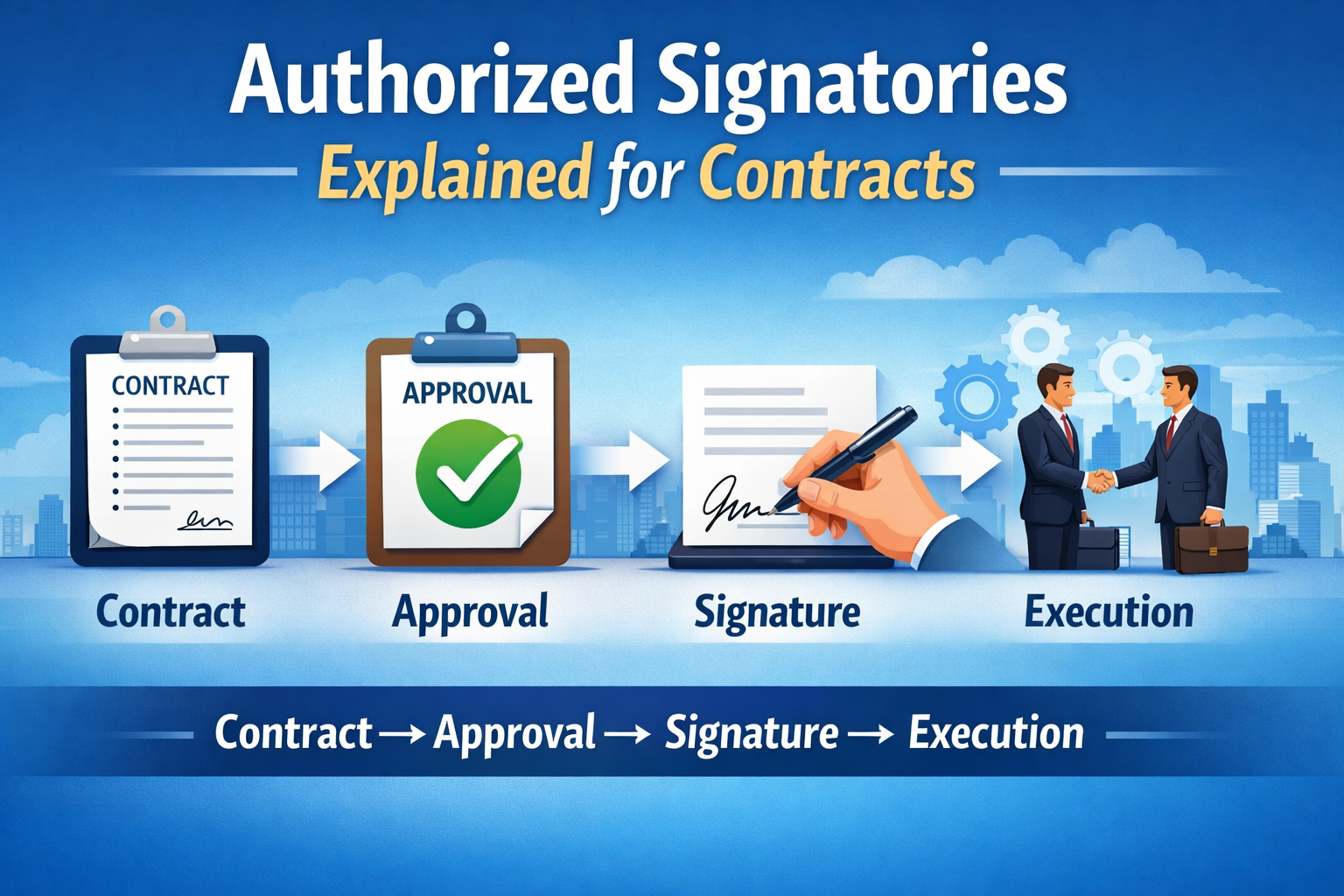
This is where contract lifecycle management (CLM) technology becomes essential. Modern CLM platforms automate the entire contract workflow—from drafting and approvals to signature and storage.
How CLM Software Helps Control Signatory Authority
A CLM system ensures only authorized individuals can execute contracts. Key capabilities include:
Automated approval workflows
Contracts automatically route to the correct approvers before signature.
Signatory verification
Only approved signatories can execute contracts within their authority limits.
Audit trails
Every contract signature and approval is logged, ensuring regulatory compliance.
Integrated e-signatures
Platforms integrate with tools like DocuSign to enable legally binding electronic signatures.
According to research from Deloitte, organizations that implement automated contract workflows can reduce contract cycle times by up to 30–50% while improving compliance and reducing risk.

Best Practices for Managing Authorized Signatories
Organizations should implement clear governance around contract signing authority.
Maintain a central signatory register
A centralized list ensures employees know who is authorized to sign specific contracts.
Implement approval workflows
Contracts should pass through legal, finance, or procurement approvals before signature.
Use secure digital signatures
Digital signature solutions improve auditability and reduce execution delays.
Audit signatory authority regularly
Organizations should review signatory lists periodically to reflect role changes and organizational restructuring.
The Role of Document Management in Signatory Governance
Beyond contract management, organizations must also store signed agreements securely. Enterprise document management systems (DMS) help organizations:
- centralize contract storage
- control document access permissions
- track version history
- protect sensitive information
According to Gartner, organizations that digitize document workflows improve operational productivity by 20–30% due to faster information retrieval and reduced manual processing.
Final Thoughts
Authorized signatories play a critical role in ensuring contracts are legally binding, compliant, and executed efficiently. Without proper governance around signing authority, organizations expose themselves to unnecessary legal and operational risks.
For growing companies managing high volumes of agreements, relying on manual processes or scattered documents is no longer sustainable.
Looking for CLM that meets all of your requirements for your legal team? Switching to Fortva platform—a single source of truth—is the right decision you will ever make. Fortva helps organizations manage contracts from creation to execution with:
- centralized contract storage
- automated approval workflows
- secure e-signatures
- role-based permissions
- AI-powered document insights
- enterprise-grade security
Ready to close contracts faster?
Fortva is one of the world’s easiest-to-use contract lifecycle management platforms for legal teams and enterprises looking to streamline document workflows, accelerate approvals, and execute agreements with confidence.
Frequently Asked Questions About Authorized Signatories
What is an authorized signatory in a contract?
An authorized signatory is a person who has the legal authority to sign contracts and official documents on behalf of a company or organization. When this person signs an agreement, they legally bind the organization to the contract terms. This authority usually comes from internal corporate governance such as:
- board resolutions
- company bylaws
- delegation of authority policies
Without proper authorization, a signed contract may be challenged because the individual did not have the legal power to bind the organization.
Who can be an authorized signatory in a company?
The individuals who can act as authorized signatories typically depend on a company’s governance structure and approval policies. Common examples include:
- Chief Executive Officer (CEO)
- Chief Financial Officer (CFO)
- company directors
- legal counsel or general counsel
- procurement or finance managers with delegated authority
Many organizations maintain an authorized signatory register to clearly identify which employees can sign specific contracts.
What happens if a contract is signed by someone who is not authorized?
If a contract is signed by someone without proper authority, the agreement may become unenforceable or legally disputed.
Possible consequences include:
- contract delays or renegotiation
- legal disputes between parties
- financial or compliance risks
In some cases, the organization may still accept the agreement through a process called ratification, where the company formally approves the contract after it has already been signed.
What is the difference between a signatory and a signer?
The terms are often used interchangeably, but they have slightly different meanings. A signer refers to anyone who signs a document, while a signatory typically refers to a recognized party in a formal agreement who signs with legal authority.
In business contracts, the term signatory is more commonly used because it reflects the legal role of the person executing the agreement.
How do companies verify authorized signatories?
Organizations verify signing authority through internal documentation and governance policies. This process usually involves reviewing:
- corporate bylaws or articles of incorporation
- board resolutions granting signing authority
- internal delegation-of-authority policies
- authorized signatory lists maintained by legal or finance teams
Many organizations now manage this process using contract lifecycle management systems to automate approvals and prevent unauthorized signatures.
What is an authorized signatory clause in a contract?
An authorized signatory clause confirms that the person signing the contract has the legal authority to bind the organization they represent.
A typical clause might state:
“Each party confirms that the individual signing this agreement has the full authority to enter into and bind the organization to the terms of this contract.”
This clause protects both parties by ensuring that the agreement has been executed by properly authorized representatives.
Can authorized signatories use electronic signatures?
Yes. In most jurisdictions, authorized signatories can legally execute contracts using electronic signatures, provided the platform complies with relevant digital signature regulations.
Electronic signature platforms such as DocuSign allow organizations to securely sign agreements while maintaining a verifiable audit trail.
Many organizations integrate e-signature tools within contract lifecycle management systems to streamline contract approvals and execution.
How do companies manage authorized signatories at scale?
As organizations grow, managing signatory authority manually becomes difficult. Businesses often adopt contract lifecycle management platforms such as Fortva to centralize contract governance. These platforms help organizations:
- maintain authorized signatory lists
- automate contract approval workflows
- enforce signing authority rules
- track document versions and approvals
- securely store executed contracts