Contract Optimization: How To Use the 80% Template Rule to Standardize Contract Templates for Growth
Contracting is where revenue is won, risk is managed, and relationships are formalized and contract optimization is the process of improving how contracts are created, negotiated, and managed to maximize efficiency, reduce risk, and protect revenue.
Yet in most organizations—especially across procurement, financial services, legal, and revenue teams—contracts remain one of the least standardized, most fragmented business processes. The result is predictable: slow deal cycles, inconsistent risk allocation, compliance gaps, and millions lost in revenue leakage.
The 80% template rule offers a practical, proven way to fix this. But most organizations misunderstand it. They either over-standardize and lose flexibility, or they under-standardize and create chaos disguised as customization.
This guide goes deeper than surface-level explanations. It combines legal strategy, operational execution, and data-backed insights to show how to use the 80% rule to build scalable, high-performing contract systems—while aligning legal, procurement, and revenue teams.
Key Takeaways
- Platforms like Fortva enable procurement to turn contracts into a strategic growth driver.
- The 80% rule standardizes most procurement contracts, reducing friction while preserving flexibility where it matters.
- Poor contract management can erode up to 9–11% of value—standardization directly protects margins.
- Pre-approved templates accelerate deal cycles, turning weeks of negotiation into days.
- Centralization ensures consistency—without a single source of truth, templates fail.
- Automation transforms templates into a scalable system with tracked obligations and zero missed deadlines.
What Is the 80% Contract Template Rule? (Featured Snippet Definition)
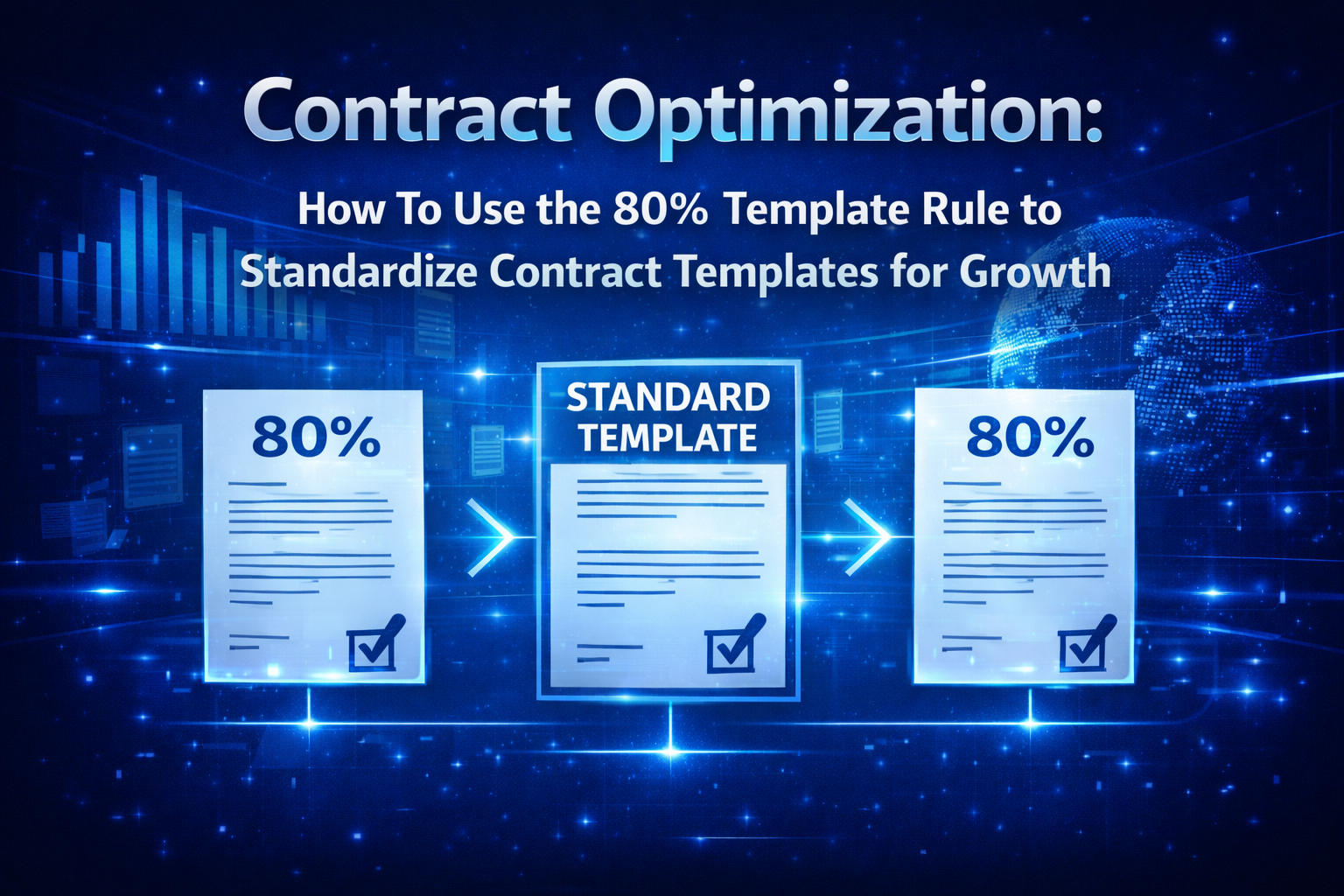
The 80% contract template rule is a contract optimization strategy where approximately 80% of contracts are standardized using pre-approved templates, while the remaining 20% is flexible to accommodate negotiation, unique terms, or business-specific requirements.
This principle is rooted in operational efficiency: most contracts within an organization are structurally similar, even across different departments. By standardizing the majority, organizations reduce friction without sacrificing adaptability.
Why Contract Standardization Matters More Than Ever
Modern organizations are under increasing pressure to move faster without increasing risk. Procurement teams need to onboard vendors quickly, financial services firms must comply with strict regulatory requirements, and sales teams are expected to close deals faster than ever. However, contract processes are often the bottleneck.
Research from World Commerce & Contracting (formerly IACCM) consistently shows that poor contract management costs organizations an average of 9.2% of annual revenue due to inefficiencies, missed obligations, and disputes. McKinsey has also highlighted that companies implementing structured contract lifecycle management can reduce contract cycle times by 20% to 50%.
These are not marginal gains. They represent a direct impact on revenue, risk exposure, and operational efficiency. The problem is not the contracts themselves—it is the lack of structure behind them.
The Hidden Cost of “Everything Is Custom”
Many organizations believe customization equals better outcomes. In reality, excessive customization leads to inconsistency, delays, and legal risk.
When every contract is treated as a one-off document, several issues emerge. Legal teams become overwhelmed with repetitive reviews. Procurement struggles to enforce consistent terms across vendors. Sales teams face delays that directly impact revenue recognition. Compliance teams lose visibility into obligations. The result is fragmentation.
Instead of a controlled system, contracts become scattered documents stored across inboxes, shared drives, and disconnected systems. This makes it nearly impossible to track deadlines, enforce obligations, or analyze performance. The 80% rule is designed to eliminate this fragmentation without eliminating flexibility.
Understanding the 80/20 Balance in Practice
The concept is simple, but execution requires precision. The 80% standardized portion of a contract typically includes core legal and commercial elements that should not change frequently. These include governing law, limitation of liability frameworks, payment structures, data protection clauses, and standard obligations.
The 20% flexible portion allows for negotiation and customization. This includes pricing adjustments, service-level agreements, specific deliverables, or unique regulatory considerations—particularly important in financial services and procurement-heavy environments.
The key insight is this: not all parts of a contract carry equal risk or strategic importance. Standardizing high-frequency, low-variance elements creates efficiency, while allowing flexibility where it truly matters preserves business agility.
Why Most Organizations Fail at Implementing the 80% Rule
Despite its simplicity, many organizations fail to implement the 80% rule effectively. The failure is rarely due to lack of intent—it is due to poor execution.
One common mistake is over-standardization. Legal teams sometimes attempt to lock down 95% or more of contract content. This creates rigidity, frustrates business teams, and leads to workarounds outside approved systems.
Another issue is lack of governance. Templates are created once and then forgotten. Over time, they become outdated, inconsistent with current regulations, or misaligned with business strategy.
There is also a technology gap. Without a centralized system, even the best templates fail to scale. Teams continue to download old versions, modify them locally, and reintroduce inconsistency.
Finally, there is a cultural challenge. If legal, procurement, and sales teams are not aligned, templates are often bypassed entirely. The 80% rule is not just a legal framework—it is an organizational discipline.
The Business Impact of Getting It Right
When implemented correctly, the 80% template rule transforms contract management from a bottleneck into a growth enabler.
Organizations that standardize contracts effectively see faster deal cycles, because fewer contracts require full legal review. Procurement teams gain leverage through consistent vendor terms. Compliance improves because obligations are clearly defined and trackable. Revenue leakage decreases because key clauses are consistently enforced.
Cycle times drop significantly. Instead of weeks, contracts can move in days—or even hours for low-risk agreements.
More importantly, data becomes usable. When contracts are standardized, organizations can extract insights across their entire portfolio. This enables better forecasting, risk assessment, and strategic decision-making.
Template vs Non-Template Contracts: A Practical Comparison
| Factor | Standardized Templates | Fully Custom Contracts |
|---|---|---|
| Speed | Fast, repeatable workflows | Slow, manual processes |
| Risk | Controlled and pre-approved | Inconsistent and unpredictable |
| Compliance | Easier to enforce | Difficult to monitor |
| Collaboration | Structured and aligned | Fragmented across teams |
| Scalability | High | Limited |
How to Implement the 80% Template Rule (Step-by-Step Framework)
Step 1: Audit Your Existing Contracts
The first step is to understand your current state. Most organizations are surprised by how many variations of similar contracts exist across departments.
A thorough audit reveals patterns. You will find that a significant portion of contracts share the same structure, even if they appear different on the surface. This is where the 80% opportunity lies.
This step also helps identify high-risk clauses, inconsistencies, and areas where standardization will have the greatest impact.
Step 2: Identify the Core 80%
Once patterns are identified, the next step is to define the standardized core.
This involves collaboration between legal, procurement, and business teams. Legal ensures compliance and risk control. Procurement ensures vendor alignment. Business teams ensure usability and practicality.
The goal is to create templates that are both legally sound and operationally efficient.
This is particularly critical in financial services, where regulatory compliance must be embedded into the template structure itself.
Step 3: Define the Flexible 20%
Flexibility is not the absence of rules—it is controlled variation. Organizations should define clear guidelines for what can be modified, by whom, and under what conditions. This prevents unnecessary escalation to legal while maintaining control over risk.
For example, pricing adjustments may be allowed within predefined thresholds, while changes to liability clauses may require legal approval. This structured flexibility is what makes the 80% rule sustainable.
Step 4: Centralize Templates and Enforce Version Control
Templates must live in a single source of truth. Without centralization, standardization breaks down.
Version control is critical. Teams must always access the latest approved templates, with clear audit trails of changes.
This is where modern contract lifecycle management platforms play a crucial role. They ensure that templates are not just created, but consistently used.
Step 5: Automate Workflows and Approvals
Standardization alone is not enough. To fully realize the benefits, workflows must be automated.
Automated approvals ensure that low-risk contracts move quickly, while high-risk deviations are flagged for review. Notifications and reminders prevent missed deadlines and obligations. This reduces manual effort and ensures consistency across the organization.
Step 6: Continuously Optimize Templates
The 80% rule is not static. As business needs evolve, templates must be updated. Data plays a key role here. By analyzing contract performance, organizations can identify which clauses cause delays, which terms are frequently negotiated, and where improvements can be made. Continuous optimization ensures that templates remain aligned with business goals.
The Role of Technology in Scaling the 80% Rule
Manual processes cannot sustain contract standardization at scale. Modern organizations require systems that integrate document management, contract lifecycle management, and workflow automation into a single platform. This enables teams to create, manage, and analyze contracts efficiently.
A platform like Fortva is designed to support this transformation. By combining document management with contract lifecycle capabilities, it allows organizations to centralize templates, automate workflows, and maintain full visibility across their contract portfolio.
Features such as AI-powered data extraction, intelligent OCR, and automated reminders ensure that contracts are not just stored—but actively managed. Integration with tools like Microsoft Word, CRM platforms, and e-signature solutions ensures that contracts are seamlessly embedded into the broader business workflow. This is how the 80% rule moves from theory to execution.
Contract Optimization in Financial Services and Procurement
In financial services, the stakes are particularly high. Regulatory requirements demand consistency, auditability, and transparency.
Standardized templates ensure that compliance requirements are embedded into every contract. This reduces the risk of regulatory breaches and simplifies audits.
Procurement teams benefit from improved vendor management. Standardized terms create consistency across supplier relationships, making it easier to enforce obligations and negotiate effectively.
In both cases, the 80% rule provides a structured approach to balancing efficiency and control.
How the 80% Rule Reduces Revenue Leakage
Revenue leakage often occurs due to poorly managed contracts—missed renewals, incorrect pricing terms, or unenforced obligations.
By standardizing contracts, organizations ensure that key commercial terms are consistently applied. Automated reminders prevent missed deadlines, while centralized visibility ensures that obligations are tracked and enforced. This directly impacts the bottom line.
Studies indicate that organizations can recover significant lost revenue simply by improving contract visibility and enforcement. The 80% rule is a foundational step in achieving this.
Common Pitfalls to Avoid
While the benefits are clear, implementation requires careful execution. One major pitfall is treating templates as static documents. Without regular updates, templates quickly become outdated.
Another issue is lack of adoption. If templates are difficult to use, teams will bypass them. Usability is as important as legal accuracy.
Finally, organizations must avoid siloed implementation. Contract optimization requires alignment across legal, procurement, sales, and operations. Without this alignment, even the best templates will fail to deliver results.
The Future of Contract Management
The future of contract management is data-driven, automated, and integrated. Organizations are moving beyond static documents toward dynamic systems that provide real-time insights and predictive analytics. AI is playing an increasing role in identifying risks, suggesting optimizations, and automating routine tasks.
The 80% template rule is a foundational element of this future. It creates the structure needed to leverage advanced technologies and scale contract operations effectively. Procurement Teams Standardize Contract Templates: The 80% Rule for Scalable, Risk-Resilient Growth
Procurement has quietly become one of the most strategic functions in modern enterprises. It is no longer just about negotiating lower prices or managing suppliers. Today, procurement teams are responsible for protecting margins, ensuring compliance, enabling operational continuity, and driving long-term value across the organization.
Yet despite this elevated role, one of procurement’s most critical tools—contracts—remains deeply fragmented in many organizations.
Contracts are still created from scratch, modified inconsistently, stored across disconnected systems, and negotiated without structured guardrails. The consequences are not theoretical. They are measurable, material, and often severe. Organizations lose 8–9% of annual revenue due to poor contract management, with procurement contracts alone leaking up to 11% of value when not properly governed.
This is where procurement teams must evolve. The shift is clear: from reactive contracting to standardized, scalable contract systems built on the 80% template rule.
This guide goes beyond surface-level explanations and competitor content. It provides a deeply structured, data-backed framework for procurement leaders to standardize contract templates globally—without sacrificing flexibility, compliance, or commercial leverage.
Why Procurement Teams Must Standardize Contract Templates
Procurement operates at scale. Large enterprises manage thousands—sometimes tens of thousands—of supplier agreements annually. Each contract defines pricing, obligations, service levels, and risk allocation. Collectively, these agreements govern a significant portion of enterprise spending.
According to McKinsey & Company, in many industries, up to 90% of company spending is governed by contracts, yet procurement functions often lack structured visibility into contract terms and performance.
This mismatch creates a systemic problem. Contracts are treated as static documents rather than dynamic commercial instruments.
When templates are not standardized, procurement teams face several recurring issues. Negotiations become slower because every contract starts from a different baseline. Risk increases because clauses vary across agreements. Compliance weakens because obligations are harder to track. Most importantly, negotiated savings often fail to materialize because contract terms are not consistently enforced.
Research shows that up to 80% of procurement teams are not fully aware of competitive contract structures, which leads to inconsistent and suboptimal agreements. Standardization is not about simplifying contracts. It is about creating a repeatable system for value capture.
The 80% Rule: A Procurement-Centric Interpretation
The 80% template rule is often explained in legal terms, but procurement teams must interpret it through a commercial lens.
At its core, the principle is simple. Approximately 80% of procurement contracts share common structures, risks, and commercial terms. These should be standardized into pre-approved templates. The remaining 20% should allow controlled flexibility for supplier-specific negotiations or strategic exceptions. The key is understanding that not all contract elements are equally important.
Core procurement clauses—such as pricing mechanisms, payment terms, delivery obligations, service-level agreements, liability structures, and termination rights—should be standardized because they are repeated across supplier relationships.
Customization should be reserved for areas where differentiation creates value. This may include supplier-specific performance incentives, regulatory requirements in financial services, or complex outsourcing arrangements. The insight is powerful: standardization reduces friction, while controlled flexibility preserves leverage.
The Real Cost of Non-Standardized Procurement Contracts
The cost of not standardizing templates is often hidden until it compounds into measurable financial loss. One of the most significant impacts is value leakage. Studies consistently show that organizations lose around 9% of contract value due to poor management, with some cases reaching up to 40% erosion over the contract lifecycle. In procurement specifically, leakage occurs in predictable ways.
Missed renewals result in contracts auto-renewing on unfavorable terms. Inconsistent pricing clauses lead to overpayments or missed discounts. Weak enforcement of service-level agreements results in unclaimed penalties or service credits. Poor visibility into obligations leads to non-compliance with negotiated terms. These issues are not isolated. They are systemic.
According to World Commerce & Contracting, procurement organizations lose an average of 11% of contract value due to gaps in contract lifecycle management. This is not just inefficiency—it is a direct erosion of enterprise value.
Why Traditional Procurement Contracting Fails
Traditional procurement contracting models are built for control, not scale. Templates exist, but they are often outdated, inconsistently used, or stored in multiple locations. Procurement teams rely on manual processes, email chains, and decentralized document storage. Legal teams become bottlenecks because every deviation requires review. The result is a system that cannot keep up with modern business demands.
Even more concerning, only 11% of organizations consider their contract management processes highly effective, highlighting a widespread lack of maturity in this area. The problem is not a lack of templates. It is a lack of standardization discipline and systemization.
Template Standardization as a Strategic Procurement Lever
When procurement teams standardize contract templates effectively, the impact extends far beyond legal efficiency.
First, negotiation speed improves significantly. Starting from a pre-approved template reduces back-and-forth and accelerates supplier onboarding. This is critical in industries where speed to execution directly impacts operations.
Second, risk becomes controlled and predictable. Standardized clauses ensure that liability, compliance, and regulatory requirements are consistently applied across all supplier relationships.
Third, procurement gains leverage. When suppliers are presented with standardized terms, negotiations become more structured, and deviations can be evaluated systematically rather than ad hoc.
Finally, data becomes usable. Standardized contracts enable organizations to analyze supplier performance, track obligations, and identify optimization opportunities across the entire contract portfolio. This is where procurement transitions from a cost center to a value optimization function.
Procurement vs Legal: Aligning on Template Ownership
One of the most overlooked challenges in contract standardization is ownership. Procurement often assumes legal owns templates. Legal assumes procurement should enforce them. The result is fragmentation. Effective organizations solve this by creating a shared governance model.
Legal defines the risk framework and approves standardized clauses. Procurement operationalizes templates, ensuring they are used consistently across supplier engagements. Business teams provide input on usability and commercial practicality. This alignment is critical. Without it, templates become theoretical documents rather than operational tools.
A Practical Framework for Procurement Template Standardization
Step 1: Map Your Procurement Contract Landscape
The first step is visibility. Procurement teams must understand the types, volumes, and variations of contracts they manage.
This includes supplier agreements, master service agreements, purchase agreements, and vendor-specific contracts. Patterns quickly emerge. Most contracts share common structures, even if they appear different on the surface. This is where the 80% opportunity becomes visible.
Step 2: Define the Standardized Core
The next step is to define the standardized portion of procurement contracts.
This includes clauses that should remain consistent across all supplier relationships. These typically cover pricing structures, payment terms, liability frameworks, compliance requirements, and termination rights.
Standardization at this level ensures that procurement operates within a controlled risk and commercial framework.
Step 3: Establish Controlled Flexibility
Flexibility must be intentional.
Procurement teams should define clear rules for deviations. This includes identifying which clauses can be modified, under what conditions, and who has approval authority.
For example, pricing adjustments may be allowed within predefined thresholds, while changes to liability clauses may require legal approval.
This structured flexibility prevents unnecessary escalation while maintaining control.
Step 4: Centralize Templates and Enforce Usage
Templates must be accessible, up-to-date, and consistently used. Without a centralized system, standardization fails. Teams revert to old versions, modify contracts locally, and reintroduce inconsistency. Centralization ensures that every contract starts from the same baseline.
Step 5: Automate Procurement Contract Workflows
Standardization alone is not enough. Procurement must move toward automation. Automated workflows ensure that contracts follow predefined approval paths. Low-risk agreements can be executed, while high-risk deviations are flagged for review. Automation also ensures that obligations, renewals, and deadlines are tracked systematically.
Step 6: Continuously Optimize Based on Data
Contract standardization is not a one-time initiative.Procurement teams must continuously analyze contract data to identify inefficiencies, negotiation bottlenecks, and recurring deviations. This enables continuous improvement, ensuring that templates remain aligned with business goals.
The Role of Technology in Procurement Contract Standardization
Manual processes cannot sustain standardized contracting at scale. Procurement teams need integrated systems that combine document management, contract lifecycle management, and workflow automation.
A platform like Fortva enables procurement teams to operationalize the 80% rule effectively. By centralizing templates, automating workflows, and integrating with tools like CRM systems and e-signature platforms, it ensures that contracts are not just created—but actively managed throughout their lifecycle.
AI-powered data extraction and intelligent OCR further enhance visibility, allowing procurement teams to track obligations, monitor performance, and identify risks in real time. This is the difference between having templates and having a scalable contracting system.
Procurement in Financial Services: Why Standardization Is Non-Negotiable
In financial services, procurement operates under heightened regulatory scrutiny. Contracts must comply with strict requirements related to data protection, outsourcing, third-party risk, and operational resilience. Any inconsistency can lead to compliance failures and significant penalties.
Standardized templates ensure that regulatory requirements are embedded into every contract. This reduces risk and simplifies audits.
Moreover, financial institutions manage complex supplier ecosystems. Standardization ensures consistency across these relationships, enabling better governance and oversight.
How Standardized Templates Reduce Procurement Value Leakage
Procurement value leakage is often misunderstood. It is not just about pricing errors—it is about the gap between negotiated value and realized value.
This gap is driven by missed obligations, untracked performance metrics, inconsistent terms, and lack of enforcement. Standardized templates address these issues at their root.
By ensuring that key commercial terms are consistently applied, procurement teams can enforce pricing, track performance, and claim entitlements effectively.
Automation further enhances this by ensuring that deadlines, renewals, and obligations are never missed.The result is a direct improvement in financial performance.
Common Mistakes Procurement Teams Must Avoid
While the benefits of standardization are clear, execution requires discipline. One common mistake is over-standardization. Templates that are too rigid create friction and reduce adoption. Procurement teams must balance consistency with usability.
Another issue is lack of governance. Templates must be regularly updated to reflect regulatory changes, market conditions, and business strategy.
Finally, organizations must avoid siloed implementation. Procurement, legal, and business teams must work together to ensure alignment. Without this, standardization efforts will fail to scale.
Conclusion
Contracts should not slow your business down. They should enable it. The 80% template rule provides a practical, scalable approach to contract optimization. By standardizing the majority of contract content while allowing controlled flexibility, organizations can reduce risk, accelerate processes, and unlock valuable insights.
However, success requires more than templates. It requires the right combination of strategy, governance, and technology.
When implemented correctly, the 80% rule transforms contract management from a reactive function into a strategic advantage.
Automatic Deadline Management with Fortva
Never miss important notice periods again. Avoid expensive contract extensions and missed deadlines by bringing your contracts into a centralized, automated system powered by Fortva.
Create automatic reminders and recurring tasks with just a few clicks. Reduce errors, eliminate unnecessary stress, and make your contract management seamless.
Start a free trial or book a demo today—and take control of your contracts before they control your business.
Frequently Asked Questions (FAQ)
What does it mean for procurement teams to standardize contract templates?
Standardizing contract templates means creating pre-approved, consistent contract structures that procurement teams use across supplier agreements. Instead of drafting contracts from scratch, teams start from a controlled template, ensuring consistency in pricing, risk allocation, compliance, and key terms while still allowing limited customization where necessary.
What is contract optimization and why does it matter?
Contract optimization is the process of improving how contracts are created, negotiated, and managed to maximize efficiency, reduce risk, and protect revenue. It matters because poorly managed contracts can lead to delays, compliance issues, and significant revenue leakage, while optimized contracts accelerate business performance.
What is the 80% rule in procurement contract management?
The 80% rule means that around 80% of contract content is standardized using approved templates, while 20% remains flexible for negotiation or supplier-specific requirements. This approach balances efficiency and control, allowing procurement teams to move faster without increasing risk.
How does contract template standardization reduce costs?
Standardization reduces costs by minimizing negotiation time, preventing value leakage, and ensuring that favorable terms are consistently applied. It also reduces legal review workload and avoids costly errors such as missed renewals, incorrect pricing, or unenforced service-level agreements.
Why do procurement teams struggle with contract standardization?
Most procurement teams struggle due to fragmented systems, lack of centralized templates, and poor alignment with legal teams. In many cases, templates exist but are outdated or inconsistently used, leading to continued reliance on manual processes and contract variations.
Can standardized templates still allow negotiation with suppliers?
Yes, effective standardization includes controlled flexibility. Procurement teams define which sections can be negotiated and within what limits. This ensures suppliers can propose changes where necessary, while critical clauses such as liability or compliance remain protected.
How does standardization improve supplier management?
Standardized contracts create consistency across supplier relationships, making it easier to enforce obligations, track performance, and compare vendors. This improves visibility and strengthens procurement’s ability to manage risk and drive value.
What role does technology play in contract template standardization?
Technology enables procurement teams to centralize templates, automate workflows, and track contract performance. Platforms like Fortva ensure that teams always use the latest templates, manage approvals efficiently, and never miss key deadlines or obligations.
How often should procurement contract templates be updated?
Templates should be reviewed regularly—typically quarterly or biannually—and updated whenever there are regulatory changes, market shifts, or recurring negotiation patterns. Continuous optimization ensures templates remain relevant and effective.
Is contract standardization important for regulated industries like financial services?
Yes, it is critical. In regulated industries, standardized templates ensure compliance requirements are embedded into every contract, reducing the risk of regulatory breaches and simplifying audits.
What is the biggest benefit of standardizing procurement contracts?
The biggest benefit is turning contracts into a scalable system. Instead of slowing down procurement, standardized templates enable faster execution, better risk control, and improved value capture—making procurement a true driver of business growth.