

Contract Management Software Key Market Insight: A Buyer’s Guide For Business Growth
The systems managing your contracts are either accelerating revenue — or quietly slowing your business down.
Contracts are no longer static documents sitting in shared drives or email threads. They are dynamic business assets that influence revenue velocity, compliance, risk exposure, and customer experience. Yet, across industries—from financial services and healthcare to construction, logistics, and legal teams—most organizations still rely on fragmented tools that were never designed to manage the full contract lifecycle.
This is where Contract Lifecycle Management (CLM) software and Document Management Systems (DMS) converge—and where the market is evolving rapidly.
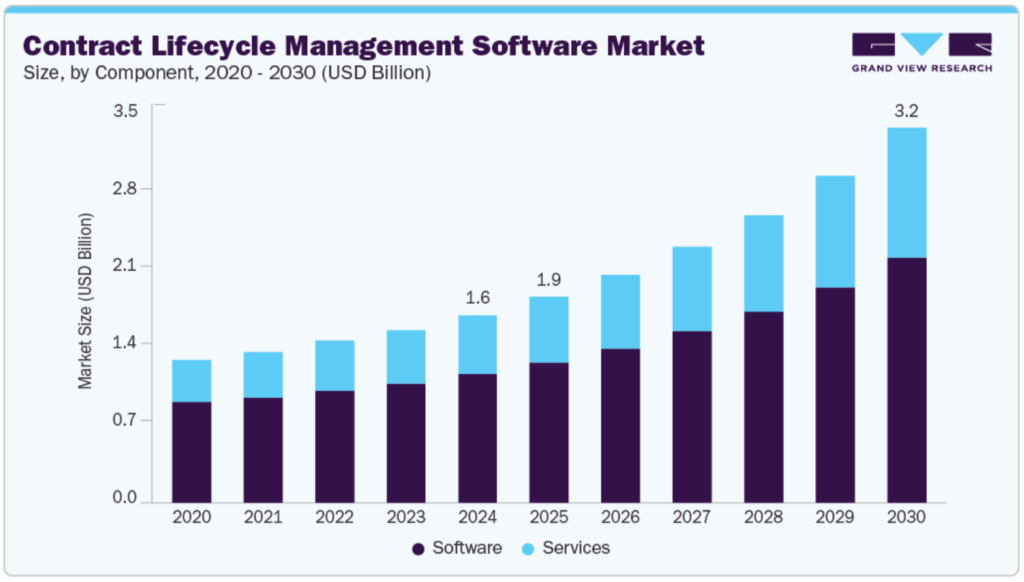
According to multiple industry analyses, the global contract lifecycle management software market is experiencing sustained double-digit growth, driven by rising compliance requirements, increasing contract complexity, and the need for operational efficiency. Grand View Research estimates the market will surpass $6 billion within the next few years, while Fortune Business Insights and Mordor Intelligence highlight automation, AI-driven insights, and integration ecosystems as key growth drivers shaping the next decade.
This guide breaks down the core differences, strategic value, and key buying considerations for modern contract management software—while helping you understand why leading organizations are moving beyond traditional systems.
The Difference Between Contract Management and Document Management
At a glance, contract management and document management may seem interchangeable. In reality, they solve fundamentally different problems—and understanding that difference is critical when evaluating software.
A Document Management System (DMS) is designed to store, organize, retrieve, and secure documents. It acts as a centralized repository where files are version-controlled, permission-based, and easily searchable. For departments like HR, finance, procurement, and operations, a DMS ensures that critical business documents are not lost, duplicated, or mismanaged.
In contrast, Contract Lifecycle Management (CLM) software goes several steps further. It is not just about storing contracts—it is about managing every stage of a contract’s lifecycle, from creation and negotiation to approval, execution, renewal, and compliance monitoring.
Where a traditional DMS answers:
- “Where is this document?”
- “Who has access to it?”
- “What is the latest version?”
A CLM platform answers:
- “What stage is this contract in?”
- “What risks or obligations does it contain?”
- “What actions need to happen next?”
- “How does this contract impact revenue, compliance, or operations?”
This distinction is becoming increasingly important as contracts grow more complex and regulatory environments become stricter. Organizations that rely solely on document storage systems often find themselves lacking visibility into obligations, deadlines, and risk exposure.
Modern platforms like Fortva bridge this gap by combining document management with full contract lifecycle intelligence, eliminating the need for disconnected tools.
Why You Need Both CLM and DMS for Your Business
The reality is not CLM versus DMS—it is CLM powered by DMS capabilities. Businesses today operate across multiple departments and industries, each generating large volumes of documents and contracts. A financial services firm managing compliance agreements, a construction company handling subcontractor contracts, or a healthcare provider maintaining patient-related documentation all require structured, secure, and intelligent systems.
Without an integrated approach, organizations face several challenges. Documents may be stored in one system, while contract approvals happen in another. Version control becomes inconsistent, approvals are delayed, and audit trails are incomplete. This fragmentation leads to inefficiencies that compound over time. This is why the market is shifting toward unified platforms that combine:
- Secure document storage and organization
- Workflow automation for approvals and reviews
- Real-time collaboration across teams
- Full lifecycle visibility for contracts
Research from Mordor Intelligence highlights that organizations adopting integrated CLM solutions report significant reductions in contract turnaround time and operational costs, while also improving compliance outcomes.
For industries like insurance, logistics, and energy—where contracts are tied directly to regulatory requirements and revenue streams—this integration is not optional. It becomes a competitive advantage.
How Contract Lifecycle Management Software Reduces Risk and Speeds Up Deals
One of the most compelling reasons organizations adopt CLM software is the direct impact on risk mitigation and deal velocity.
Contracts inherently carry risk—missed obligations, unclear terms, regulatory violations, or outdated clauses can lead to financial and legal consequences. Traditional contract handling methods make it difficult to track these risks proactively.
CLM platforms address this by introducing structure, automation, and visibility into every stage of the contract lifecycle.
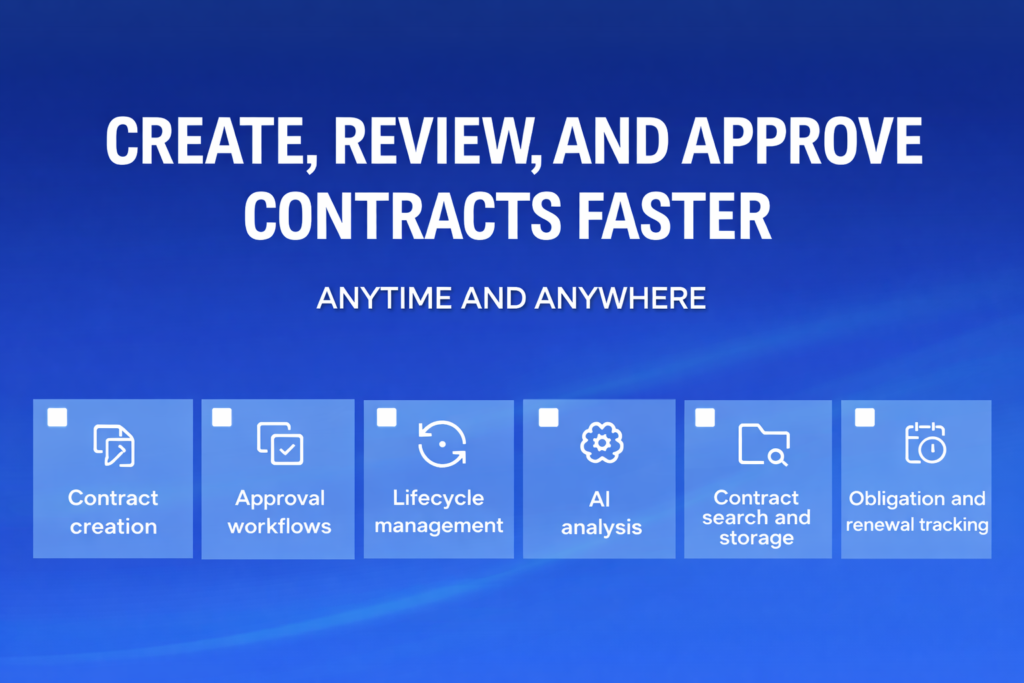
Through automated workflows, contracts are routed to the right stakeholders for review and approval, eliminating bottlenecks. Version control ensures that teams are always working on the latest document, reducing errors and miscommunication. Audit trails provide a complete record of every action taken, which is critical for compliance and dispute resolution.
More importantly, modern CLM systems leverage AI and intelligent data extraction to identify key clauses, obligations, and deadlines within contracts. This transforms contracts from static files into searchable, actionable data.
Fortune Business Insights emphasizes that organizations implementing advanced CLM solutions experience faster contract cycles and improved compliance accuracy, particularly in regulated industries.
For sales and revenue teams, this translates into shorter deal cycles and faster revenue recognition. For legal and compliance teams, it means reduced exposure to risk and greater control over contractual obligations.
End-to-End Contract Management: From Creation to Renewal Explained
To fully understand the value of CLM software, it is essential to look at the entire contract lifecycle. The process begins with contract creation, where standardized templates ensure consistency and reduce drafting time. Templates also help enforce compliance by embedding approved legal language.
Once created, contracts move into the negotiation phase. This is where version control, redlining, and collaboration become critical. Teams can track changes, compare versions, and ensure that all stakeholders are aligned.
The approval stage follows, often involving multiple departments such as legal, finance, and procurement. Automated workflows ensure that approvals happen efficiently, without unnecessary delays.
Execution is the next step, where e-signature capabilities streamline the signing process, allowing contracts to be finalized quickly regardless of location.
After execution, the focus shifts to contract management and monitoring. This includes tracking obligations, key dates, and performance metrics. Alerts and reminders help ensure that deadlines are not missed.
Finally, contracts reach the renewal or expiration stage. Without proper visibility, organizations often miss renewal opportunities or fail to renegotiate terms. CLM software ensures that these critical moments are managed proactively.
This end-to-end visibility is what transforms contract management from a reactive process into a strategic function.
Top Features to Look for in Contract Lifecycle Management Software
-
Centralized Document Storage with Smart Search: A strong CLM platform should provide a unified repository where all contracts and related documents are securely stored, organized, and easily searchable using advanced filters and keyword-based retrieval. Storage alone is not enough without fast accessibility and structured organization.
-
Workflow Automation for Approvals and Processes :Look for configurable automation that streamlines contract approvals, routing documents to the right stakeholders based on predefined rules. This reduces manual intervention, eliminates bottlenecks, and ensures consistent contract processing across departments.
-
Collaboration, Redlining, and Version Control: Modern CLM tools should enable real-time collaboration across legal, procurement, sales, and finance teams. Built-in redlining, commenting, and version tracking ensure that every change is recorded, transparent, and easily reversible when needed.
-
Integration with Core Business Systems: Seamless integration with tools like CRM platforms, ERP systems, productivity suites, and e-signature solutions is essential. This ensures contract data flows smoothly across the entire business ecosystem without duplication or silos.
-
Security, Access Control, and Compliance Management: Enterprise-grade security features are critical, including role-based access permissions, encryption, audit trails, and compliance tracking. These safeguards ensure sensitive contract data remains protected and meets regulatory standards across industries.
-
AI-Driven Insights and OCR Capabilities: Advanced CLM platforms increasingly use AI and optical character recognition (OCR) to extract key data from contracts, identify obligations, and automate downstream workflows. This transforms contracts from static documents into actionable business intelligence.
-
Market Direction: Intelligence Over Automation: Industry research from Grand View Research highlights a clear shift toward AI-enabled contract management systems, where vendors are evaluated not just on automation capabilities, but on their ability to deliver intelligent, data-driven contract decision-making.
How to Automate Contract Approvals, Redlining, and E-Signatures
-
Automation as the Core of Modern CLM Systems: Contract lifecycle management is increasingly driven by automation, making it a central factor in the rapid adoption of CLM platforms across industries. It eliminates repetitive manual work and creates structured, predictable contract workflows.
-
Limitations of Traditional Approval Workflows: In legacy processes, contract approvals rely heavily on email chains, manual reminders, and unclear ownership. This creates delays, increases administrative burden, and raises the likelihood of errors or missed approvals.
-
Automated Approval Routing and Workflow Triggers: Modern systems allow approval workflows to be predefined and automatically triggered based on conditions such as contract type, value thresholds, department, or risk level. Contracts are instantly routed to the correct stakeholders, with automated notifications ensuring timely action.
-
Collaborative Redlining and Real-Time Negotiation
Redlining becomes significantly more efficient through real-time collaboration tools that allow multiple stakeholders to review, edit, and comment on contracts simultaneously. Every change is tracked, versioned, and accessible, ensuring full transparency during negotiation cycles. -
Seamless E-Signature Integration for Faster Execution: E-signature capabilities remove the need for manual or physical signing processes. Contracts can be executed securely within minutes, regardless of geographic location, making it especially valuable for distributed teams and high-volume contract environments.
-
Impact on Contract Cycle Time and Efficiency: The combined effect of automation across approvals, redlining, and execution dramatically reduces contract turnaround times. Industry findings consistently show that organizations using CLM automation can reduce cycle times by approximately 30–50%, depending on contract complexity and volume.
-
Business Value Across Key Functions: For sales, procurement, legal, and operations teams, this level of automation translates directly into faster deal closures, improved compliance, and greater operational efficiency across the entire contract lifecycle.
Contract Management Market Insight: Data, Growth Trends & Global Outlook
The global contract lifecycle management (CLM) software market is no longer emerging—it is scaling aggressively, driven by enterprise digitization and increasing regulatory complexity.
According to Grand View Research, the global CLM market was valued at over $1.5 billion in 2023 and is projected to expand at a compound annual growth rate (CAGR) exceeding 13% through 2030. This sustained growth is fueled by the exponential increase in contract volume across enterprises and the urgent need for centralized control and visibility.
Key Market Drivers Backed by Data
-
Rising contract volume: Large enterprises now manage tens of thousands of active contracts, creating operational bottlenecks without automation.
-
Compliance pressure: Regulatory environments across regions like North America, Europe, and Asia-Pacific are becoming stricter, pushing organizations toward auditable, traceable contract systems.
-
Revenue leakage concerns: Studies estimate that poor contract management can lead to up to 9% revenue loss annually, making CLM a financial priority—not just an operational tool.
-
Digital transformation spend: Enterprises are significantly increasing investments in SaaS platforms that unify document management, workflow automation, and analytics.
Regional Insights: Where Growth Is Happening
-
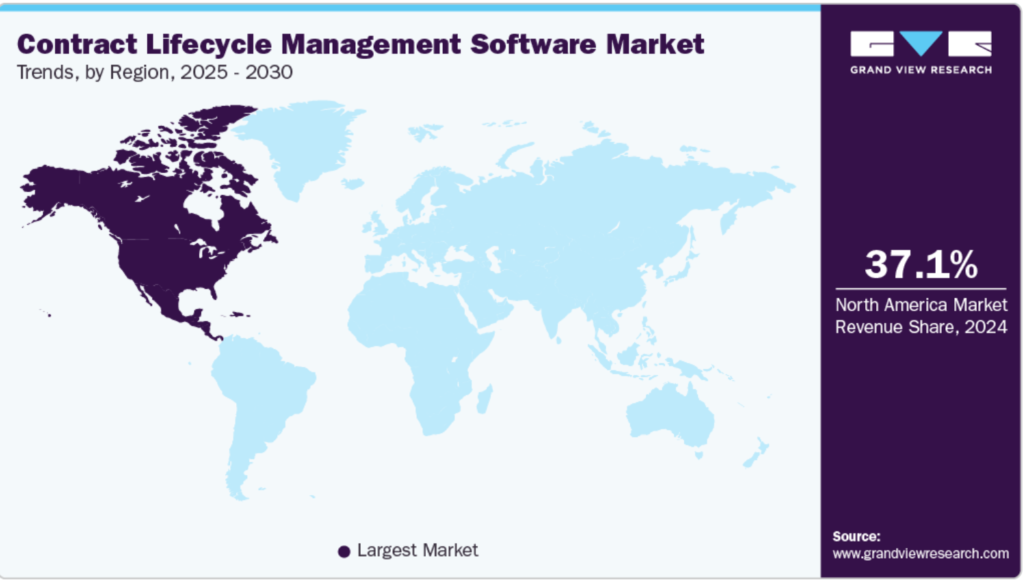
North America dominates the market recorded the largest revenue share of over 37.10% in 2024, driven by early adoption, mature IT infrastructure, and strong presence of enterprise vendors.
-
Europe is seeing accelerated growth due to compliance frameworks such as GDPR, pushing demand for secure and transparent contract handling.
-
Asia-Pacific is the fastest-growing region, fueled by rapid digital transformation in countries like India, China, and Southeast Asia, where businesses are leapfrogging legacy systems.
Technology Trends Shaping the Market
-
AI-powered contract analysis is enabling automated clause extraction, risk detection, and contract summarization.
-
Cloud-based CLM platforms are replacing on-premise systems due to scalability and remote accessibility.
-
Integration ecosystems (CRM, ERP, e-signature tools) are becoming a non-negotiable requirement for buyers.
Industry Adoption Is Expanding Fast
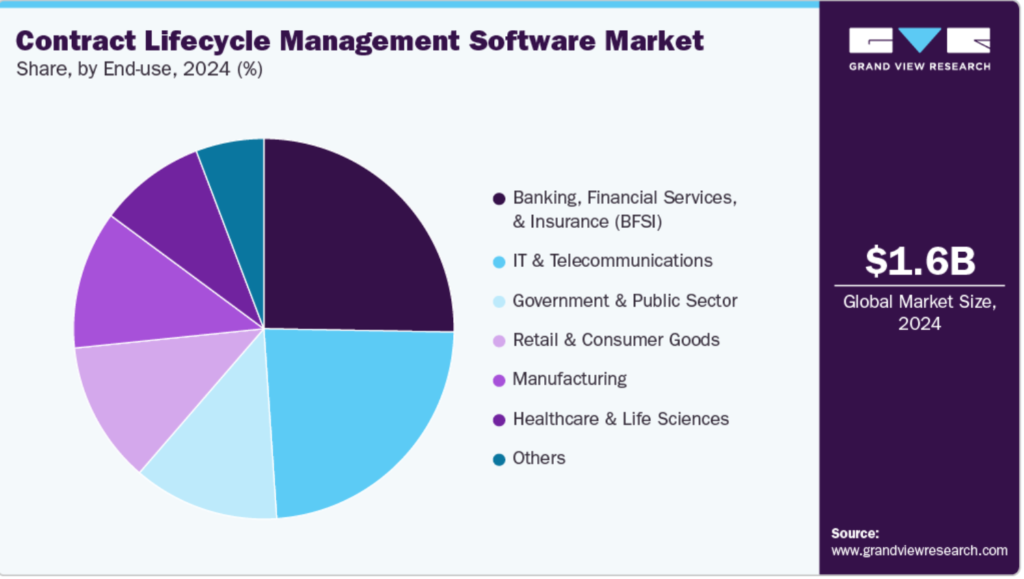
CLM adoption is no longer limited to legal teams. It is now critical across:
-
Government and Public Sector
-
Consumer Goods and Retail
-
Healthcare and Life Sciences
-
Banking, Financial Services, and Insurance (BFSI)
-
Financial services (risk & compliance-heavy environments)
-
Healthcare (regulatory documentation and vendor contracts)
-
Manufacturing & logistics (supplier agreements and procurement contracts)
-
Technology companies (high-volume SaaS and partnership agreements)
What This Means for Buyers
The data makes one thing clear: contract management is shifting from a back-office function to a strategic growth lever. Modern buyers are no longer looking for simple storage solutions—they are investing in platforms that:
-
Reduce contract cycle time
-
Improve compliance and audit readiness
-
Eliminate revenue leakage
-
Provide real-time visibility into obligations and risks
A New Standard Is Emerging
What becomes clear from both market data and real-world adoption is that the definition of contract management software is changing.
It is no longer enough to simply store documents or manage contracts in isolation. Businesses need platforms that combine document management, contract lifecycle management, automation, and intelligence into a single, cohesive system.
This is where modern solutions like Fortva are redefining expectations—by delivering not just functionality, but a unified experience that aligns with how businesses actually operate today.
What Smart Buyers Evaluate Before Choosing Contract Management Software
By the time buyers reach this stage, they are no longer asking “What is contract lifecycle management?”—they are asking “Which platform will actually work for my business without slowing us down?” This is where many evaluations go wrong.
Most organizations focus heavily on feature lists and vendor demos, but overlook the operational reality of adoption. A platform may look powerful on paper, but if it is difficult to use, slow to implement, or disconnected from existing workflows, it becomes shelfware.
Modern buyers are now prioritizing a different set of criteria—ones that align with long-term usability, scalability, and ROI.
Ease of use has become one of the most decisive factors. Platforms that require extensive training or technical expertise often create friction across departments, especially in industries like healthcare, logistics, and financial services where time and accuracy are critical. A system that teams can adopt quickly without resistance consistently outperforms more complex alternatives.
Equally important is the ability to unify document management and contract lifecycle management into a single system. Businesses no longer want separate tools for storage, approvals, and execution. They want a single source of truth where documents, contracts, workflows, and insights coexist seamlessly.
Integration capability is another critical consideration. Contract data does not exist in isolation—it connects to CRM systems, finance tools, procurement platforms, and customer workflows. Buyers are increasingly favoring platforms that integrate natively with tools like Salesforce, HubSpot, Microsoft Word, and e-signature solutions, ensuring that contracts are embedded directly into business processes.
Security has also moved to the forefront. With increasing regulatory scrutiny and data sensitivity, especially in industries like insurance and financial services, organizations require systems that go beyond basic protection. Zero-knowledge encryption and granular permission controls are becoming essential, not optional.
Finally, automation and intelligence are redefining expectations. Buyers are no longer satisfied with manual workflows. They expect platforms to extract data, trigger actions, and provide insights automatically, reducing human intervention and accelerating decision-making.
Why Companies Are Switching from Legacy CLM Platforms
A growing number of organizations are actively replacing their existing contract management systems—not because they lack functionality, but because they fail in execution.
Across the market, several consistent patterns are driving this shift. Cost is one of the most visible factors. Many legacy and enterprise-focused platforms come with high licensing fees, complex pricing tiers, and hidden implementation costs. While they may offer extensive capabilities, the total cost of ownership often becomes difficult to justify, especially for mid-sized businesses or growing enterprises.
Complexity is another major barrier. Platforms that require heavy configuration, long onboarding cycles, or dedicated administrators tend to slow down adoption. Instead of simplifying workflows, they introduce new layers of friction.
Integration limitations also play a role. In an environment where businesses rely on interconnected systems, platforms that cannot integrate seamlessly with CRM, ERP, or automation tools create silos rather than eliminating them.
Perhaps most importantly, many traditional systems were not built for today’s pace of business. They lack the automation, AI capabilities, and real-time collaboration features that modern teams expect.
This is why companies are increasingly moving toward simpler, more unified platforms that deliver both power and usability—without the overhead.
The Shift Toward All-in-One CLM + DMS Platforms
The market is undergoing a clear transition from fragmented tools to integrated ecosystems.
Previously, organizations might have used:
- A document storage system for files
- A separate tool for contract creation
- Email for approvals
- External platforms for e-signatures
This fragmented approach created inefficiencies, data inconsistencies, and limited visibility. Today, the demand is for platforms that bring everything together into a single environment. This includes document management, contract lifecycle management, workflow automation, collaboration, and analytics.
This shift is not just about convenience—it is about performance. When all contract-related activities are centralized, organizations gain:
- Real-time visibility into contract status
- Faster approval cycles
- Improved compliance tracking
- Better data accuracy
Industry analysts consistently highlight this convergence as a defining trend in the CLM market. Businesses are no longer evaluating standalone tools—they are evaluating platform ecosystems.
This is where newer-generation solutions are gaining traction, as they are built from the ground up to support this unified approach.
Fortva: The New Standard for Contract and Document Management
As the market evolves, a new category of platforms is emerging—solutions that combine simplicity, intelligence, and full lifecycle capabilities without the complexity of legacy systems. Fortva represents this shift.
At its core, Fortva is designed to eliminate the fragmentation that exists in traditional workflows. Instead of forcing businesses to manage documents, contracts, approvals, and signatures across multiple tools, it brings everything into a single, cohesive platform.
What sets Fortva apart is not just the breadth of its capabilities, but how seamlessly they work together. Documents are not simply stored—they are structured, searchable, and connected to workflows. Contracts are no just tracked—they are actively managed, analyzed, and optimized throughout their lifecycle.
Automation is embedded into every stage, from approvals and redlining to execution and renewal. Teams no longer need to chase signatures or follow up manually—processes are triggered automatically based on predefined rules.
Security is built at the foundation, with advanced encryption and permission controls ensuring that sensitive information remains protected without compromising accessibility.
Integration is equally central. By connecting with tools like Microsoft Word, CRM platforms such as Salesforce and HubSpot, and automation systems like Zapier, Fortva ensures that contract management is not a standalone function, but an integrated part of the broader business ecosystem.
Perhaps most importantly, Fortva is built with usability in mind. While many platforms sacrifice simplicity for functionality, Fortva delivers both—making it accessible to teams across departments, from legal and procurement to sales and finance.
Use Cases Across Industries and Departments
The value of a modern contract management platform becomes most evident when applied to real-world scenarios.
In financial services and insurance, where compliance and accuracy are critical, centralized contract management ensures that regulatory requirements are consistently met. Automated workflows reduce manual errors, while audit trails provide full transparency for compliance reviews.
In construction and real estate, where multiple stakeholders are involved in every project, contract visibility becomes essential. A unified platform allows teams to track agreements, manage approvals, and ensure that deadlines are met without delays.
Healthcare organizations benefit from secure document handling and strict access controls, ensuring that sensitive information is protected while remaining accessible to authorized personnel.
For sales teams, faster contract cycles directly impact revenue. Automated approvals and integrated e-signatures enable deals to close more quickly, reducing friction in the sales process.
Procurement and finance teams gain better control over vendor agreements, ensuring that terms are enforced and obligations are tracked effectively.
Across all these use cases, the common thread is clear: organizations are moving away from reactive contract management toward proactive, data-driven processes.
Good — this is exactly the kind of upgrade that turns this from a blog post into a market intelligence asset.
CLM & DMS Platform Comparison
| Platform | Core Strength | Ease of Use | Automation & AI | Integration | Pricing | Free Trial | Implementation | Limitation |
| Ironclad | Enterprise CLM workflows | Medium–Complex | Strong AI contract workflows | Salesforce, Slack, Microsoft | $600–$1,500+ / user or enterprise bundles | Limited demo access | 6–12 weeks | Expensive, enterprise-heavy setup |
| Icertis | Deep enterprise compliance & governance | Complex | Advanced AI & risk analysis | Strong ERP integrations | $1,000–$2,500+ / user (enterprise only) | No self-serve trial | 8–16+ weeks | Very high cost, requires implementation team |
| DocuWare | Document management & workflow automation | Medium | Limited AI (basic OCR/search) | SAP, Microsoft, CRM tools | $300–$700 / user | Yes (trial available) | 2–6 weeks | Weak CLM capabilities (contract lifecycle gaps) |
| Laserfiche | Enterprise document management | Medium–Complex | Moderate automation | Strong government/enterprise integrations | $400–$900 / user | Demo-based | 4–10 weeks | Not CLM-native, document-first system |
| Contractbook | SMB-friendly CLM | Easy | Basic automation + templates | HubSpot, Google Workspace | $59–$150 / user | Yes | 1–2 weeks | Limited enterprise scalability |
| Concord | Simple contract workflows | Very Easy | Basic automation | CRM integrations | $49–$99 / user | Yes | 1 week | Lacks deep enterprise features |
| Juro | Legal contract collaboration | Easy–Medium | Moderate AI + automation | Slack, Salesforce | $50–$150 / user | Yes | 1–3 weeks | Limited document management depth |
| Coupa | Procurement + contract management | Complex | Strong procurement automation | ERP-heavy ecosystem | Enterprise pricing only | Demo only | 8–14 weeks | Overkill for non-procurement users |
| DealHub | Revenue lifecycle + contracting | Medium | Strong CPQ automation | Salesforce-centric | $300–$1,000+ / user | Demo | 4–8 weeks | Narrow sales-focused use case |
| Fortva | Unified CLM + DMS + automation platform | Very Easy | AI + OCR + full lifecycle automation | Salesforce, HubSpot, MS Word, DocuSign, Zapier | Affordable, pricing (only use what you need) | Yes (easy onboarding access) | A Days to 2 | (None in its category; newer market entrant advantage) |
Common Buyer Mistakes And How to Avoid Them
-
Over-prioritizing features over usability
Many buyers are initially drawn to platforms with extensive feature lists, assuming more functionality automatically means better value. However, in real-world usage, a complex system often leads to low adoption across teams. If employees find the platform difficult to navigate, they revert to email, spreadsheets, or legacy tools—defeating the purpose of the investment. Usability and intuitive design should always be prioritized to ensure widespread adoption and consistent usage across departments. -
Underestimating implementation and onboarding complexity
Another frequent mistake is failing to account for how long it takes to fully implement a CLM system. Some platforms require weeks or even months of configuration, training, and technical setup before they become fully operational. This delays ROI and can create internal resistance, especially if teams feel overwhelmed by change. A successful deployment should balance capability with fast, structured onboarding that allows teams to see value quickly. -
Ignoring integration requirements with existing systems
Many organizations only realize after purchase that their chosen CLM software does not integrate smoothly with essential tools such as CRM systems, ERP platforms, or e-signature solutions. This creates data silos and forces manual workarounds that reduce efficiency. Strong integration capabilities are essential to ensure contract data flows seamlessly across sales, finance, legal, and procurement systems without duplication or errors. -
Focusing only on short-term needs instead of scalability
Buyers sometimes select software based solely on immediate requirements, without considering future growth. While a platform may meet current needs, it may not scale as contract volumes increase or business complexity expands. A scalable solution should support evolving workflows, additional users, and more advanced automation over time, without requiring a complete system replacement. -
Overlooking total cost of ownership (hidden long-term cost factor)
Beyond subscription fees, many CLM platforms come with hidden costs such as implementation services, training, customization, and ongoing administration. These costs can significantly increase the total investment over time. Buyers should evaluate not only pricing tiers but also long-term operational costs to avoid budget surprises after adoption.
Final Thought
Selecting contract management software is no longer just a technical decision—it is a strategic one.
The right platform should not only solve today’s challenges but also support future growth, improve efficiency, and reduce risk across the organization.
For businesses evaluating their options, the key is to look beyond surface-level features and focus on what truly drives value: usability, integration, automation, and security.
Take Control of Your Contract Management
If you are evaluating contract management software, the real question is not whether you need a solution—it is whether your current approach is holding your business back.
Exploring platforms that combine document management, contract lifecycle management, and automation into a single system is often the turning point.
Fortva is built for organizations that want that shift—without complexity, without hidden costs, and without compromise. When you’re ready, the next step is simple: see how it fits into the way your business already works.
Start a free trial today or book a demo.
