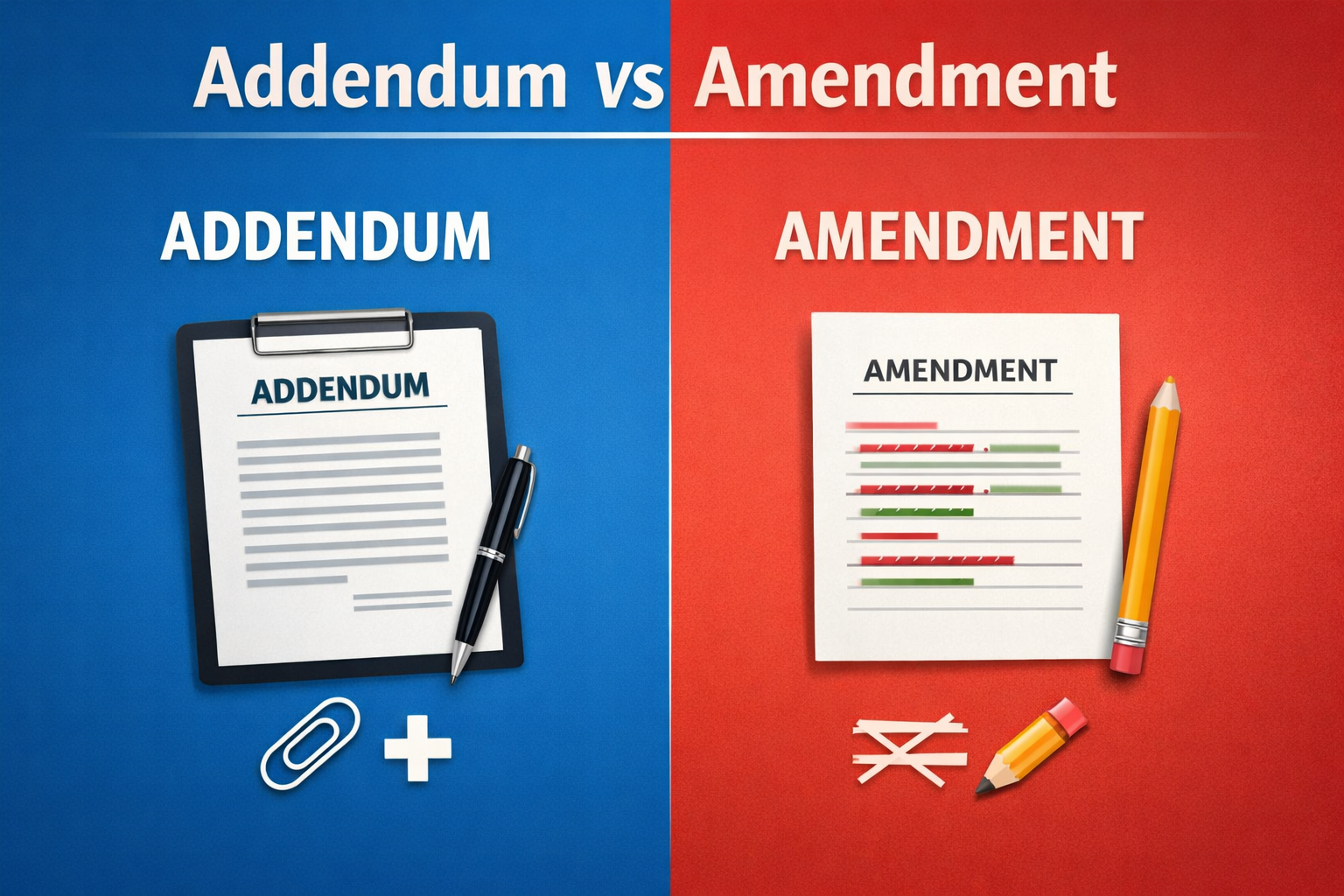
Addendum vs Amendment in Real Estate Contract Management
Addendum vs amendment in real estate contract management refers to whether you are adding new terms to a contract or changing existing ones—an important legal distinction that directly affects enforceability, compliance, and risk in property transactions.
Key Takeaways
- The distinction between addendum vs amendment is critical in real estate because it determines whether you are supplementing a contract or legally altering it.
- An addendum introduces new clauses, disclosures, or conditions without modifying the original agreement.
- An amendment changes existing terms such as price, timelines, or obligations already agreed upon.
- Misusing either can lead to contract disputes, delayed closings, or even litigation.
- Modern contract lifecycle management software eliminates confusion by tracking every contract change with version control and audit trails.
- Centralized contract repositories and automation ensure all updates are compliant, visible, and enforceable.
Why Addendum vs Amendment Matters in Real Estate Contracts
Real estate contracts are not static documents. They evolve throughout the lifecycle of a transaction—from negotiation to closing and sometimes even beyond. This dynamic nature makes it essential to clearly distinguish between an addendum and an amendment.
In practice, this is where many organizations fail. Legal teams, brokers, and operations managers often use the terms interchangeably, but from a legal and operational standpoint, they serve very different purposes. That confusion becomes dangerous when disputes arise.
In real estate, contracts often involve multiple stakeholders: buyers, sellers, agents, lenders, and legal advisors. Each change must be documented with precision. A poorly handled modification—whether mislabeled or improperly executed—can create ambiguity that weakens enforceability.
Research from World Commerce & Contracting shows that organizations lose up to 9% of contract value due to poor contract management practices, including mismanaged updates and lack of clarity in contract modifications. In real estate, where deals often involve six- or seven-figure sums, that risk becomes significant.
This is why leading organizations now rely on structured contract lifecycle management software to manage contract changes systematically, ensuring that every addendum and amendment is correctly applied, approved, and recorded.
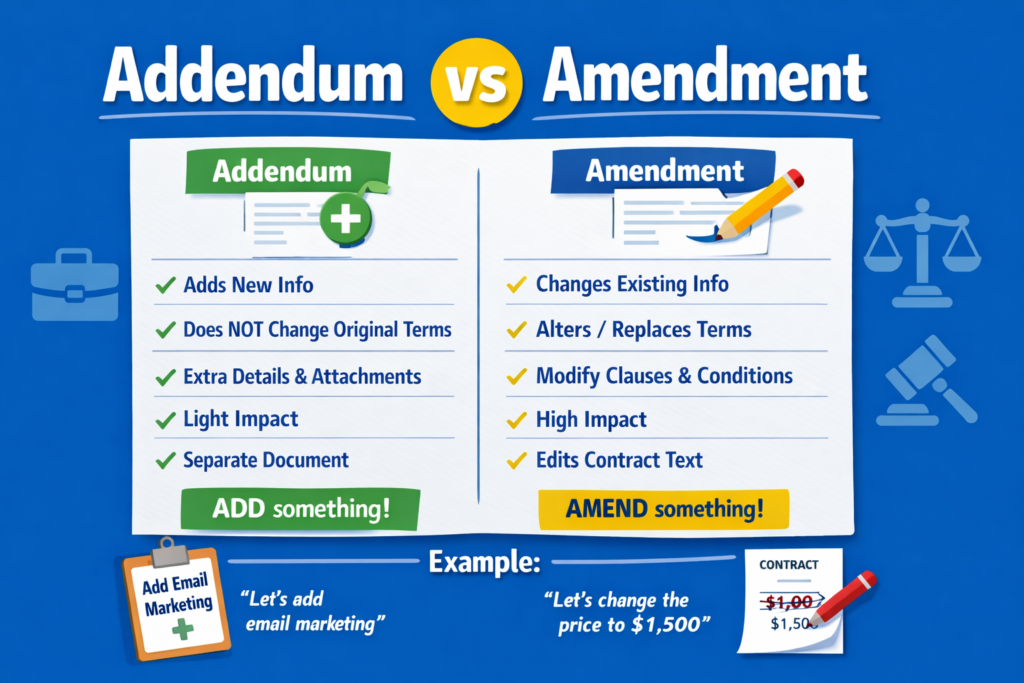
Addendum vs Amendment Comparison
| Aspect | Addendum | Amendment |
| Core idea | Adds new info | Changes existing info |
| Effect on original contract | Does NOT change original terms | Alters / replaces original terms |
| Purpose | Add details, clarifications, attachments | Modify clauses, terms, or conditions |
| Scope | Supplementary / extra info | Core contract changes |
| Examples | Add schedule, specs, extra services | Change price, deadline, parties |
| Impact level | Light impact | High impact |
| Complexity | Simple | More complex |
| Risk of dispute | Lower | Higher (affects key terms) |
| Drafting style | Separate document attached | Direct changes to contract text |
| When to use | When adding something new | When fixing or changing something existing |
What Is a Contract in Real Estate?
To fully understand the difference between addenda and amendments, we must start with the foundation: what is a contract?
A contract is a legally binding agreement between two or more parties that establishes enforceable rights and obligations. In real estate, contracts are particularly complex because they often include financial commitments, regulatory requirements, and strict timelines.
Common real estate contracts include purchase agreements, lease agreements, financing contracts, and construction or development agreements. Each of these documents defines critical terms such as price, payment structure, contingencies, and responsibilities of each party.
Because real estate transactions rarely proceed exactly as initially planned, these contracts often need to be updated. Those updates must be handled either through an addendum or an amendment, depending on the nature of the change.
What Is an Addendum in Contract Management?
An addendum is a separate document attached to an existing contract that introduces new information or additional terms without altering the original agreement.
In real estate, addenda are widely used during the early and mid-stages of a transaction when new details emerge after the initial contract has been drafted or signed. These additions expand the scope of the agreement while preserving its original structure.
For example, consider a residential property purchase. After the contract is signed, the buyer conducts a home inspection and discovers issues that require repair. Instead of rewriting the contract, the parties may agree to include repair obligations through an addendum. The original terms remain intact, but new conditions are added.
This distinction is important because an addendum does not rewrite history—it builds on it. The original contract still governs the relationship, while the addendum supplements it with additional context or requirements.
From a legal perspective, an addendum must clearly reference the original contract and be signed by all relevant parties to be enforceable. When properly executed, it becomes part of the overall agreement.
However, in organizations without a structured document management system, addenda can easily become disorganized. Files may be stored across email threads, shared drives, or disconnected systems, making it difficult to determine which version of a contract is current. This lack of visibility increases the risk of disputes and operational inefficiencies.
What Is an Amendment in Contract Management?
An amendment, by contrast, is a formal change to the existing terms of a contract. Instead of adding new information, it modifies what has already been agreed upon.
In real estate transactions, amendments are common when deal conditions change. For instance, if the buyer and seller agree to adjust the purchase price, extend the closing date, or modify financing terms, those changes must be documented through an amendment.
Unlike an addendum, an amendment directly alters the original contract language. It may replace clauses, revise timelines, or remove provisions entirely. Because of this, amendments carry a higher legal weight and must be handled with precision.
To be valid, an amendment must explicitly state what is being changed and must be agreed upon and signed by all parties involved. Courts typically scrutinize amendments more closely than addenda because they affect the core terms of the agreement.
Improperly executed amendments are a leading cause of litigation in contract disputes, particularly in real estate where timelines and financial terms are critical. A missing signature, unclear language, or conflicting versions can invalidate changes and lead to costly legal consequences.
Addendum vs Amendment: A Practical Legal Distinction
The difference between addendum and amendment is not just semantic—it directly impacts how a contract is interpreted and enforced.
An addendum operates as an extension of the contract. It adds new provisions without disturbing the original framework. In contrast, an amendment reshapes the contract itself by modifying its existing terms.
In real estate contract management, this distinction determines how obligations are interpreted. For example, if a closing date is extended through an addendum instead of an amendment, it may create ambiguity about whether the original deadline still applies. Such ambiguity can become a point of contention if one party claims breach of contract.
This is why legal professionals emphasize precision in drafting and labeling contract modifications. The terminology used must accurately reflect the nature of the change.
Addendum vs Amendment in Real Estate Transactions
Real estate transactions are particularly sensitive to contract changes because they involve strict timelines, regulatory compliance, and financial commitments.
During the lifecycle of a real estate deal, multiple changes may occur. Some involve adding new conditions, while others require modifying existing terms. Understanding when to use an addendum versus an amendment ensures that each change is legally sound and operationally clear.
For instance, adding a disclosure about environmental hazards is appropriately handled through an addendum because it introduces new information. On the other hand, renegotiating the purchase price requires an amendment because it changes a core term of the agreement.
The complexity increases in commercial real estate, where contracts may involve multiple amendments over time. Without proper tracking, it becomes difficult to determine which version of the contract is authoritative.
This is where a centralized contract repository becomes critical. By maintaining a single source of truth, organizations can ensure that all addenda and amendments are properly linked to the original contract and easily accessible.
The Role of Contract Lifecycle Management in Managing Changes
As real estate transactions become more complex, manual contract management is no longer sufficient. Organizations are increasingly adopting contract lifecycle management software to handle contract creation, modification, and execution.

A modern CLM platform like Fortva provides a structured environment where all contract-related activities are centralized. This includes drafting, reviewing, approving, and storing contracts, as well as managing addenda and amendments.
With Fortva’s contract lifecycle management software, teams can track every change made to a contract, including who made the change, when it was made, and what was modified. This level of transparency eliminates confusion and ensures accountability.
Additionally, Fortva integrates with tools like Microsoft Word and DocuSign, enabling seamless document editing and e-signature workflows. This ensures that all contract updates are not only documented but also legally executed.
How Contract Automation Reduces Risk
One of the biggest challenges in real estate contract management is maintaining consistency and accuracy across multiple versions of a contract. Manual processes are prone to errors, delays, and miscommunication.
Contract automation addresses these challenges by standardizing workflows and reducing human intervention. With automated systems, addenda and amendments follow predefined approval processes, ensuring that all changes are reviewed and authorized before being finalized.
According to Deloitte, organizations that implement contract automation can reduce contract cycle times by up to 30%, significantly improving operational efficiency.
Fortva enhances this process through features such as AI-powered data extraction and intelligent OCR, which automatically identify key contract terms and flag inconsistencies. This proactive approach helps organizations avoid potential disputes and maintain compliance.
Legal and Compliance Considerations
Compliance is a critical aspect of real estate contract management. Both addenda and amendments must meet specific legal requirements to be enforceable.
An addendum must clearly identify the original contract and specify the additional terms being introduced. It must also be signed by all parties involved. Similarly, an amendment must explicitly state the changes being made and include updated language that replaces or modifies existing clauses.
Failure to meet these requirements can result in unenforceable agreements, financial loss, and legal disputes. In regulated markets, non-compliance can also lead to penalties and reputational damage.
This is why organizations must adopt structured processes and leverage technology to ensure that all contract modifications are properly documented and executed.
Best Practices for Managing Addenda and Amendments
Effective management of addenda and amendments requires a combination of legal expertise and operational discipline. Organizations should start by standardizing contract templates to ensure consistency across all agreements. Using pre-approved templates reduces ambiguity and ensures that all necessary clauses are included. You can start here:
Equally important is maintaining a centralized contract repository. By storing all contracts and related documents in a single system, organizations can ensure easy access and reduce the risk of duplication or loss.
Automation plays a key role in streamlining workflows and reducing errors. By automating approval processes and integrating e-signature capabilities, organizations can accelerate contract execution while maintaining compliance.
Finally, version control is essential for tracking changes and maintaining a clear audit trail. This ensures that all stakeholders have access to the most up-to-date version of a contract.
Real Estate Contract Management
The future of contract management in real estate is increasingly digital. Organizations are moving toward cloud-based solutions that offer greater flexibility, scalability, and security.
Emerging technologies such as artificial intelligence and machine learning are transforming how contracts are managed. These technologies enable automated analysis of contract terms, identification of risks, and generation of insights that support decision-making.
Fortva is at the forefront of this transformation, offering a comprehensive platform that combines document management, contract automation, and advanced analytics. By integrating with CRM systems like Salesforce and HubSpot, Fortva connects contract management to the broader customer lifecycle, enabling organizations to operate more efficiently.
Final Thoughts
The distinction between addendum vs amendment in real estate contract management is fundamental to effective contract governance. While the difference may seem subtle, its implications are significant.
An addendum expands a contract by adding new terms, while an amendment reshapes it by modifying existing ones. Understanding when and how to use each ensures clarity, compliance, and enforceability.
In an industry where precision is critical, organizations cannot afford to rely on manual processes or outdated systems. By adopting modern contract lifecycle management software, they can streamline operations, reduce risk, and improve outcomes.
Transform Your Contracting Process Effortlessly
Managing addenda and amendments doesn’t have to be complex.
With Fortva, you can automate contract workflows, centralize your contract repository, and ensure every change is tracked, approved, and compliant. Transform your contracting process effortlessly.
FAQs
- What is the difference between addendum and amendment?
An addendum adds new terms or information to a contract without changing the original agreement. An amendment modifies or replaces existing terms already agreed upon. In real estate contract management, the distinction affects enforceability and legal clarity.
- Is an addendum the same as a contract?
No, an addendum is not a standalone contract. It is a supplemental document attached to an existing agreement. It only becomes legally binding when properly referenced and signed with the original contract.
- Is an amendment the same as a contract?
No, an amendment is not a separate contract. It is a formal change made to an existing agreement’s terms. Once signed, it becomes part of the original contract and alters its legal effect.
- What is the difference between an agreement and an amendment?
An agreement is the original legally binding contract between parties. An amendment is a modification made to that agreement after execution. In contract management, amendments ensure contracts stay accurate over time.
- When should you use an addendum in real estate contracts?
An addendum is used when adding new conditions, disclosures, or contingencies. It is common during inspections or when new information emerges. It does not change existing terms but expands the contract scope.
- When should you use an amendment in real estate contracts?
An amendment is used when changing key terms like price, dates, or obligations. It is necessary when both parties agree to revise the original deal. All amendments must be clearly documented and signed to be valid.
- Can an addendum become legally binding?
Yes, an addendum is legally binding when properly executed. It must reference the original contract and be signed by all parties. Once attached, it forms part of the overall agreement.
- How does contract lifecycle management help with addenda and amendments?
Contract lifecycle management software tracks all changes in one system. It ensures proper version control, approvals, and audit trails. This reduces risk, improves compliance, and prevents contract disputes.