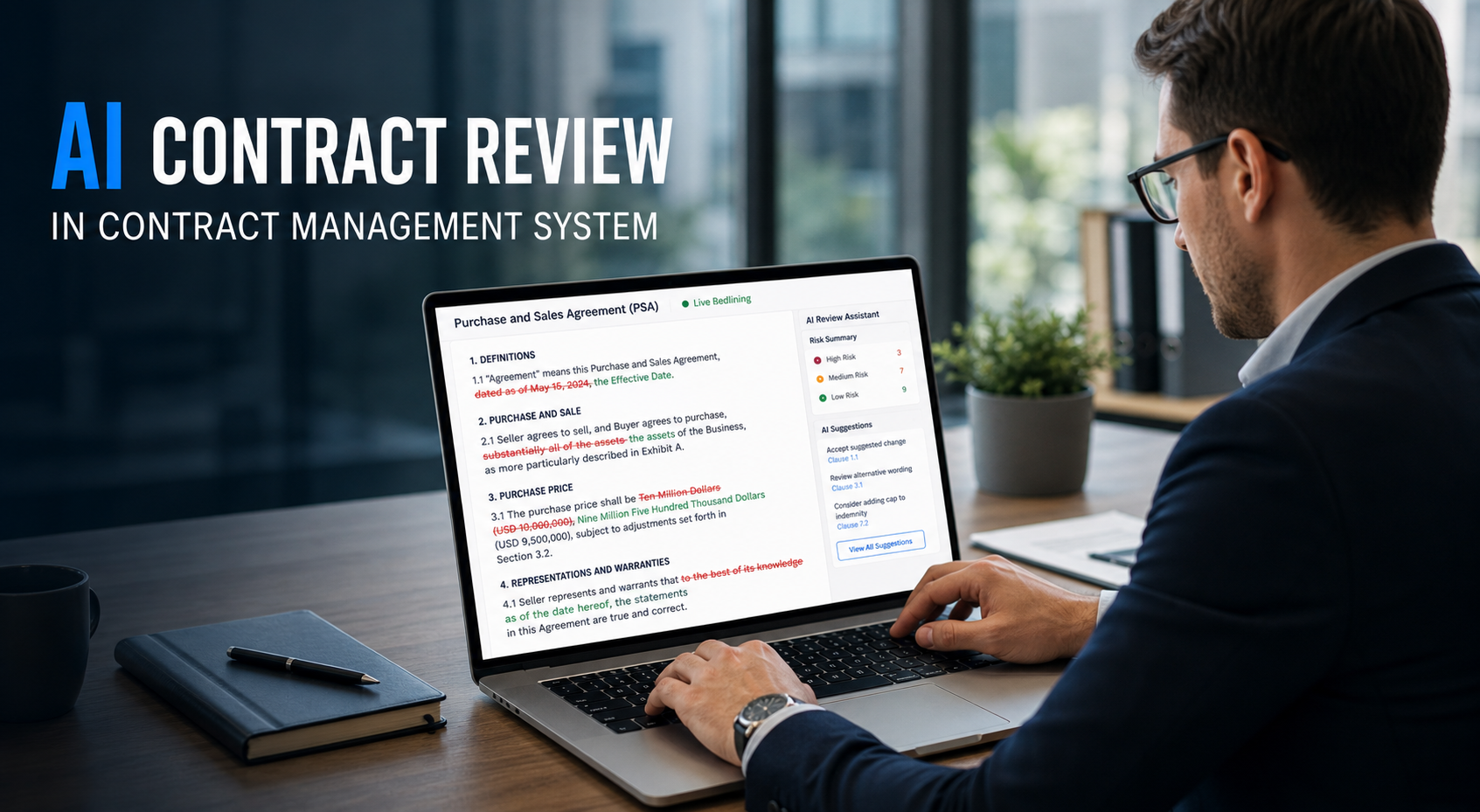
AI Contract Review in Contract Management System and AI contract Checker
AI contract review is no longer a futuristic concept—it’s the fastest way modern legal and business teams eliminate risk, accelerate deals, and scale contract intelligence.
In today’s high-velocity business environment, companies using AI-powered contract management systems are not just more efficient—they are outperforming competitors in speed, compliance, and revenue execution.
Key Takeaways
- AI contract review automates clause analysis, risk detection, and contract insights in seconds instead of hours or days.
- Legal, sales, and operations teams all benefit from AI-powered contract lifecycle management (CLM).
- AI improves contract accuracy, reduces legal risk, and accelerates deal cycles significantly.
- Modern AI contract management systems combine OCR, machine learning, and workflow automation into one platform.
- Businesses adopting AI in contract management see measurable ROI in time savings, compliance, and revenue velocity.
- AI contract checkers are evolving into full decision-support systems, not just review tools.
Picture This: The Hidden Cost of Manual Contract Review
It’s Monday morning. Your legal team is buried under a backlog of contracts—NDAs, vendor agreements, sales contracts—all waiting for review. Sales is pushing for faster approvals. Compliance is raising concerns. Finance needs visibility.
One contract sits unopened in someone’s inbox. That delay costs you a deal. Another contract is approved—but a risky clause slips through unnoticed. That mistake costs you millions later.
This is not hypothetical. It’s happening every day in organizations still relying on manual contract review. According to a report by World Commerce & Contracting, companies lose up to 9.2% of annual revenue due to poor contract management practices.
At the same time, research from McKinsey & Company shows that automation technologies, including AI, can reduce contract review time by up to 80%.
The gap between these two realities is where AI contract review lives—and where businesses either fall behind or pull ahead.
What Is AI for Contract Management?
AI for contract management refers to the use of artificial intelligence technologies—such as machine learning, natural language processing (NLP), and intelligent OCR—to automate and enhance every stage of the contract lifecycle.
This includes drafting, reviewing, approving, storing, analyzing, and renewing contracts. At its core, AI contract review focuses on understanding legal language at scale. Instead of a lawyer manually reading every clause, AI systems scan documents, identify key terms, flag risks, and extract critical data instantly.
Modern contract lifecycle management (CLM) platforms like Fortva go beyond basic automation. They integrate AI into workflows, enabling:
- Real-time clause analysis
- Automated contract categorization
- Risk scoring and anomaly detection
- Data extraction for reporting and compliance
- Workflow automation for approvals and execution
The result is not just faster contract review—but smarter contract management.
How AI Is Changing Contract Management for Legal Teams
Legal departments are no longer just risk managers—they are strategic enablers of business growth. AI is accelerating this transformation.
Traditionally, contract review required hours of manual reading, negotiation cycles, and back-and-forth communication. AI eliminates these inefficiencies by providing instant visibility into contracts.
A study by Thomson Reuters found that legal professionals spend up to 40% of their time on repetitive tasks, including contract review. AI directly targets this inefficiency.
With AI-powered systems:
1. Legal teams can instantly identify non-standard clauses and deviations from approved templates. This ensures consistency across contracts while reducing risk exposure.
2. AI also enables proactive compliance. Instead of reacting to issues after contracts are signed, legal teams can detect risks during the drafting and review phase.
3. More importantly, AI allows legal teams to scale. Whether reviewing 10 contracts or 10,000, the system maintains speed and accuracy—something manual processes cannot achieve.
How Legal Departments Use AI in Contract Management
The practical applications of AI in legal departments go far beyond simple document review. AI contract review tools are now embedded into daily workflows, transforming how legal teams operate across the organization.
Contract Drafting and Standardization
AI systems leverage pre-approved templates to ensure consistency in contract creation. Platforms like Fortva provide built-in templates or allow organizations to upload their own, ensuring every contract starts from a compliant foundation. This reduces negotiation cycles and minimizes legal risk from the outset.
Clause Detection and Risk Analysis
AI identifies critical clauses such as indemnity, liability, termination, and confidentiality. It then compares them against standard language to flag deviations.
This allows legal teams to focus only on high-risk areas instead of reviewing entire documents line by line.
Automated Approvals and Workflow Management
Contracts no longer sit idle waiting for approval. AI-driven workflows route documents automatically to the right stakeholders, ensuring faster turnaround times.
Compliance and Audit Trails
AI-powered systems maintain detailed audit trails, tracking every change, approval, and signature. This is critical for regulatory compliance and internal governance.
Data Extraction and Reporting
AI extracts key contract data—such as renewal dates, obligations, and payment terms—and turns it into actionable insights.
According to Gartner, organizations that leverage AI in contract analytics can improve contract compliance by up to 50%.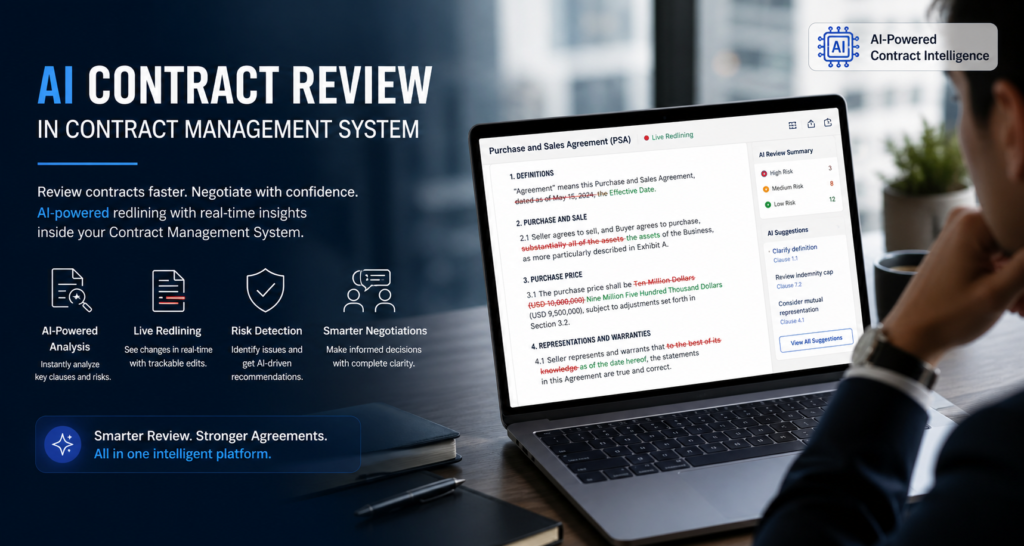
How Can Contract Management Systems Benefit from AI?
AI transforms contract management systems from passive storage tools into intelligent decision-making platforms.
Speed and Efficiency
AI reduces contract review time from hours to minutes. This directly impacts deal velocity, especially for sales teams closing time-sensitive agreements.
Risk Reduction
AI detects inconsistencies, missing clauses, and unusual terms that could expose the business to legal or financial risk.
Cost Savings
Manual contract review is resource-intensive. AI reduces the need for repetitive human effort, lowering operational costs.
Scalability
As businesses grow, contract volume increases. AI ensures systems can handle this growth without compromising performance.
Improved Collaboration
Modern AI-powered CLM platforms integrate with tools like Salesforce and HubSpot, allowing seamless collaboration between legal, sales, and operations teams.
The Use of Artificial Intelligence for Legal Departments
Artificial intelligence is not replacing lawyers—it is augmenting them. AI handles repetitive, data-heavy tasks, freeing legal professionals to focus on strategic decision-making, negotiation, and advisory roles.
A report by Deloitte predicts that AI will automate up to 100,000 legal roles globally, not by eliminating jobs, but by transforming how legal work is performed.
This shift is already happening. Legal departments that adopt AI are becoming more agile, more data-driven, and more aligned with business objectives.
What Is an AI Contract Checker?
An AI contract checker is a tool that automatically reviews contracts to identify risks, inconsistencies, and key information. Unlike traditional review methods, AI contract checkers:
- Analyze entire documents instantly
- Highlight problematic clauses
- Suggest improvements based on best practices
- Ensure compliance with company policies
Advanced systems go even further. They learn from past contracts, improving accuracy over time and adapting to specific organizational needs. This evolution is turning AI contract checkers into intelligent assistants for legal teams.
Comparison Table of AI Contract Review Platforms
| Feature | Fortva | Ironclad | Luminance | Kira Systems | ContractSafe |
| AI Contract Search | Advanced semantic + AI-powered full contract search across all documents | Good search, but workflow-focused | Strong AI analysis, limited search UX | Strong clause-level search | Basic keyword search only |
| AI Contract Analysis | Deep AI extraction: clauses, risks, obligations, insights across full lifecycle | Moderate analysis + workflow focus | Very strong for due diligence use cases | Excellent clause extraction | Minimal AI analysis |
| Contract Lifecycle Management (CLM) | Full end-to-end CLM (draft → review → approval → e-sign → storage) | Strong CLM platform | Limited CLM functionality | Not full CLM | Storage-focused only |
| Workflow Automation | Fully automated approval workflows + routing + notifications | Strong workflows | Limited workflow capability | Minimal workflows | No real workflow engine |
| E-Signature Integration | Native + DocuSign integration DocuSign | Yes (integrations required) | No native support | No native support | No native support |
| Contract Templates | Built-in + customizable templates for legal & sales teams | Available but limited flexibility | Not core focus | Limited | Not available |
| AI Data Extraction | Intelligent OCR + structured contract data extraction at scale | Moderate | Very strong extraction for legal review | Strong extraction | Limited or none |
| Contract Search Experience | Google-like intelligent search across entire contract repository | Good but structured search | Strong but technical interface | Strong clause search | Basic filtering only |
| Integrations | Salesforce, HubSpot, Zapier, Word, CRM ecosystems Salesforce HubSpot | Strong enterprise integrations | Limited integrations | Limited integrations | Very limited |
| Audit Trail & Compliance | Full audit logs + downloadable compliance reports | Strong | Strong | Strong | Basic logs |
| Ease of Use | Modern, intuitive UI built for legal + non-legal teams | Complex enterprise setup | Technical interface | Legal-heavy UX | Simple but outdated |
| Overall Strength | All-in-one AI + CLM + automation + intelligence platform (clear leader) | Strong CLM system | Best for deep legal AI analysis | Strong clause intelligence tool | Entry-level contract storage tool |
Best AI Tools for Contract Search and Analysis
While many tools exist in the market, only a few combine deep AI capabilities with full contract lifecycle management. Here are five notable AI contract review platforms:
1. Fortva
Fortva stands out as a comprehensive AI-powered document management and contract lifecycle management platform. It combines contract review, workflow automation, and secure document storage into one unified system.
With features like intelligent OCR, clause extraction, version control, audit trails, and seamless integration with DocuSign, Fortva enables businesses to manage contracts with precision and confidence.
Its built-in templates and integrations with CRM platforms ensure contracts are not just reviewed—but fully integrated into the business lifecycle.
2. Ironclad
Known for its strong workflow automation and user-friendly interface, Ironclad is widely used by legal teams to manage contract processes.
3. ContractSafe
ContractSafe focuses on secure contract storage and search functionality, with growing AI capabilities.
4. Luminance
Luminance leverages machine learning for deep contract analysis, particularly in due diligence scenarios.
5. Kira Systems
Kira is known for its powerful AI-driven contract analysis, especially in complex legal environments.
Each of these tools offers unique strengths, but the future clearly belongs to platforms that combine AI review with full lifecycle management—like Fortva.
AI Contract Review Software: What to Look For
Choosing the right AI contract review software requires more than comparing features. It requires understanding how the system fits into your organization’s workflow. The most effective solutions combine:
Deep AI capabilities with user-friendly interfaces, ensuring both legal and non-legal teams can use the platform effectively.
Seamless integrations with existing tools such as CRMs, e-signature platforms, and document management systems.
Robust security measures, including encryption and access controls, to protect sensitive contract data. Scalable architecture that supports business growth without performance issues. Fortva exemplifies this approach by combining ease of use with enterprise-grade functionality.
The Future of AI in Contract Management
AI in contract management is still evolving, but its trajectory is clear. Future systems will not only review contracts—they will predict outcomes, recommend negotiation strategies, and provide real-time decision support.
According to PwC, AI could contribute up to $15.7 trillion to the global economy by 2030, with legal and contract management being key beneficiaries.
We are moving toward a world where contracts are no longer static documents, but dynamic data assets that drive business intelligence.
10 Pros of AI Contract Review Software
AI contract review software is quickly becoming a core component of modern contract lifecycle management. It goes beyond simple automation—bringing intelligence, speed, and consistency into how organizations handle contracts. Below are ten key advantages, explained in a way that reflects real-world business impact.
1. Significant Time Savings
AI contract review software can analyze entire agreements in seconds, identifying key clauses, risks, and inconsistencies. What traditionally took hours—or even days—can now be completed almost instantly, freeing teams to focus on higher-value work.
2. Increased Review Accuracy
Unlike manual processes that are prone to oversight, AI applies consistent logic across every contract. It reduces the chances of missing critical clauses or errors, especially in high-volume environments where fatigue can impact human reviewers.
3. Early Risk Identification
AI tools are trained to detect unusual or high-risk clauses, such as unfavorable indemnity terms or ambiguous obligations. This allows organizations to address potential issues before contracts are finalized, reducing exposure to legal and financial risks.
4. Standardization Across Contracts
AI ensures that all contracts adhere to predefined templates and approved language. This consistency is essential for maintaining compliance, reducing negotiation friction, and protecting the organization’s legal position.
5. Faster Deal Cycles
By accelerating contract review and approval workflows, AI helps businesses close deals faster. Sales teams benefit directly, as reduced delays in legal review mean quicker turnaround on agreements and improved revenue velocity.
6. Cost Efficiency
AI reduces reliance on external legal resources for routine contract reviews. While legal expertise remains essential, AI ensures that professionals spend time on complex matters rather than repetitive tasks, lowering overall operational costs.
7. Scalable Contract Operations
As contract volume grows, AI software scales effortlessly without requiring additional staff. Whether handling dozens or thousands of contracts, the system maintains performance and accuracy, supporting business growth.
8. Improved Data Visibility and Insights
AI extracts key data points from contracts—such as renewal dates, payment terms, and obligations—and turns them into structured information. This visibility enables better decision-making and proactive contract management.
9. Enhanced Collaboration
Modern AI contract review software integrates with business tools like Salesforce and HubSpot, allowing legal, sales, and operations teams to work seamlessly together. Everyone has access to the same contract data, reducing miscommunication and delays.
10. Stronger Compliance and Audit Trails
AI-powered systems track every change, approval, and signature within a contract. This creates a complete audit trail, making it easier to demonstrate compliance with internal policies and external regulations during audits or disputes.
AI contract review software is not just a convenience—it is a strategic upgrade. It empowers organizations to manage contracts with greater speed, precision, and confidence, positioning them for sustainable growth in an increasingly complex business environment.
5 Cons of AI Contract Review Software
AI contract review software delivers major efficiency gains, but it is not a perfect replacement for human legal expertise. Like any technology, it comes with limitations that businesses—especially small and mid-sized ones—need to understand before full adoption.
1. Limited Understanding of Complex Legal Nuance
AI is strong at pattern recognition and clause detection, but it can struggle with deep legal nuance, contextual interpretation, or jurisdiction-specific subtleties.
For example, a clause may be technically “standard” in structure but still carry strategic or business risk depending on the deal context. Human legal judgment is still required to interpret intent and business impact.
2. Dependence on Data Quality and Training
AI systems learn from existing contract data. If the training data is incomplete, biased, or poorly structured, the output quality can suffer.
This means organizations must invest time in properly configuring templates, rules, and contract libraries for the AI to perform reliably.
3. False Positives and Over-Flagging
AI contract review tools can sometimes flag clauses as risky when they are actually acceptable in context.
This “over-alerting” can slow down workflows because legal teams may need to manually review issues that are not truly problematic, reducing some of the efficiency gains.
4. Implementation and Integration Complexity
Deploying AI contract review software is not always plug-and-play.
Businesses often need to integrate the system with existing tools such as CRMs, document storage systems, and e-signature platforms like DocuSign. Without proper setup, organizations may face workflow disruptions during early adoption stages.
5. Over-Reliance on Automation
One of the biggest risks is becoming too dependent on AI. While AI can accelerate review and improve consistency, it should not replace human legal oversight entirely. Over-reliance may lead to missed contextual risks, especially in high-value or complex agreements.
What is an AI Detector?
An AI detector is a tool designed to analyze text and estimate whether it was written by a human or generated by artificial intelligence (such as large language models).
It works by examining patterns in writing—such as sentence structure, predictability, word choice, repetition, and statistical patterns that are common in AI-generated content. Most AI detectors use a combination of:
- Machine learning models trained on human vs AI text
- Probability scoring systems that measure “predictability” of words
- Linguistic pattern analysis (tone, rhythm, and variation)
How AI detectors are used
AI detectors are commonly used in:
- Education (to check student submissions)
- Publishing (to verify originality of articles)
- SEO content quality checks
- Recruitment and professional writing validation
Limitations of AI detectors
Despite their usefulness, AI detectors are not perfect. They can:
- Flag human-written content as AI-generated (false positives)
- Miss well-edited AI content (false negatives)
- Struggle with hybrid content (human + AI collaboration)
Because of this, AI detection should be treated as an indicator, not absolute proof.
What is a Humanizer?
A humanizer is a tool or technique used to rewrite AI-generated text so that it reads more naturally, like it was written by a human. The goal is not to change meaning—but to improve tone, flow, variation, and authenticity. Humanizers typically adjust:
- Sentence length and rhythm (mixing short and long sentences)
- Word choice (reducing overly formal or robotic phrasing)
- Tone (making it more conversational or context-aware)
- Reducing repetitive structures common in AI writing
Why humanizers are used
Humanizers are often used for:
- Improving readability of AI-written content
- Making content sound more natural for blogs and marketing
- Reducing “AI-like” tone in professional writing
- Enhancing engagement and emotional connection
Important note
A humanizer does not necessarily “hide AI.” Instead, it improves readability and natural expression. High-quality content should always focus on clarity, accuracy, and usefulness—not just detection avoidance.
AI Detectors vs Humanizers (Simple Difference)
- AI Detector: Tries to identify whether text is AI-generated
- Humanizer: Tries to make text sound more human
One analyzes content. The other improves content. Together, they sit on opposite sides of the same challenge: ensuring written communication is clear, authentic, and trustworthy in an AI-driven world.
Why Fortva Is Built for This Future
Fortva is designed for organizations that want more than just contract storage. It provides a unified platform where documents and contracts are:
- Created using built-in templates or uploaded seamlessly
- Reviewed using AI-powered analysis and OCR
- Approved through automated workflows
- Signed via integrated e-signature solutions
- Stored securely with zero-knowledge encryption
- Tracked with full audit trails and reporting
Conclusion
AI contract review is not just a technological upgrade—it is a strategic necessity. Organizations that adopt AI-powered contract management systems gain a competitive advantage in speed, accuracy, and decision-making. Those that don’t risk falling behind.
The question is no longer whether to use AI in contract management. The question is how quickly you can implement it effectively.
Start Managing Your Contracts with Confidence and Ease
Fortva gives you everything you need to transform your contract management process—from AI-powered review to seamless workflow automation. Start managing your contracts with confidence and ease.
Start a free trial today or book a demo.
FAQ
1. What is AI contract review?
AI contract review is the use of artificial intelligence to automatically analyze legal contracts, identify key clauses, detect risks, and extract important information. It helps legal and business teams review agreements faster and more accurately than manual processes.
2. How does AI contract review work?
AI contract review works by using technologies like natural language processing (NLP), machine learning, and intelligent OCR to read and understand contract language. It scans documents, highlights critical clauses, flags risks, and compares terms against standard templates or policies.
3. Is AI contract review software reliable for legal work?
Yes, but it is best used as a support tool rather than a full replacement for legal professionals. AI improves speed and consistency, but human lawyers are still needed to interpret complex legal context, negotiate terms, and make final decisions.
4. What are the main benefits of AI contract review?
Key benefits include faster contract turnaround, reduced legal costs, improved accuracy, better risk detection, stronger compliance, and the ability to scale contract operations without increasing headcount.
5. Can AI contract review replace lawyers?
No. AI does not replace lawyers. Instead, it enhances their work by handling repetitive tasks like clause identification, document comparison, and data extraction. Lawyers still play a critical role in strategy, negotiation, and legal judgment.
6. What types of contracts can AI review?
AI can review a wide range of contracts including NDAs, vendor agreements, employment contracts, sales agreements, service-level agreements (SLAs), and enterprise legal documents. Advanced systems can handle both simple and complex contract structures.
7. How secure is AI contract management software?
Most enterprise-grade platforms use advanced security measures such as encryption, access control, and audit trails. For example, platforms like Fortva use zero-knowledge encryption to ensure sensitive contract data remains protected at all times.
8. How does AI improve contract management systems?
AI transforms contract management systems from simple storage tools into intelligent platforms. It enables automated workflows, contract analytics, risk detection, compliance tracking, and integration with tools like Salesforce and HubSpot.
9. What is an AI contract checker?
An AI contract checker is a tool that automatically scans contracts for errors, missing clauses, risky terms, and inconsistencies. It provides suggestions or alerts to help users improve contract quality before final approval.
10. What should I look for in AI contract review software?
You should look for features like end-to-end contract lifecycle management, workflow automation, AI-powered clause detection, e-signature integration, strong security, and system integrations. Platforms like Fortva combine all these capabilities into one unified system.
11. How does AI help small and mid-sized businesses?
AI helps SMBs save time, reduce legal costs, improve accuracy, and scale contract operations without hiring large legal teams. It allows smaller businesses to operate with the efficiency of larger enterprises.
12. What is the future of AI in contract management?
The future of AI in contract management is predictive and fully automated. Systems will not only review contracts but also predict risks, recommend negotiation strategies, and provide real-time business insights across the entire contract lifecycle.